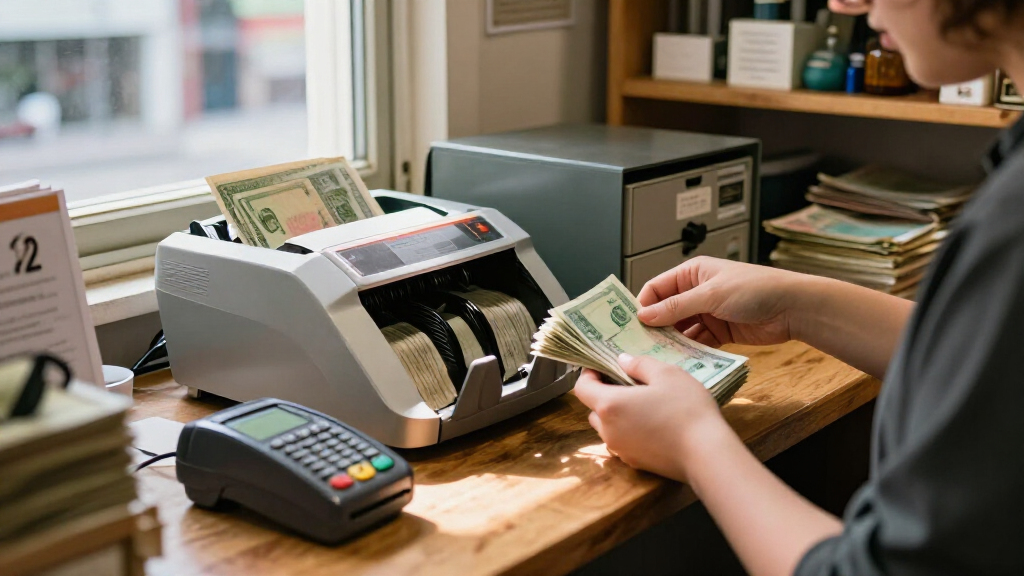

Money counting machines range from simple note counters to value-counting models that identify denominations and flag suspicious bills. My best overall pick is the Kolibri Money Counter Machine with a 4.5-inch TFT display, which pairs mixed-denomination USD counting with detection features. The Aneken N60 stands out for its clear 3.5-inch display, while the Cassida Business Grade is a simpler choice for fast, single-note counting. The main tradeoff is between speed and straightforward operation versus denomination recognition and broader counterfeit checks. Read on for the full comparison and guidance on matching a machine to your cash-handling routine.

Get smart everyday buys delivered free with Prime
- Fast, free delivery on millions of items
- Prime Video, Amazon Music and more included
- Member-only deals all year
Key Takeaways
- Mixed-denomination value counting is a defining difference in this lineup: the money-20&ascsubtag=dc-1167256″ target=”_blank” rel=”nofollow sponsored noopener”>Kolibri 4.5-inch model and Aneken N60 are aimed at users who need a total value, not just a note count.
- Detection features vary widely. Several PONNOR models list multiple checks, while the Cassida emphasizes UV/MG detection; a longer feature list does not replace reviewing the machine’s supported currencies and operating instructions.
- Speed claims are not the whole story. The Cassida and some SVANTTO and Aneken models specify 1,300 notes per minute, but denomination recognition, sorting, and rechecking can shape real workflow more than headline speed.
- Display and output choices affect daily use. The Kolibri 4.5-inch screen, Aneken touch-screen model, and dual- or external-display options from MUNBYN and PONNOR suit different counter layouts and operator needs.
- There is no single feature set across the brands. The lineup includes USD-only mixed-value options, USD/EUR machines, multi-currency models, and basic counting choices, so checking currency support before buying is a key ranking and selection step.
| Kolibri Money Counter Machine with 4.5″ TFT Display, Advanced Counterfeit Detection, and Mixed Denomination Counting (USD) |  | Best Overall for Mixed USD Cash | Display: 4.5-inch TFT | Counting speed: Up to 1,200 notes per minute | Detection methods: IR, UV, MG, MT, DD, HLF | VIEW LATEST PRICE | See Our Full Breakdown |
| Money Counter Machine Pro with Value Count for Dollar and Euro, Accurate 110V |  | Best for USD/EUR Sorted-Bill Counting | Counting speed: Up to 1,350 bills per minute | Supported currencies: USD and EUR | Counterfeit detection: 8-layer UV, MG, IR, MT, DD, DBL, HLF, CHN | VIEW LATEST PRICE | See Our Full Breakdown |
| Aneken N60 Mixed Denomination Money Counter Machine with Counterfeit Detection and 3.5″ TFT Display |  | Best for Multi-Currency Flexibility | Working modes: Mixed denomination, single denomination, count, batch, accumulation | Supported currencies: USD, CAD, MXN, EUR, GBP | Display: 3.5-inch TFT LCD with external display | VIEW LATEST PRICE | See Our Full Breakdown |
| Aneken Mixed Denomination Money Counter with Counterfeit Detection, Touch Screen, and Multi-Detection Technology |  | Best for Touchscreen Cash Management | Currency recognition: 120 currencies | Counting speeds: 800, 1,000, or 1,200 notes per minute | Detection technologies: UV, MG, IR, MT, serial-number detection | VIEW LATEST PRICE | See Our Full Breakdown |
| Cassida Money Bill Counter – Business Grade, 1,300 Notes/Min, UV/MG Counterfeit Detection |  | Best for Straightforward Batch Counting | Counting speed: Up to 1,300 notes per minute | Detection: UV and MG sensors; infrared error prevention | Operating modes: Count, add, batch | VIEW LATEST PRICE | See Our Full Breakdown |
| AROHANI Money Counter Machine with Value Count for USD and EUR, Counterfeit Detection, Auto Modes, LED Display, Gray |  | Best for Quiet Workspaces | Counting speed: 1,300 bills per minute | Hopper capacity: 200 bills | Stacker capacity: 200 bills | VIEW LATEST PRICE | See Our Full Breakdown |
| PONNOR Money Counter Machine with Value Count, UV/MG/IR/MT/DD Counterfeit Bill Detection, Dollar Euro Cash Counter with Count/Add/Batch/Auto Modes, External LCD Display |  | Best for Shared Viewing | Counting speed: 1,200 notes per minute | Detection technologies: UV, MG, IR, MT, DD | Modes: Count, Add, Batch, Auto, Manual | VIEW LATEST PRICE | See Our Full Breakdown |
| PONNOR Money Counter Machine with Value Bill Count, Cash Counter for Dollar and Euro, with UV/MG/IR/DD/DBL/HLF/CHN Counterfeit Detection, Large LCD Display |  | Best for Large, Easy-to-Read Display | Counting speed: 1,300 bills per minute | Hopper capacity: 200 bills | Display: 3.7-inch LCD | VIEW LATEST PRICE | See Our Full Breakdown |
| MUNBYN IMC22 Pro Money Counter Machine with Dual-Display, Blue |  | Best for Mixed-Denomination Counting | Model: IMC22 | Counting speed: 1,200 bills per minute | Currency support: USD, CAD, MXN, COP, and 120+ currencies | VIEW LATEST PRICE | See Our Full Breakdown |
| SVANTTO Money Counter Machine with Value Count, Bill Counter 1300 Notes/Min |  | Best for Fast Sorted-Bill Batching | Counting speed: 1,300 notes per minute | Hopper capacity: 200 bills | Stacker capacity: 200 bills | VIEW LATEST PRICE | See Our Full Breakdown |
| MUNBYN IMC22 Money Counter Machine with Multi-Currency and Counterfeit Detection |  | Best for Multi-Currency Operations | Model: IMC22 | Counting speed: 1,200 bills per minute | Currency support: USD, MXN, EUR, CAD; over 120 currency upgrades | VIEW LATEST PRICE | See Our Full Breakdown |
| Kolibri Money Counter Machine with LCD Display, Multi-Currency, Advanced Detection, Business Grade, 3-Year Warranty |  | Best for Business-Grade Counting Modes | Model: KBR-500 | Counting speed: Up to 1,200 bills per minute | Detection technologies: IR, UV, MG, MT, DD, HLF | VIEW LATEST PRICE | See Our Full Breakdown |
| MUNBYN IMC51 Money Counter Machine, Count Value Bill Counter Cash Counter |  | Best Compact Pick for Sorted Bills | Model: IMC51-GR | Counting speed: 1,100 bills per minute | Detection technology: UV, IR, MG, MT | VIEW LATEST PRICE | See Our Full Breakdown |
| Aneken Money Counter Machine with Value Count, Dollar, Euro, Counterfeit Bill Detectors, Add and Batch Modes, LCD Display |  | Best for Straightforward Dollar-and-Euro Counting | Model: AL-1000 | Counting speed: Up to 1,000 bills per minute | Supported currencies: USD, EUR | VIEW LATEST PRICE | See Our Full Breakdown |
| Aneken Money Counter with Value Count, 1300 Bills/Min for USD & EUR |  | Best for High-Speed Sorted-Cash Runs | Counting speed: Up to 1,300 bills per minute | Bill capacity: 200 bills | Supported currencies: USD, EUR | VIEW LATEST PRICE | See Our Full Breakdown |
| money counting machine | Counting speed | Weight | Dimensions | Display |
|---|---|---|---|---|
| Kolibri Money Counter Machine | Up to 1,200 notes per minute | 16.22 pounds | 14 x 13 x 13 inches | 4.5-inch TFT |
| Money Counter Machine Pro with | Up to 1,350 bills per minute | 12 pounds | 12 x 9.7 x 6.2 inches | — |
| Aneken N60 Mixed Denomination | 1,200 bills per minute | — | — | 3.5-inch TFT LCD with external display |
| Aneken Mixed Denomination Mone | — | 13.66 pounds | 10.43 x 9.57 x 11.14 inches | 4.5-inch touchscreen |
| Cassida Money Bill Counter | Up to 1,300 notes per minute | 11.9 pounds | 10.9 x 9.9 x 6.2 inches | — |
| AROHANI Money Counter Machine | 1,300 bills per minute | 7.54 pounds | — | — |
| PONNOR Money Counter Machine w | 1,200 notes per minute | 8.5 pounds | 13.89 x 11.3 x 7.4 inches | External LCD |
| PONNOR Money Counter Machine w | 1,300 bills per minute | 12.54 pounds | 9.5 x 11.5 x 5.5 inches | 3.7-inch LCD |
| MUNBYN IMC22 Pro Money Counter | 1,200 bills per minute | 13.17 pounds | — | — |
| SVANTTO Money Counter Machine | 1,300 notes per minute | — | — | External LED display |
| MUNBYN IMC22 Money Counter Mac | 1,200 bills per minute | 8.8 pounds | 15.75 x 9.25 x 13.39 inches | Dual 3.5-inch TFT screens |
| Kolibri Money Counter Machine | Up to 1,200 bills per minute | 14.77 pounds | 14.3 x 13 x 9.2 inches | — |
| MUNBYN IMC51 Money Counter Mac | 1,100 bills per minute | 8.8 pounds | 11.1 x 9.41 x 5.71 inches | — |
| Aneken Money Counter Machine w | Up to 1,000 bills per minute | 10.41 pounds | 10.83 x 8.82 x 5.83 inches | LCD |
| Aneken Money Counter with Valu | Up to 1,300 bills per minute | 8.34 pounds | 13.24 x 11.05 x 7.87 inches | — |
More Details on Our Top Picks
Kolibri Money Counter Machine with 4.5″ TFT Display, Advanced Counterfeit Detection, and Mixed Denomination Counting (USD)
The Kolibri KBR-1500 V2 is my strongest pick for businesses that need to count mixed USD bills and calculate their total value without sorting every denomination first. Its 1,200-note-per-minute rate is fast enough for busy retail or event cash handling, while the 4.5-inch display gives operators a more readable interface than the Aneken N60’s 3.5-inch screen. Detection covers IR, UV, magnetic, and additional checks, and the three-year warranty with lifetime tech support adds support for a more involved machine. The tradeoff is its 16.22-pound weight and larger footprint: it is less convenient to move than the lighter Money Counter Machine Pro. Setup and training may also take time, so I would skip it for occasional, straightforward batch counting.
Pros:- Counts mixed USD denominations and calculates total value
- 1,200 notes per minute with multiple counterfeit detection methods
- Large 4.5-inch TFT display
- Three-year warranty and lifetime technical support
Cons:- At 16.22 pounds, it is less portable than the Money Counter Machine Pro
- Larger 14 x 13 x 13-inch body needs dedicated counter space
- Setup and training can be more involved than for basic counters
Best for: Retailers, event operators, and cash offices handling mixed USD bills who want value totals and layered counterfeit checks.
Not ideal for: Small counters or occasional users who need a lightweight machine for basic sorted-bill counts and do not need mixed-denomination value counting.
- Display:4.5-inch TFT
- Counting speed:Up to 1,200 notes per minute
- Detection methods:IR, UV, MG, MT, DD, HLF
- Denominations:Mixed USD
- Warranty:3 years
- Weight:16.22 pounds
- Dimensions:14 x 13 x 13 inches
- Material:ABS
Our verdict“Choose the Kolibri if mixed USD cash valuation and ongoing support matter more than portability or simple setup.”
Money Counter Machine Pro with Value Count for Dollar and Euro, Accurate 110V
For a business that already sorts denominations, this model offers a useful balance of speed, currency flexibility, and a compact 12-pound design. It counts up to 1,350 bills per minute and supports USD and EUR with manual denomination selection, so operators can calculate value without paying the workflow cost of feeding mixed bills for automatic recognition. That distinction separates it from the Kolibri KBR-1500 V2 and Aneken N60, both of which support mixed-denomination counting. Its eight listed detection checks and operation below 50 decibels suit a busy workplace where security and noise matter. The tradeoff is that bills must be sorted and value settings chosen by hand; it is also built for 110V US power, which limits use elsewhere without a voltage converter.
Pros:- Counts up to 1,350 bills per minute
- Supports USD and EUR with manual denomination selection and value calculation
- Eight listed counterfeit detection methods
- Compact 12-pound body and operation under 50 decibels
Cons:- Does not automatically recognize mixed denominations, unlike the Kolibri KBR-1500 V2
- Requires manual denomination setup for value counting
- 110V US power limits use abroad without a voltage converter
Best for: Small businesses and cash offices that count pre-sorted USD or EUR bills and want fast operation in a compact machine.
Not ideal for: Teams that regularly receive mixed-denomination cash and need automatic denomination recognition, or operators outside the US without suitable voltage conversion.
- Counting speed:Up to 1,350 bills per minute
- Supported currencies:USD and EUR
- Counterfeit detection:8-layer UV, MG, IR, MT, DD, DBL, HLF, CHN
- Power requirement:110V US standard
- Noise level:Under 50 decibels
- Weight:12 pounds
- Dimensions:12 x 9.7 x 6.2 inches
Our verdict“Pick this machine for quiet, fast USD/EUR counting when bills are sorted before they reach the counter.”
Aneken N60 Mixed Denomination Money Counter Machine with Counterfeit Detection and 3.5″ TFT Display
The Aneken N60 suits operators who handle cash in several currencies and want mixed-denomination counting across five supported currencies: USD, CAD, MXN, EUR, and GBP. Its modes cover mixed and single denominations, batches, accumulation, and simple counts, giving a small office room to use one machine for different cash routines. Compared with the Kolibri KBR-1500 V2, the N60 supports more listed currencies and includes an external display, but its 3.5-inch main screen is smaller and its listed detection methods are less extensive than the Kolibri’s. A 200-bill capacity and 1,200-bill-per-minute speed support regular workloads. The tradeoff is a learning curve: the supplied guidance matters, as incorrect operation can lead to jams. I would not choose it for teams seeking the simplest setup.
Pros:- Supports mixed-denomination counting in USD, CAD, MXN, EUR, and GBP
- Includes count, batch, accumulation, and single-denomination modes
- Counts up to 1,200 bills per minute with a 200-bill capacity
- External display and lifetime software upgrades are included
Cons:- Smaller 3.5-inch main display than the Kolibri KBR-1500 V2
- Operating guidance may be needed to reduce the risk of jams
- Multiple modes can take time for new operators to learn
Best for: Businesses, exchange desks, and organizations that count mixed cash in several of the listed currencies and need multiple operating modes.
Not ideal for: Occasional users who want a simple, low-training counter or teams that prioritize a larger main display and straightforward operation.
- Working modes:Mixed denomination, single denomination, count, batch, accumulation
- Supported currencies:USD, CAD, MXN, EUR, GBP
- Display:3.5-inch TFT LCD with external display
- Counterfeit detection:Infrared, ultraviolet, magnetic, dimensional
- Bill capacity:200 bills
- Counting speed:1,200 bills per minute
- Included accessories:Power cord, calibration paper, nylon brush, cleaning cloth, fuse, manual, currency straps
- Software support:Lifetime software upgrades
Our verdict“Choose the N60 when multi-currency flexibility matters more than a larger display or the simplest learning curve.”
Aneken Mixed Denomination Money Counter with Counterfeit Detection, Touch Screen, and Multi-Detection Technology
This Aneken is the most interface-focused choice here: its 4.5-inch touchscreen pairs with recognition of 120 currencies, serial-number recording, and selectable speeds of 800, 1,000, or 1,200 notes per minute. That combination makes it better suited than the Cassida to operators who need more than a fast count, especially when cash records or adjustable pace are part of the workflow. The Kolibri KBR-1500 V2 is the more clearly specified option for mixed USD value counting, while this Aneken emphasizes broad currency recognition and screen-driven features. Its UV, MG, IR, MT, and serial-number detection list is extensive, but the many functions may take training to configure. At 13.66 pounds, it is also not a lightweight portable counter.
Pros:- Recognizes 120 currencies
- 4.5-inch touchscreen provides a larger, direct-control interface
- Offers three counting speeds up to 1,200 notes per minute
- Includes serial-number recording and multiple detection technologies
Cons:- At 13.66 pounds, it is less portable than the Cassida counter
- Feature-rich setup may require operator training
- The supplied product details do not specify bill capacity or warranty
Best for: Cash offices and international-facing businesses that want touchscreen controls, broad currency recognition, and serial-number recording.
Not ideal for: Small shops seeking a simple, lightweight counter or buyers who need clearly stated mixed-currency value-counting details before choosing.
- Currency recognition:120 currencies
- Counting speeds:800, 1,000, or 1,200 notes per minute
- Detection technologies:UV, MG, IR, MT, serial-number detection
- Display:4.5-inch touchscreen
- Weight:13.66 pounds
- Dimensions:10.43 x 9.57 x 11.14 inches
- Color:Gray
Our verdict“Choose this Aneken for touchscreen controls and currency breadth when your team can make use of its recording features.”
Cassida Money Bill Counter – Business Grade, 1,300 Notes/Min, UV/MG Counterfeit Detection
The Cassida focuses on the core job: counting, adding, and batching sorted bills at up to 1,300 notes per minute. Its UV and magnetic sensors, plus infrared-assisted error prevention, add basic security checks without the mixed-denomination value workflow found on the Kolibri KBR-1500 V2 or Aneken N60. That makes the Cassida a more direct fit for businesses that prepare bills by denomination and need repeatable batches rather than automatic denomination recognition. Self-diagnostic features and self-lubricating bearings may also help with routine upkeep. Its limits are practical: the hopper and stacker each hold 100 bills, so larger jobs require more frequent reloading than the N60’s listed 200-bill capacity. The back-loader layout and 11.9-pound weight also suit a fixed counter better than frequent transport.
Pros:- Counts up to 1,300 notes per minute
- Count, add, and batch modes support common cash routines
- UV and magnetic sensors with infrared-assisted error prevention
- Self-diagnostic features and self-lubricating bearings support maintenance
Cons:- 100-bill hopper and stacker require more frequent handling than the Aneken N60’s 200-bill capacity
- Does not provide mixed-denomination value counting like the Kolibri KBR-1500 V2
- Back-loader design and 11.9-pound weight are less suited to frequent relocation
Best for: Businesses that count pre-sorted bills and regularly need add or batch functions without mixed-denomination value counting.
Not ideal for: Cash offices that need denomination recognition, larger hopper capacity, or a lightweight machine for frequent relocation.
- Counting speed:Up to 1,300 notes per minute
- Detection:UV and MG sensors; infrared error prevention
- Operating modes:Count, add, batch
- Hopper capacity:100 bills
- Stacker capacity:100 bills
- Loading style:Back loader
- Dimensions:10.9 x 9.9 x 6.2 inches
- Weight:11.9 pounds
Our verdict“Choose the Cassida for fast, repeatable batches of sorted bills, but look elsewhere for mixed-denomination totals or higher capacity.”
AROHANI Money Counter Machine with Value Count for USD and EUR, Counterfeit Detection, Auto Modes, LED Display, Gray
The AROHANI stands out for pairing 1,300-bill-per-minute counting with a quiet operation mode, a useful mix for small offices where the counter runs near customers or staff. Its UV, MG, IR, and DD screening adds several checks, while count, add, batch, auto, and manual modes cover routine till work. Compared with the PONNOR B0DCZ1MQ6F, AROHANI lists a higher counting speed and a lighter weight, but the PONNOR includes an external LCD display for a second viewing position. AROHANI’s key limitation is denomination handling: it does not automatically identify bills, so users need to sort notes or enter the denomination manually to calculate value. Its broad mode selection may also take some practice. I’d choose it for quiet, sorted-bill counting, not mixed-denomination totals.
Pros:- Counts up to 1,300 bills per minute.
- UV, MG, IR, and DD detection technologies provide multiple screening checks.
- Quiet operation mode suits shared workspaces.
- Count, add, batch, auto, and manual modes support different cash routines.
Cons:- Does not automatically recognize bill denominations, so value counting requires manual input.
- Several operating modes may take time for infrequent users to learn.
Best for: Small retail teams and office staff who count sorted USD or EUR bills near customers and value quieter operation.
Not ideal for: Businesses that regularly receive unsorted mixed denominations and need automatic bill recognition or totals without manual denomination entry.
- Counting speed:1,300 bills per minute
- Hopper capacity:200 bills
- Stacker capacity:200 bills
- Detection technologies:UV, MG, IR, DD
- Modes:Count, Add, Batch, Auto, Manual
- Currency support:USD and EUR
- Weight:7.54 pounds
- Color:Gray
Our verdict“Choose the AROHANI for fast, quieter counting of sorted bills, but skip it if you need automatic mixed-denomination value totals.”
PONNOR Money Counter Machine with Value Count, UV/MG/IR/MT/DD Counterfeit Bill Detection, Dollar Euro Cash Counter with Count/Add/Batch/Auto Modes, External LCD Display
The PONNOR’s clearest advantage is its external LCD display, which lets a cashier and customer or a second staff member follow the count without crowding around the machine. It also offers 1,200-note-per-minute counting, silent operation, and UV, MG, IR, MT, and DD detection, making it a flexible sorted-cash counter for a checkout or back office. Compared with the faster AROHANI, it counts at a lower stated rate but adds the separate display; compared with the heavier PONNOR B08Q3H2HQX, it is listed at 8.5 pounds and gives the display a more explicit shared-use role. It is limited to 110V, and its ADD mode does not total mixed denominations. Bills also need correct orientation to avoid errors, so this is not a hands-off solution for rushed cash intake.
Pros:- External LCD makes the running count visible from another position.
- Counts up to 1,200 notes per minute.
- UV, MG, IR, MT, and DD screening technologies are listed.
- Count, add, batch, auto, and manual modes accommodate routine sorted-bill tasks.
Cons:- 110V limitation may require a converter outside compatible regions.
- ADD mode cannot calculate totals across mixed denominations.
- Incorrect bill orientation can lead to errors.
Best for: Retail counters where a cashier and customer or coworker need to see the count on a separate display.
Not ideal for: Businesses outside 110V regions without a suitable converter, or operators who need automatic totals for mixed denominations.
- Counting speed:1,200 notes per minute
- Detection technologies:UV, MG, IR, MT, DD
- Modes:Count, Add, Batch, Auto, Manual
- Display:External LCD
- Voltage:110V
- Dimensions:13.89 x 11.3 x 7.4 inches
- Weight:8.5 pounds
- Color:Black
Our verdict“Pick this PONNOR when a separate customer-facing readout matters more than the highest listed speed or mixed-bill value counting.”
PONNOR Money Counter Machine with Value Bill Count, Cash Counter for Dollar and Euro, with UV/MG/IR/DD/DBL/HLF/CHN Counterfeit Detection, Large LCD Display
For operators who want count information easy to read at the machine, this PONNOR pairs a 3.7-inch LCD with a stated speed of 1,300 bills per minute and a 200-bill hopper. Its listed detection methods include UV, MG, IR, and DD, alongside DBL, HLF, and CHN functions, giving cash handlers a broader set of checks and alerts than the AROHANI’s listed four detection technologies. Unlike the lighter AROHANI, however, this model weighs 12.54 pounds, so moving it between counters is less convenient. It is also specified for 110V and USD/EUR use, which narrows its fit for international operations. The large display and fast throughput make it a stronger match for a fixed cash station than for buyers who prioritize portability or broad currency flexibility.
Pros:- 3.7-inch LCD provides a larger viewing area for count information.
- Listed counting speed is 1,300 bills per minute.
- 200-bill hopper supports substantial counting batches.
- Detection methods include UV, MG, IR, DD, DBL, HLF, and CHN.
Cons:- At 12.54 pounds, it is less convenient to move than the AROHANI.
- 110V specification may call for a converter in other regions.
- Designed primarily for USD and EUR rather than broad multi-currency use.
Best for: Fixed checkout or office stations counting USD and EUR where a large on-machine display and fast processing are priorities.
Not ideal for: Mobile cash teams, buyers needing broad multi-currency support, or users in regions where 110V power is unavailable without conversion.
- Counting speed:1,300 bills per minute
- Hopper capacity:200 bills
- Display:3.7-inch LCD
- Detection methods:UV, MG, IR, DD, DBL, HLF, CHN
- Voltage:110V
- Currency support:USD and EUR
- Dimensions:9.5 x 11.5 x 5.5 inches
- Weight:12.54 pounds
Our verdict“Choose this PONNOR for a stationary USD/EUR counting point where its large LCD and listed speed matter more than portability.”
MUNBYN IMC22 Pro Money Counter Machine with Dual-Display, Blue
The MUNBYN IMC22 Pro is the lineup’s clearest choice for businesses that need more than a pile count: it recognizes mixed denominations, so users can get a value total without sorting every note first. Its dual 3.5-inch TFT displays also make counts visible to both the operator and a customer, while listed support for USD, CAD, MXN, COP, and more than 120 currencies gives it broader reach than the USD/EUR-focused SVANTTO. The tradeoff is a 150-bill recommended load, below the 200-bill hopper figures listed for the AROHANI and PONNOR B08Q3H2HQX, plus a 13.17-pound body and a more involved feature set. Careful bill alignment is needed to limit jams. This is the more capable cash-value tool, but sorted-bill counters may be simpler for occasional use.
Pros:- Recognizes mixed denominations to calculate bill value without pre-sorting.
- Dual operator and customer displays support transparent counting.
- Supports USD, CAD, MXN, COP, and more than 120 currencies.
- 100–240V input supports use across a wider range of power regions.
Cons:- Recommended loading is limited to 150 bills at a time.
- Bill alignment matters to reduce jams.
- Its range of functions may feel complex for occasional operators.
Best for: Retailers, cash offices, and multi-currency businesses that routinely receive mixed bills and need denomination-based value totals.
Not ideal for: Infrequent users who only need to count sorted stacks, or teams seeking the lightest machine and simplest controls.
- Model:IMC22
- Counting speed:1,200 bills per minute
- Currency support:USD, CAD, MXN, COP, and 120+ currencies
- Detection technologies:CIS, UV, IR, MG, MT sensors
- Displays:3.5-inch TFT primary and secondary displays
- Recommended load:150 bills
- Voltage:100–240V
- Weight:13.17 pounds
- Warranty:2 years
Our verdict“Choose the IMC22 Pro when mixed-denomination value counting and multi-currency support outweigh a smaller recommended load and more involved operation.”
SVANTTO Money Counter Machine with Value Count, Bill Counter 1300 Notes/Min
The SVANTTO makes sense for teams that process sorted stacks quickly and need batch counts or single-denomination value counting. It handles up to 1,300 notes per minute, lists a 200-bill hopper and stacker, and adds an external LED display so another person can follow the count. Its UV, MG, MT, IR, and DD screening is also broader on paper than the AROHANI’s listed detection set. The limit is clear: it cannot count mixed denominations, so bills must be sorted manually, and the value mode applies to single denominations. That makes it less capable than the MUNBYN IMC22 Pro for mixed tills, even though the SVANTTO is described as compact and offers the same stated top speed. Its 110V specification and need for correct bill orientation further narrow the fit.
Pros:- Counts up to 1,300 notes per minute.
- 200-bill hopper and stacker support sizeable sorted batches.
- UV, MG, MT, IR, and DD screening methods are listed.
- External LED display shares the count with another viewer.
Cons:- Cannot count mixed denominations; bills must be sorted manually.
- Value counting is for single denominations rather than mixed cash.
- Requires correct bill orientation and uses 110V power.
Best for: Small businesses that routinely sort notes by denomination and want fast batch counts with a separate readout.
Not ideal for: Cash offices handling mixed tills that need automatic denomination recognition, or operators who cannot use 110V power.
- Counting speed:1,300 notes per minute
- Hopper capacity:200 bills
- Stacker capacity:200 bills
- Screening methods:UV, MG, MT, IR, DD
- Modes:Add, Batch, Value counting
- Display:External LED display
- Voltage:110V
- Color:Gray
Our verdict“Pick the SVANTTO for fast batch and single-denomination value counts, but choose the MUNBYN IMC22 Pro for mixed bills.”
MUNBYN IMC22 Money Counter Machine with Multi-Currency and Counterfeit Detection
The MUNBYN IMC22 is the strongest fit here for businesses that regularly handle more than one currency. It supports USD, MXN, EUR, and CAD, with more than 120 currency upgrades available, while its 1,200-bill-per-minute speed helps keep larger counting sessions moving. Multiple counterfeit-detection sensors and dual 3.5-inch displays add security and let a customer or colleague follow the count. Compared with the Kolibri KBR-500, which offers several counting modes and a longer stated warranty, the IMC22 is lighter and puts more emphasis on broad currency support and a second display. Its tradeoffs are practical: bills must be placed correctly to reduce jams, and at 8.8 pounds it is portable but not a pocketable countertop tool. Choose it for currency flexibility, not the most detailed mode list.
Pros:- Supports USD, MXN, EUR, and CAD, with more than 120 currency upgrades available
- Counts up to 1,200 bills per minute
- Multiple sensors provide counterfeit detection
- Dual 3.5-inch displays make counts visible from both sides
Cons:- Incorrect bill placement can cause jams
- The 8.8-pound unit takes up dedicated counter space
- The listed information does not specify its counting modes
Best for: Retailers, exchange desks, and cash rooms handling several supported currencies who want a customer-visible count.
Not ideal for: Businesses counting only sorted bills that want a simpler, less feature-rich machine, or operators who need a broad set of named counting modes.
- Model:IMC22
- Counting speed:1,200 bills per minute
- Currency support:USD, MXN, EUR, CAD; over 120 currency upgrades
- Display:Dual 3.5-inch TFT screens
- Weight:8.8 pounds
- Dimensions:15.75 x 9.25 x 13.39 inches
- Warranty:2 years
Our verdict“Choose the IMC22 if multi-currency support and a customer-facing display matter more than a long list of operating modes.”
Kolibri Money Counter Machine with LCD Display, Multi-Currency, Advanced Detection, Business Grade, 3-Year Warranty
The Kolibri KBR-500 suits cash operations that need more than a running total: its mix, sort, count, add, and batch modes let staff adapt the machine to different routines. It reaches 1,200 bills per minute and lists IR, UV, MG, MT, DD, and HLF detection, pairing speed with a broad set of checks. Its support for USD, CAD, MXN, GBP, and EUR is useful for businesses handling several currencies, though the listed set is narrower than the upgrade range advertised for the MUNBYN IMC22. The KBR-500 also has a three-year warranty and lifetime technical support, but its nearly 15-pound weight makes it less convenient to move between workstations. Its feature set may take staff training; choose it when operating flexibility and support matter more than a lighter footprint.
Pros:- Offers mix, sort, count, add, and batch modes
- Counts up to 1,200 bills per minute
- Lists six counterfeit-detection technologies
- Includes a three-year warranty and lifetime technical support
Cons:- At 14.77 pounds, it is the heaviest option in this five-product group
- The range of modes may require staff training
- Its stated currency list is less expansive than the upgrade support listed for the MUNBYN IMC22
Best for: Businesses with multiple staff or cash-handling routines that need mix, sort, add, and batch functions plus ongoing technical support.
Not ideal for: Small counters or mobile cash teams that need a light machine, or users who prefer a minimal setup with few modes to learn.
- Model:KBR-500
- Counting speed:Up to 1,200 bills per minute
- Detection technologies:IR, UV, MG, MT, DD, HLF
- Supported currencies:USD, CAD, MXN, GBP, EUR
- Modes:Mix, sort, count, add, batch
- Weight:14.77 pounds
- Dimensions:14.3 x 13 x 9.2 inches
- Warranty:3 years, with lifetime technical support
Our verdict“Pick the KBR-500 for a fixed business cash station where varied counting modes and long-term support outweigh portability.”
MUNBYN IMC51 Money Counter Machine, Count Value Bill Counter Cash Counter
The MUNBYN IMC51 is the compact choice for shops that sort bills by denomination before counting. Its 11.1 x 9.41 x 5.71-inch footprint is notably smaller than the MUNBYN IMC22, making it easier to fit on a crowded counter or store away between shifts. It counts up to 1,100 bills per minute and offers UV, IR, MG, and MT detection, with value, add, and batch modes for totaling and preparing bundles. The central compromise is that it cannot count mixed denominations: staff must separate bills and operate manually when changing denominations. That makes it less suitable for fast, unsorted deposits than the KBR-500’s mix mode. Its 8.8-pound weight is manageable, but correct bill orientation still matters to avoid errors.
Pros:- Compact dimensions suit crowded counters and storage shelves
- Counts up to 1,100 bills per minute
- UV, IR, MG, and MT detection is listed
- Value, add, and batch modes support common cash-counting tasks
Cons:- Cannot count mixed-denomination bills
- Bills require manual separation when changing denominations
- Incorrect bill orientation can lead to errors
Best for: Small retailers and offices that count denomination-sorted cash and need a compact machine with batch and add functions.
Not ideal for: Businesses processing unsorted mixed-denomination cash or teams that need the machine to recognize different bill values automatically.
- Model:IMC51-GR
- Counting speed:1,100 bills per minute
- Detection technology:UV, IR, MG, MT
- Modes:Value, add, batch
- Weight:8.8 pounds
- Dimensions:11.1 x 9.41 x 5.71 inches
- Voltage:110V
- Color:Gray
Our verdict“Choose the IMC51 if your bills are already sorted and saving counter space matters more than mixed-denomination counting.”
Aneken Money Counter Machine with Value Count, Dollar, Euro, Counterfeit Bill Detectors, Add and Batch Modes, LCD Display
The Aneken AL-1000 is a practical match for operators who want automatic and manual counting, plus add and batch functions, without needing mixed-denomination recognition. It counts at up to 1,000 bills per minute and supports USD and EUR, so its remit is straightforward compared with the more expansive currency support of the MUNBYN IMC22. Its LCD and multiple detection modes give users a clear count and counterfeit checks, while lifetime technical support may appeal to small businesses without dedicated cash-equipment staff. The key limitation is that it does not automatically recognize denominations; value counting still depends on handling bills by denomination. At 10.41 pounds, it is also heavier than the smaller MUNBYN IMC51. This is a functional, focused pick, not the best fit for frequent currency changes or unsorted stacks.
Pros:- Supports USD and EUR
- Offers add, batch, manual, and automatic modes
- LCD display and multiple detection modes support routine counting and checks
- Lifetime technical support is listed
Cons:- Does not automatically recognize bill denominations
- Limited to a 110V power supply
- At 10.41 pounds, it is heavier than the compact MUNBYN IMC51
Best for: Small businesses counting separated USD or EUR bills that want add, batch, manual, and automatic operation.
Not ideal for: Cash rooms handling mixed denominations or international currencies beyond USD and EUR, and buyers who need a light unit to move often.
- Model:AL-1000
- Counting speed:Up to 1,000 bills per minute
- Supported currencies:USD, EUR
- Modes:Add, batch, manual, automatic
- Display:LCD
- Weight:10.41 pounds
- Dimensions:10.83 x 8.82 x 5.83 inches
- Operating voltage:110V
Our verdict“Select the AL-1000 for routine, denomination-sorted USD or EUR counting when its basic modes meet your workflow.”
Aneken Money Counter with Value Count, 1300 Bills/Min for USD & EUR
The Aneken DC002 posts the fastest stated rate in this group at 1,300 bills per minute, making it appealing when a small business needs to process denomination-sorted stacks quickly. Its 200-bill capacity reduces how often an operator has to reload, and add and batch functions help with totals and prepared bundles. The listed UV, MG, IR, THK, DIM, CCH, FL, and SL detection modes provide a broad set of checks. As with the Aneken AL-1000, though, this model does not automatically recognize denominations, so value counting requires manual input and sorted bills. That narrows the time-saving advantage when cash arrives mixed. Sensitivity setup may also take care, while the MUNBYN IMC51 is smaller and easier to place but counts more slowly.
Pros:- Highest stated speed in this group at 1,300 bills per minute
- 200-bill capacity limits reload interruptions
- Lists eight counterfeit-detection modes
- Add and batch functions support totals and cash bundling
Cons:- Does not automatically recognize denominations; value counting requires manual input
- Sensitivity-mode setup may be complex for new operators
- Supports only USD and EUR
Best for: Retailers and small businesses counting large batches of pre-sorted USD or EUR bills where speed and hopper capacity matter.
Not ideal for: Businesses receiving mixed denominations or operators who want automatic value recognition and minimal sensitivity setup.
- Counting speed:Up to 1,300 bills per minute
- Bill capacity:200 bills
- Supported currencies:USD, EUR
- Detection modes:UV, MG, IR, THK, DIM, CCH, FL, SL
- Weight:8.34 pounds
- Dimensions:13.24 x 11.05 x 7.87 inches
Our verdict“Choose the DC002 for fast runs of sorted USD or EUR bills, but skip it if automatic mixed-value counting is a requirement.”

How We Picked
I compared these money counting machines by the work they are designed to do: simple note counting, denomination-based value totals, or mixed-currency cash handling. I gave more weight to clearly specified value-counting capability, usable displays, practical modes such as add and batch, and stated counterfeit-detection methods. Speed mattered, but I treated it as one part of the workflow rather than a guarantee of faster end-to-end cash reconciliation.
The ranking favors models whose listed features offer the strongest balance for routine cash handling, then separates machines with narrower roles, such as single-note speed, multi-currency support, or external displays. Where the product names do not specify details such as exact currency coverage or detection performance, I avoid assuming them. Buyers should verify those points with the current listing and manufacturer before relying on a machine for a particular currency or cash-control process.
Factors to Consider When Choosing Money Counting Machines
Before choosing a machine, decide what job it must perform at your counter. The most useful comparison is not simply the number of features, but whether the machine’s counting method, currency support, and detection options fit the way your cash arrives and gets reconciled.
Choose between note counting and value counting
A basic counter reports how many notes passed through it, which can be enough when every bundle contains one denomination. A value counter identifies denominations and calculates a total, helping when a till contains mixed bills. Do not assume that a machine described as a money counter automatically provides mixed-denomination value totals; look for that capability explicitly. If staff separate cash by denomination before counting, a simpler model may be easier to operate and maintain. If mixed cash is common, value counting can reduce manual addition, though the operator still needs a process for handling flagged or unrecognized notes. Match the machine to your cash routine rather than paying for a counting mode you will not use.
Match currency support to the cash you handle
USD and EUR support appears on several models in this roundup, while other descriptions refer more broadly to multi-currency use. That wording can hide important limits: supported currencies may differ by mode, and mixed-currency counting may not mean the machine can total different currencies together. Check the exact currencies, bill series, and software or mode requirements before purchasing. Businesses near borders or handling foreign cash should confirm that each currency can be recognized reliably as a separate total. A machine built around one primary currency may offer a simpler workflow for a single-currency business. Avoid choosing on a broad multi-currency label alone.
Treat counterfeit detection as a screening aid
UV, magnetic, infrared, and other listed detection methods describe screening features, not a guarantee that every counterfeit will be detected. More named checks can be useful when staff handle varied notes, but detection still depends on supported currencies, bill condition, setup, and proper note feeding. Consider which currencies and note types your business actually receives, then check that the machine’s detection modes apply to them. Plan a manual procedure for bills the machine flags rather than treating an alert as a final judgment. A shorter feature list may suit a low-volume operation if it fits the notes handled and staff know when to inspect a bill. For higher-risk cash work, pair the machine with staff training and established cash-control steps.
Evaluate speed against the full counting workflow
A stated rate such as 1,300 notes per minute describes a machine’s advertised counting speed, not necessarily how quickly a person can close a register. Sorting mixed denominations, entering batches, reviewing errors, and recounting suspect notes all add time. For busy operations, prioritize a reliable feed, useful error alerts, and modes that suit deposit preparation alongside headline speed. For occasional use, a slower or simpler machine may be less complicated to set up and operate. Think about peak cash volume and how many times cash is counted each day. A small improvement in handling and reconciliation may matter more than the fastest published rate.
Pick a display and controls that fit the counter
Display size and placement matter when the operator needs to read totals while feeding notes or when a customer or supervisor needs to see the result. Larger TFT screens and touch controls can make menus and totals easier to follow, while an external or dual display can improve visibility from another position. Those additions also create more controls or components to place on a crowded counter. Before buying, picture where the machine, cash trays, and operator will sit, and check whether an external screen is included or optional. If several staff members will share the machine, straightforward modes and legible feedback can reduce training friction. Choose for the real viewing angle and counter layout, not screen size alone.
Check maintenance, support, and daily fit
Cash dust and worn or folded notes can affect feeding and produce interruptions, so routine cleaning and accessible instructions matter in regular use. Review the maker’s guidance for cleaning, troubleshooting, and service, along with the stated warranty terms. A longer warranty, such as the one specified for a Kolibri model in this lineup, may be attractive, but it does not replace checking what the coverage includes. Consider the machine’s footprint, power requirements, and whether the hopper and output capacity suit your usual batches. For an occasional-use office, setup simplicity may matter more than a broad feature set. For a high-volume cash desk, support access and a clear maintenance routine deserve more weight.
Frequently Asked Questions
Do I need a value-counting machine if I already sort bills by denomination?
Not always. If staff reliably separate each denomination and only need a note count, a basic counter can fit the job without extra value-counting modes. A value counter becomes more useful when cash arrives mixed, when totals must be prepared quickly, or when manual addition is a frequent source of errors. It can also help when several people share closing duties and need a consistent total. Compare the time spent sorting and adding by hand with the added setup and operating steps of value counting. The right choice depends on your workflow, not on whether one feature set sounds more advanced.
Can one machine count USD and EUR together in a single total?
A product listing that names both USD and EUR does not necessarily mean it combines them into one total. Many machines count each currency using a selected mode, and totals across currencies may need to remain separate because their values differ. Check whether the specific model supports switching currencies, mixed-currency recognition, or separate currency totals. Also confirm which bill series and denominations are covered. If your business accepts multiple currencies, plan how staff will label and reconcile each total. Ask the manufacturer or seller for clarification when the product description does not spell out the behavior.
Are machines with more counterfeit-detection modes always safer?
A longer list of detection methods can offer more screening options, but it does not guarantee better results for every currency or note condition. The useful question is whether the machine’s checks support the bills your business handles and how it signals a suspected note. Detection should be one part of cash handling, alongside staff training and a manual review procedure. Read the operating guidance so staff know what to do when a bill is rejected or flagged. Compare the stated methods and currency coverage, not just the number of abbreviations in a listing. For critical cash operations, ask the manufacturer about supported note types and limitations.
Is a 1,300-notes-per-minute rating useful for a small business?
It can help when the business regularly counts large stacks, but the advertised feed rate is only one stage of the task. A small shop may spend more time sorting denominations, reviewing totals, and dealing with rejected notes than feeding bills through the machine. For low-volume use, simple controls and dependable batch counting may offer more day-to-day value than maximum speed. For busy cash desks, speed matters more when the machine also supports the counting modes and detection process the business needs. Estimate your busiest counting session, not just an average day. That gives a better basis for deciding whether a high-speed model earns its place.
What should I verify before relying on a machine for daily cash reconciliation?
Confirm that its currency and denomination support match the cash you receive, then check how it reports value totals, batch counts, and suspected errors. Read the instructions for note orientation, rejected bills, and cleaning, since operator habits affect consistent feeding. Verify the warranty and service route, especially if the machine will be central to end-of-day operations. Run a trial with representative notes and compare the output with a manual count before adopting it as the sole reconciliation step. Keep a documented process for recounts and discrepancies. This reduces the chance that speed or automation will hide a handling error.
Conclusion
For most businesses that need mixed-denomination USD totals and a readable screen, my best overall choice is the Kolibri model with the 4.5-inch TFT display. The Aneken N60 is a strong alternative for buyers who prefer its 3.5-inch display and mixed-value focus, while the Cassida Business Grade makes more sense for straightforward, high-speed note counting than mixed-cash totals. For best value, compare the simpler value-counting models against the features your workflow actually needs rather than paying for unused detection modes. For a premium-feature priority, look at the touch-screen Aneken or the PONNOR models with multiple listed detection methods, after confirming currency coverage. For beginners, choose a model with clear controls and only the counting modes your staff will use; for multi-currency needs, verify supported currencies and how totals are separated before selecting a MUNBYN, Kolibri, or USD/EUR option. The best machine is the one that fits your cash mix and reconciliation process without adding steps your team does not need.
Halloween Picks

HOPOCO Halloween Pumpkin Fog Machine with 12 LED Colors and 4 Light Modes

Max Fun 10-Foot Halloween Dragon and Pumpkin Inflatable Archway with LED Lights

Thuodo 8 FT Tall Halloween Inflatable Three-Headed Dragon with LEDs
As an affiliate, we earn on qualifying purchases.