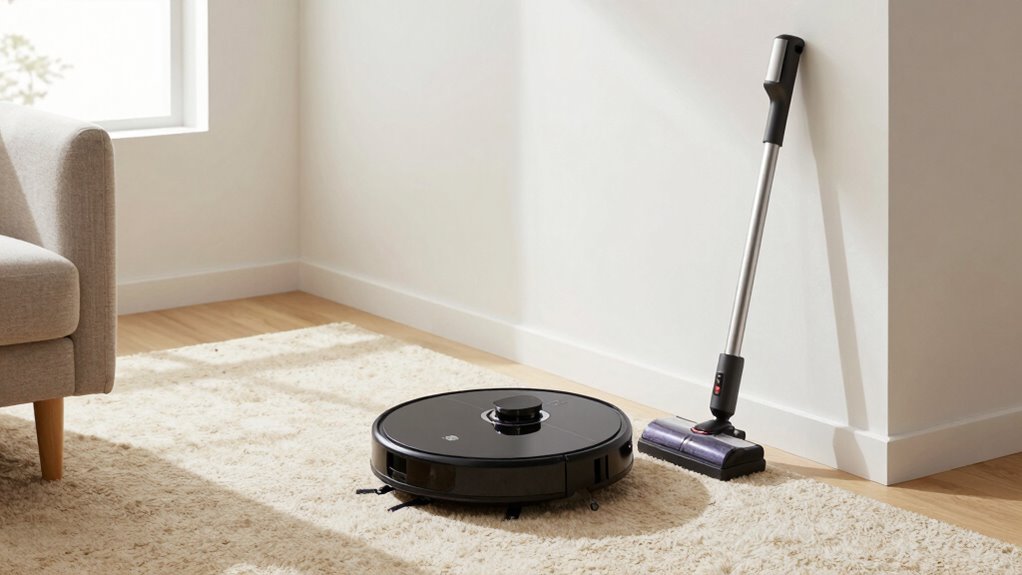

If you want a low-maintenance, space-saving option, a robot vacuum is ideal for small apartments. It’s quiet, autonomous, and can clean those tight spots easily, giving you more time to relax. However, if you prefer more power and longer battery life for quick, thorough cleanings, a stick vacuum might suit you better. Both have their pros, and exploring further will help you pick the best fit for your needs.

Get smart everyday buys delivered free with Prime
- Fast, free delivery on millions of items
- Prime Video, Amazon Music and more included
- Member-only deals all year
Key Takeaways
- Robot vacuums are ideal for small apartments due to their compact size and ability to operate quietly with minimal user effort.
- Stick vacuums offer longer battery life and more powerful cleaning, suitable for quick, intensive cleanings.
- Robot vacuums require less maintenance and can navigate around furniture automatically, saving time and effort.
- Stick vacuums are noisier and less convenient, but provide deeper cleaning when manual control is acceptable.
- For convenience and low disturbance, robot vacuums generally fit small apartment lifestyles better.

When choosing between a robot vacuum and a stick vacuum, understanding their differences can help you find the best fit for your cleaning needs. If you live in a small apartment, space efficiency, ease of use, and maintenance are crucial factors to consider. One of the first things you should evaluate is battery life. Robot vacuums typically have shorter battery spans—around 60 to 120 minutes—meaning they might need more frequent charges if your apartment is larger or has multiple rooms. However, for small spaces, this usually isn’t a problem, as they can complete cleaning cycles quickly and automatically return to their docking stations to recharge. Stick vacuums, on the other hand, are corded or come with rechargeable batteries that often last longer per charge, especially if you opt for higher-capacity models. This extended battery life allows you to clean larger areas without interruption, which can be a big advantage if you prefer quick, thorough cleanings without multiple recharges. Additionally, battery life plays a significant role in determining the convenience and efficiency of your cleaning routine. Noise levels are another important consideration, especially in small apartments where sound can easily travel and disturb neighbors or other household members. Robot vacuums are generally quieter than stick vacuums because they operate at lower decibel levels—commonly around 55 to 65 dB—allowing you to run them while working, watching TV, or even sleeping. Their soft, automated operation makes them less intrusive. Conversely, stick vacuums tend to be louder, often exceeding 70 dB, especially powerful models designed for deep cleaning. If noise is a concern, a robot vacuum might be your better choice, since it can clean without disturbing your routine or neighbors. Ease of use is another factor that leans in favor of robot vacuums for small apartments. Once set up, they require minimal effort—just press a button or schedule cleaning times via an app. They navigate around furniture, avoid obstacles, and even return to their charging stations without your supervision. Moreover, many robot vacuums now include smart navigation features that enhance their cleaning efficiency and adaptability to different floor plans. In addition, maintenance requirements for robot vacuums are generally lower, as they are designed to operate autonomously with minimal intervention. Their compact size also makes them ideal for small spaces, allowing them to reach under furniture and into tight corners more easily. Stick vacuums, while still easy to operate, require you to carry, maneuver, and plug/unplug them each time you clean, which might be less convenient if you’re short on storage space or prefer quick, on-the-go cleaning. Ultimately, if you want a low-maintenance, quiet, and space-efficient cleaning solution, a robot vacuum makes a lot of sense for a small apartment. But if you prefer more power, longer battery life, and don’t mind the extra effort, a stick vacuum could better suit your needs. Consider how much space you have, your noise tolerance, and how often you want to clean to make the best choice.
Products Worth Considering

Dell UltraSharp U3225QE 31.5-Inch 4K UHD 120Hz IPS Black Thunderbolt Hub Monitor

Samsung 32 Odyssey G5 (G51F) QHD 180Hz Gaming Monitor

LG UltraGear 27-inch QHD OLED Gaming Monitor, 240Hz, 0.03ms, G-SYNC Compatible, FreeSync Premium Pro, HDMI 2.1, DisplayPort 1.4, Black
As an affiliate, we earn on qualifying purchases.
Frequently Asked Questions
Which Vacuum Type Is Better for Allergy Sufferers?
You should choose a robot vacuum if allergy relief is your priority. They improve air quality by consistently cleaning floors and contain allergens effectively with HEPA filters, reducing dust and pet dander in your small apartment. Robot vacuums reach tight spaces and operate regularly, maintaining allergen containment. Stick vacuums can also help, but their manual effort means you might not clean as often, making robot vacuums the better option for allergy sufferers.
How Noisy Are Robot Vacuums Compared to Stick Vacuums?
Robot vacuums are generally quieter than stick vacuums, making them ideal for small apartments where noise can be disruptive. Their sound comparison shows lower noise levels, often around 55-65 decibels, similar to a conversation. In contrast, stick vacuums can reach 70-80 decibels, which is louder and might disturb your household. So, if noise levels are a concern, a robot vacuum is the better choice for a quieter cleaning experience.
Can Robot Vacuums Handle Pet Hair Effectively?
Yes, robot vacuums can handle pet hair effectively, especially if you choose models with strong suction and specialized brushes. Imagine them as tiny hair collectors darting around your space. Regular robot vacuum maintenance guarantees peak performance, and their lightweight design makes them easy to maneuver. While stick vacuums are heavier, they often pick up more stubborn pet hair. Both options work well, but robot vacuums keep your space cleaner with less effort.
What Is the Typical Battery Life of Robot Vacuums?
Robot vacuums typically offer a battery longevity of about 90 to 120 minutes per charge, depending on the model and usage. You’ll appreciate the charging convenience since they automatically return to their dock when low on power, ensuring they’re ready for the next clean. Keep in mind, frequent cleaning sessions may require you to recharge more often, but overall, their battery life is designed for small apartment needs.
Are Stick Vacuums Easier to Store in Small Apartments?
They say, “A place for everything, and everything in its place,” and stick vacuums embody that wisdom perfectly. With their slim, compact design, they’re easier to store in small apartments, offering excellent storage convenience. Their space efficiency allows you to tuck them away in closets or small corners, freeing up valuable space. If you value simplicity and easy storage, a stick vacuum is a practical choice for your cozy living environment.
Conclusion
When choosing between a robot vacuum and a stick vacuum for your small apartment, consider your cleaning habits and space. Robot vacuums are perfect for daily maintenance, saving you time, while stick vacuums offer powerful cleaning for tougher spots. Remarkably, 65% of small apartment dwellers prefer robot vacuums for convenience. Ultimately, matching your lifestyle with the right device ensures your space stays tidy effortlessly, making cleaning less of a chore and more of a breeze.