
📊 Full opportunity report: Building An ADU: Backyard Home Ideas And Updates on IdeaNavigator AI — validation score, market gap, and execution plan.

Get smart everyday buys delivered free with Prime
- Fast, free delivery on millions of items
- Prime Video, Amazon Music and more included
- Member-only deals all year
TL;DR
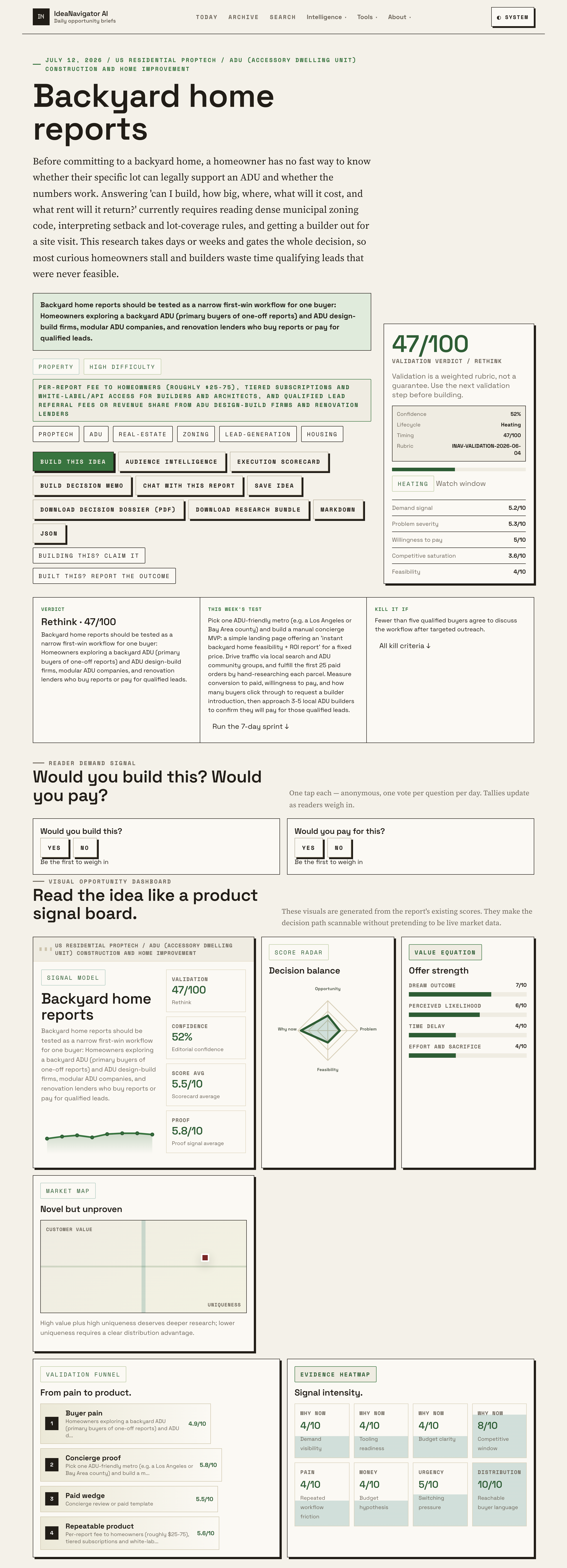
A new analysis from IdeaNavigator AI proposes paid, per-address feasibility reports that tell homeowners whether their lot can legally support a backyard ADU and what the economics look like. The plan responds to surging ADU permitting in California, where ADUs now account for roughly one in five new housing units.
A new report from IdeaNavigator AI lays out a business case for instant backyard home feasibility reports — paid, per-address analyses that tell homeowners whether their lot can legally support an accessory dwelling unit (ADU) and whether the project’s numbers work. The analysis identifies homeowners exploring a backyard ADU as the primary buyers of one-off reports, with ADU design-build firms, modular ADU companies, and renovation lenders as secondary revenue sources through subscriptions and qualified lead referrals.
According to the analysis, the core problem is that homeowners have no fast way to determine whether their specific lot can legally support an ADU. Answering basic questions — can I build, how big, where on the lot, what will it cost, and what rent will it return — currently requires reading dense municipal zoning code, interpreting setback and lot-coverage rules, and scheduling a builder site visit. The research process takes days or weeks, and the report argues this delay gates the entire decision, leaving most curious homeowners stalled while builders waste time qualifying leads that were never feasible.
The proposed minimum viable product is a web app where a homeowner enters a property address and pays for a homeowner-ready PDF report. The system would ingest county parcel data — lot boundaries, lot size, existing footprint — and evaluate the lot against state ADU law plus a manually curated rule set for one launch market, such as a few California counties. Each report would cover allowed ADU types, maximum size, setback and lot-coverage constraints, a buildable-area estimate, a realistic build-cost band, and projected rental income drawn from local rent comparables.
The revenue model has three tiers: a per-report fee of roughly $25 to $75 for homeowners; tiered subscriptions and white-label or API access for builders and architects; and qualified lead referral fees or revenue share from ADU design-build firms and renovation lenders. A “connect me with a vetted ADU builder” button would capture the lead-generation revenue.
Why ADU Feasibility Reports Draw Interest Now
The analysis arrives amid a sustained expansion of ADU construction. California legalized ADUs statewide starting in 2016 and has loosened rules nearly every year since, with other states and cities following. Los Angeles County alone permitted over 45,000 ADUs in 2023, and ADUs now represent roughly one in five new housing units produced in California, according to figures cited in the report.
The report argues that three conditions have converged to make instant feasibility reports newly practical: a persistent US housing shortage estimated in the millions of units, mature parcel and zoning data, and LLM-based code parsing that can process zoning text at scale. If accurate, the combination could compress a multi-week research process into a same-day purchase — a shift that would matter both to individual homeowners weighing six-figure construction decisions and to builders seeking better-qualified pipelines.
Products Worth Considering

Apple iPad Air (2025) 13‑inch Wi‑Fi 256 GB – Space Gray (M3 chip)

LG 34GX90SA-W 34-inch Ultragear WQHD OLED Curved Gaming Monitor

FLEXISPOT 42-Inch Electric Height-Adjustable Desk Converter with Keyboard Tray
As an affiliate, we earn on qualifying purchases.
The Validation Plan Behind the Idea
The report recommends a deliberately narrow launch path rather than building a full automated platform immediately. The proposed validation approach is to pick one ADU-friendly metro — an Los Angeles or Bay Area county is suggested — and build a manual concierge MVP: a simple landing page offering an “instant backyard home feasibility + ROI report” at a fixed price, with traffic driven through local search and ADU community groups.
The first 25 paid orders would be fulfilled by hand, with each parcel researched manually. The metrics to watch, according to the analysis, are conversion to paid, willingness to pay, and how many buyers click through to request a builder introduction. Only after those signals are measured would the founder approach three to five local ADU builders to confirm they will pay for qualified leads.
Unproven Assumptions in the Report
The analysis is a business proposal, not a validated business. No version of the product has been built or tested, according to the report itself, which frames its own validation plan as a prerequisite step. Whether homeowners will actually pay $25 to $75 for a feasibility report — rather than relying on free municipal resources or free builder consultations — is untested.
Several key claims also depend on external factors the report does not fully verify. The figure of 45,000 ADUs permitted in Los Angeles County in 2023 and the estimate that ADUs account for one in five new California housing units are cited without underlying sources. The accuracy of LLM-based zoning-code parsing across jurisdictions is asserted but not demonstrated, and the report does not address how the product would handle conflicting interpretations between state law and local ordinances, or liability for incorrect feasibility conclusions. Whether ADU builders will pay for leads, and at what rate, remains an open question the validation plan is designed to answer.
Testing the Feasibility-Report Market
Under the report’s recommended sequence, the immediate next step for anyone pursuing the idea is launching the concierge MVP in a single California county and fulfilling the first 25 reports manually. Conversion rate, willingness to pay, and builder-introduction click-through would then determine whether automation investment is justified.
Separately, the broader market backdrop will shape the opportunity: continued loosening of ADU rules in California and other states, the trajectory of construction costs and rents, and whether competitors — existing proptech tools, counties offering free pre-approval services, or builder-sponsored feasibility checks — move into the same space. The report does not name competitors, so the competitive landscape remains unmapped.
Source: IdeaNavigator AI
Key Questions
What is a backyard ADU feasibility report?
It is a per-address analysis that tells a homeowner whether their lot can legally support an accessory dwelling unit, how large it can be, where it can sit, what it will likely cost, and what rent it might return. The IdeaNavigator AI proposal would deliver it as a homeowner-ready PDF.
How much would a report cost?
The proposed pricing is roughly $25 to $75 per report for homeowners, with additional revenue from builder subscriptions, white-label API access, and qualified lead referral fees, according to the analysis.
Why is the ADU market growing?
California legalized ADUs statewide in 2016 and has loosened rules nearly every year since, while other states and cities follow suit. The report cites Los Angeles County permitting over 45,000 ADUs in 2023 and ADUs representing roughly one in five new housing units in California.
Has this product been built or tested?
No. The report is a business idea and validation plan. It recommends launching a manual concierge version in one metro, fulfilling the first 25 paid orders by hand, and measuring conversion and builder-lead demand before investing in automation.
What data would the reports use?
County parcel data such as lot boundaries, lot size, and existing footprint, evaluated against state ADU law and a hand-curated set of local zoning rules covering allowed ADU types, size limits, setbacks, and lot-coverage constraints, plus local rent comparables for income projections.
Source: IdeaNavigator AI