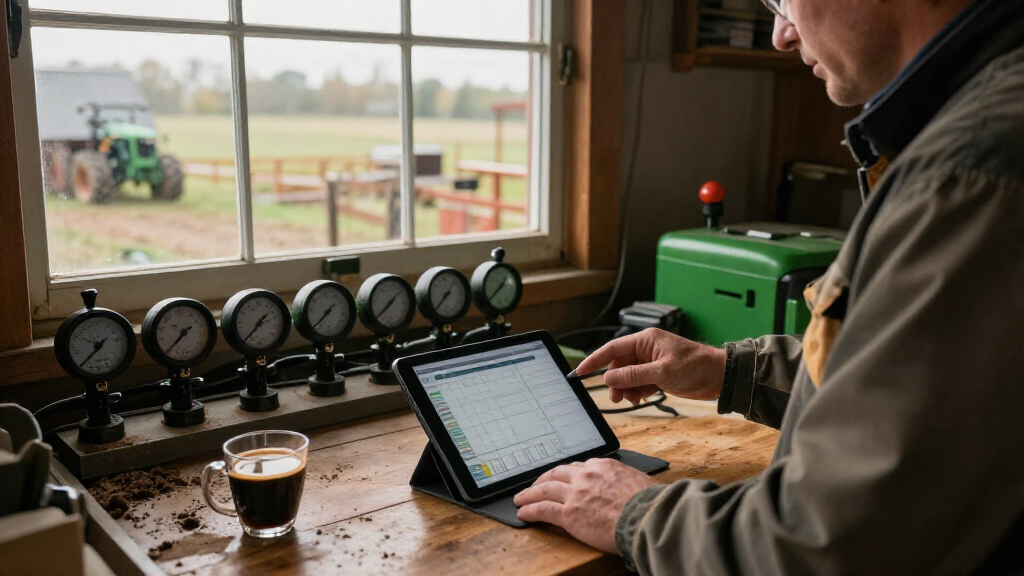
🔍 Read the full analysis: AI At Work: Lessons From An Agricultural Past on ThorstenMeyerAI.com

Get smart everyday buys delivered free with Prime
- Fast, free delivery on millions of items
- Prime Video, Amazon Music and more included
- Member-only deals all year
TL;DR
Thorsten Meyer’s November 3 essay uses agriculture’s long decline as a share of employment to examine how technology can change work. Historical data show that farming’s transformation unfolded over generations, while the article’s suggestion that AI could automate most work is a forecast, not an established outcome.
Thorsten Meyer published an essay on November 3 arguing that agriculture’s centuries-long shift away from human labor offers a useful historical comparison for debates about AI and jobs. The piece draws on employment and production figures to show that farming’s share of work fell as tools, fertilizers and improved crops raised output; its projection that automation could eventually affect as much as 90% of a sector is Meyer’s thesis, not a confirmed forecast.
Meyer’s central historical measure is the changing share of workers employed in agriculture. Estimates published by the U.S. Census Bureau put the agricultural share of the American labor force at 73.7% in 1800, or about three in four workers. The figures before 1840 are estimates, not census counts, and the underlying labor force included enslaved people. The essay notes that the number of U.S. farm workers continued to rise until about 1910, reaching an estimated 11.8 million, even as agriculture’s share of employment was declining.
The account describes change arriving through several technologies rather than a single breakthrough. It cites John Deere’s 1837 steel plough, which handled sticky Midwestern soil more effectively than earlier designs, and the later spread of mechanical equipment. It also points to fertilizer made possible by ammonia synthesis: Fritz Haber filed a patent in 1908, and the first ammonia factory opened in 1913, according to the supplied source material.
Improved crops added to those gains. In the mid-1960s, short-straw wheat varieties associated with plant breeder Norman Borlaug were introduced in India and Pakistan. Indian official figures cited by Meyer show wheat production rising from 12.3 million tonnes in 1964–65 to 26.4 million tonnes in 1971–72, then reaching 117.5 million tonnes in the 2024–25 third advance estimate. Those figures describe harvests across different periods; they do not, by themselves, isolate the contribution of any one technology.
Agriculture’s Long Employment Shift
The historical comparison matters because it separates a decline in a job’s share of the workforce from an immediate disappearance of the work itself. Meyer’s U.S. figures show farm employment continuing to grow in absolute numbers until around 1910, even while other kinds of work expanded and agriculture’s relative share fell. That distinction is relevant to AI debates: changes in productivity, employment totals and workers’ share of all jobs are different measures.
The scale of agriculture’s past change is substantial, but the process took generations and was uneven. Meyer cites an International Labour Organization estimate that 928 million people worked in agriculture worldwide in 2025, about one in four workers. The national differences are large: the essay gives agriculture’s share as about 43% in India, 1.5% in the United States and 1% in Germany. The figures underline that a sector’s transformation in one country does not mean the same transition has occurred everywhere.
Meyer also challenges the claim that fewer farmers necessarily mean less food. His article reports that global cereal production grew 4.2-fold from 1961 while the world population grew 2.7-fold, and that U.S. farm output in 2023 was nearly three times its 1948 level with only a small rise in total inputs. These comparisons support the point that output can rise while labor requirements change. They do not establish that every worker displaced by new technology finds comparable work, or that AI will follow agriculture’s path.
Products Worth Considering

Samsung 27-Inch Odyssey OLED G5 QHD Gaming Monitor

Samsung 27-inch Odyssey G5 QHD Gaming Monitor (G51F)

Dell SE2426HG 24-Inch FHD 240Hz Gaming Monitor
As an affiliate, we earn on qualifying purchases.
How Farm Work Changed
Meyer frames the essay as episode two of “Work After Work,” a series about how the economy is built. Episode one divided work into three broad sectors: the field, the factory and the office. This installment focuses on agriculture because it offers a long historical record of technology changing how many workers are needed to produce food.
The article uses estimates and reconstructions from different countries, whose dates and definitions are not identical. It cites economic historians’ estimates that agriculture or the broader primary sector accounted for about 85% of workers in Japan in 1872, and official figures showing 83.5% in China’s primary sector in 1952. India’s 1951 census counted cultivators and agricultural laborers as 69.7% of workers. Meyer cautions that historical totals, particularly early U.S. figures, have limitations; the U.S. estimate includes enslaved workers, while Germany’s 1882 occupational census may have undercounted women working on family farms.
The essay’s account of rising agricultural productivity links machinery with chemistry and crop science. Steel ploughs addressed soil conditions, ammonia fertilizer supplied usable nitrogen, and shorter wheat varieties could carry more grain without falling over when paired with fertilizer and irrigation. The argument is about a cumulative sequence, not a claim that one invention alone caused the decline in farm employment.
“The share fell long before the headcount.”
— Thorsten Meyer, in the essay
Limits of the AI Comparison
The historical figures document changes in agriculture; they do not establish how quickly AI will alter employment in other sectors. Meyer’s estimate that automation could affect a sector of up to 90% within a decade or a few decades is presented as his own thesis. The article excerpt does not specify which jobs or industries that percentage covers, how it is calculated, or what evidence would confirm it.
It also remains unclear how workers affected by AI adoption would move into other roles, how quickly employers would adopt the technology, and whether productivity gains would be shared broadly. Agriculture’s history spans different countries, technologies and time periods, so it is a comparison rather than proof that AI will produce the same pattern. The source material does not provide independent analysis of the AI forecast.
The Series Turns to Factories
Meyer says the next episode will examine mechanical reapers, threshers and tractors, continuing the account of agricultural technology. The supplied article does not give a publication date for that installment. For the broader AI question, the next useful evidence would be measured changes in adoption, output, job numbers and workers’ movement between occupations—not a forecast alone.
Readers should also distinguish new tools’ capacity to perform tasks from evidence that employers have deployed them at scale or eliminated particular jobs. The essay offers a historical lens; it does not report a new AI employment study or announce a specific change in workplace policy.
Key Questions
What is the news in this article?
Thorsten Meyer published the second episode of his “Work After Work” series on November 3, 2026. It uses agriculture’s historical shift in employment to discuss how technology may affect work in the age of AI.
How many Americans worked in agriculture around 1800?
The U.S. Census Bureau-published historical series cited by Meyer estimates that 73.7% of the U.S. labor force worked in agriculture in 1800. The figure is an estimate, not a census count, and includes enslaved people.
How many people work in agriculture worldwide?
The article cites an International Labour Organization estimate of 928 million agricultural workers in 2025, about one in four workers worldwide. The source material does not provide further detail on the estimate’s methodology.
Does the essay establish that AI will automate 90% of work?
No. Meyer labels the possibility of automation affecting a sector of up to 90% as his thesis, not a fact. The supplied material does not define the sector or provide evidence that confirms the projection.
Source: ThorstenMeyerAI.com