
TL;DR

Get smart everyday buys delivered free — and shop member deals
- Fast, free delivery on millions of items
- Access to Prime Big Deal Days deals on October 6–7
- Prime Video, Amazon Music and more included
IdeaClyst acts as a digital war room, centralizing idea validation and development. It combines AI council debates, real-time research, and a private workspace, helping founders avoid costly mistakes and accelerate their innovation process.
Imagine having a dedicated space where your ideas are scrutinized from every angle—where disagreements spark new insights, and every piece of research is at your fingertips. That’s what IdeaClyst aims to do, but on your own machine, without the cloud clutter or data risks.
Founders face the challenge of choosing ideas that truly deserve their time and resources. Startup resources. With traditional methods, it’s a gamble—gut feeling, guesswork, and hope. Now, with AI-powered tools like IdeaClyst, you get a focused war room for your ideas, designed to cut through the noise and surface what’s worth pursuing.
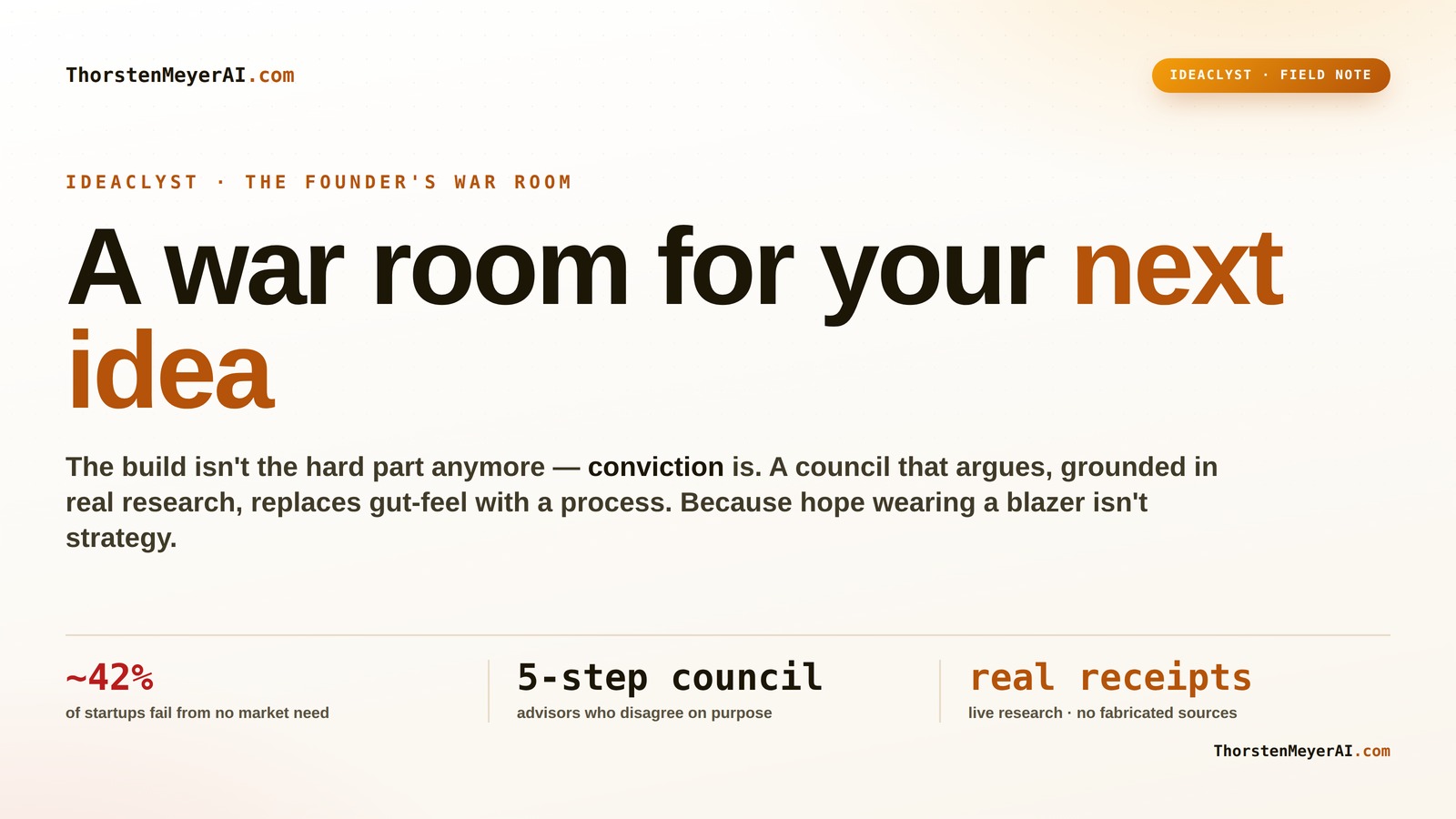
A war room for your next idea
The build isn’t the hard part anymore — conviction is. Knowing which idea deserves the next six months, and being able to defend it. Most founders answer with gut feel and optimistic math. That’s hope wearing a blazer. IdeaClyst replaces it with a process.
The most expensive decision is what to build
The single most valuable thing a tool can do is talk you out of the wrong six months. The numbers make the case better than any pitch.
Three tools in one — on your own machine
Strip away the framing and IdeaClyst is three things at once, all running locally with nothing leaving your laptop.
An AI council
Pressure-tests an idea you bring it — advisors who argue on purpose.
A discovery engine
Finds ideas you didn’t know to look for by hunting real demand signals.
A founder’s workspace
Carries winners from “interesting” all the way to “ready to build.”
Advisors who disagree on purpose
Not one confident, agreeable answer — a structured five-step deliberation where models play different roles and turn on their own work. The disagreement is the feature.
The five-step deliberation
A council that leads with the bad news surfaces the objections you’d otherwise find the expensive way, on month five.
Product strategy
Who’s it for, what’s the wedge, why now, what’s the business model.
Technical architecture
What would it actually take to build — and where’s the risk.
Critique pass
The council turns on its own work. Where’s the hand-waving? What kills this?
Second, independent critique
A different voice, a different angle — so blind spots don’t survive.
Final synthesis
Everything into one coherent founder packet: strategy, architecture, validation, plan.
When IdeaClyst cites a source, it actually fetched it
The hard departure from “ask an AI what it thinks of my startup.” It runs in a strict, real-data-only mode — if it can’t gather genuine evidence, it says so plainly rather than inventing a plausible paragraph.
Confidence with receipts
No fabricated statistics, no imaginary competitors, no made-up citations. The packet survives a skeptical co-founder or a sharp investor because the reasoning has receipts.
Market research first
Scouts the landscape before the council reasons about anything.
Competitor read
Real positioning, pricing signals, feature claims — differentiation vs. reality.
Validation with links
Not “talk to customers” — concrete signals & sources you can click.
From the blank page to build-ready
Evaluation is half the problem; the blank page is the other half. And a plan is worthless if it dies in a tab you never reopen.
Bring a space, not an idea
“AI for accountants,” “tools for indie game studios” — plus your goal and real capacity. It hunts demand signals across HN, Reddit, Product Hunt, GitHub, pricing pages.
- An honest market read — leads with the bad news when a space is hard
- An opportunity map — high pain, thin competition
- Ranked candidates — wedge, who pays, effort, risk, confidence
- each with KILL CRITERIA — when to walk away
A home and a forward path
Every promising idea gets carried forward, with every artifact in plain files on your disk.
- Validation tooling — sprint board, interview list, evidence browser
- Founder profile — a personal-fit lens; same discovery, different advice
- Build workspaces — funnel, personas, landing draft, version history
- “Build this idea” → a PRD + task queue, ready for a coding agent
Key Takeaways
- A digital war room like IdeaClyst centralizes idea validation, debate, and planning, saving time and reducing costly mistakes.
- Structured AI councils that argue with themselves expose weaknesses in your ideas that single opinions often miss.
- Grounding discussions in real-time web research prevents outdated assumptions and boosts confidence in decisions.
- Keep your war room simple, prioritized, and regularly updated to maintain momentum and clarity.
- Whether physical, digital, or hybrid, your war room should serve as the heart of your innovation process.
AI-powered idea validation software
As an affiliate, we earn on qualifying purchases.
As an affiliate, we earn on qualifying purchases.
What Exactly Is an IdeaClyst War Room and Why It Matters
An IdeaClyst war room is a digital hub where your ideas are tested, debated, and developed—without leaving your laptop. Unlike a physical whiteboard or a shared Google Doc, it’s a structured environment that uses AI to play devil’s advocate, find new ideas, and keep everything organized.
Why does this matter? Because startup ideas are often fragile—early assumptions can be misleading, and biases can cloud judgment. A digital war room provides a neutral space where ideas can be rigorously challenged, reducing the risk of costly failures later. It also fosters a culture of continuous iteration, where feedback is immediate and integrated, allowing entrepreneurs to pivot quickly. The implication is that startups using such environments are better positioned to refine their value propositions, identify flaws early, and conserve resources—ultimately increasing their chances of success. Learn more about industry insights. A digital war room provides a neutral space where ideas can be rigorously challenged, reducing the risk of costly failures later. It also fosters a culture of continuous iteration, where feedback is immediate and integrated, allowing entrepreneurs to pivot quickly. The implication is that startups using such environments are better positioned to refine their value propositions, identify flaws early, and conserve resources—ultimately increasing their chances of success.
local AI research and collaboration tools
As an affiliate, we earn on qualifying purchases.
As an affiliate, we earn on qualifying purchases.
How To Build Your Own Digital War Room in 4 Simple Steps
- Define your core idea: Write a clear, concise description—think of it as your starting point. This clarity sets the foundation for meaningful debate and analysis, preventing scope creep and ambiguity.
- Set up your AI council: Use tools like IdeaClyst to bring in different roles—product strategist, tech analyst, critic—and let them debate your idea. This diversity of perspectives helps surface blind spots and unearth innovative angles that might be missed by a single mind.
- Gather real-time research: Leverage live web data to ground your discussion in current market insights, avoiding outdated assumptions. This real-time grounding ensures your decisions are relevant and responsive to market shifts, which is critical in fast-moving industries.
- Create a living plan: Summarize the critiques, strategies, and next steps into a Markdown document you own. Keep it updated and revisit regularly. This living document acts as your strategic reference point, enabling continuous refinement and accountability.
This simple framework turns your idea from a vague notion into a battle-tested plan—ready for action. The tradeoff is that it requires discipline to maintain and update, but the payoff is a more resilient, validated concept that minimizes risks and maximizes chances of market fit. Explore curated lists. The tradeoff is that it requires discipline to maintain and update, but the payoff is a more resilient, validated concept that minimizes risks and maximizes chances of market fit.
private digital war room for startups
As an affiliate, we earn on qualifying purchases.
As an affiliate, we earn on qualifying purchases.
Physical, Digital, or Hybrid? Choosing Your War Room Setup
| Type | Best For | Pros | Cons |
|---|---|---|---|
| Physical | Teams in the same location, brainstorming sessions | Tangible collaboration, immediate feedback | Limited flexibility, space constraints, setup time |
| Digital | Remote teams, quick iteration | Accessible from anywhere, easy to update, integrated tools | Less personal, potential for clutter |
| Hybrid | Distributed teams wanting flexibility | Best of both worlds, adaptable to needs | Requires good coordination, setup can be complex |
For a founder working solo or with a small team, a digital setup like IdeaClyst offers quick access, privacy, and full control—plus, no need to rent a space or buy whiteboards. It’s the modern choice for efficient idea management. Choosing the right setup depends on your team’s size, geographic distribution, and workflow preferences. While physical spaces can foster spontaneous creativity, they often lack the flexibility or scalability needed in early-stage startups. Startup resources can help you choose the right environment. Digital setups, on the other hand, provide a level of agility that’s crucial for rapid iteration and remote collaboration. Hybrid models can offer a balance but require careful coordination to prevent fragmentation. Ultimately, the decision should align with your operational needs and growth plans, ensuring your war room remains a productive hub rather than a logistical headache.
idea development and validation software
As an affiliate, we earn on qualifying purchases.
As an affiliate, we earn on qualifying purchases.
What To Put in Your War Room and Why It Matters
A well-organized war room is packed with the right artifacts. Think maps, prototypes, market data, and decision logs—all in one place. For IdeaClyst users, this means a Markdown file with sections for research, critiques, and action plans.
Why does this matter? Because the artifacts you include directly influence the quality of your decision-making process. For example, having a comprehensive market analysis helps you understand competitive dynamics and customer needs, which guides your product development and positioning. Including prototypes or sketches provides tangible references that make abstract ideas concrete, facilitating better feedback. Decision logs track the evolution of your thinking, making it easier to review what has worked or failed in past iterations. The key is to curate artifacts that are relevant and actionable—avoiding clutter—and ensure they are updated regularly to reflect the latest insights. See how a digital war room can improve your planning. This disciplined approach ensures your war room remains a strategic asset, enabling swift pivots and informed choices, rather than becoming a repository of outdated or irrelevant information.
Common Mistakes and How to Avoid Them
Many founders turn their war rooms into cluttered dumping grounds—an endless wall of sticky notes or outdated spreadsheets. To avoid this, consider using structured digital tools like IdeaClyst to keep everything organized and current. This kills momentum and causes confusion. Overloading the space with too many artifacts dilutes focus and makes it harder to see the critical issues at hand. Additionally, inconsistent updates or lack of ownership can lead to outdated information, which misguides decision-making. When artifacts are not curated or regularly reviewed, the war room becomes a static archive rather than a dynamic engine for progress.
To keep your digital war room sharp:
- Limit artifacts to what’s necessary—avoid info overload. Focus on high-impact items like key assumptions, critical market data, and main decision points.
- Assign clear ownership for updates and reviews. Having a designated person or team ensures accountability and keeps information fresh.
- Set a regular cadence—weekly review sessions keep ideas fresh and relevant. This habit fosters discipline and ensures continuous alignment.
- Use version control—your Markdown files or project boards—so nothing gets lost and you can track changes over time. This transparency helps identify what has been addressed and what remains open.
For example, a startup that established a weekly update routine and assigned clear roles saw their decision-making accelerate, and their team stayed aligned—reducing time-to-market by approximately 30%. The key is to treat your war room as a living, breathing tool that evolves with your project, rather than a static repository of outdated information.
How a War Room Accelerates Your Path from Idea to Impact
Having a dedicated war room keeps your focus laser-sharp. It transforms vague ideas into actionable plans by surfacing assumptions, highlighting risks, and organizing next steps. This environment reduces the cognitive load on entrepreneurs by centralizing critical information, making it easier to prioritize tasks and identify bottlenecks early. When decision points are clear and feedback loops are fast, startups can pivot quickly and allocate resources more effectively. The real benefit lies in the iterative nature of a well-managed war room: continuous refinement leads to a stronger product-market fit, minimized wasted effort, and a higher likelihood of early success. Moreover, the accountability fostered within this environment encourages disciplined progress, which is often the missing link in early-stage ventures. The tradeoff, however, is that maintaining such a space requires discipline and commitment—neglecting updates or allowing clutter to accumulate can diminish its effectiveness. But with consistent effort, this focused environment becomes a powerful catalyst for turning ideas into impactful realities.
Frequently Asked Questions
What makes a digital war room better than a physical one?
A digital war room offers instant access from anywhere, easy updates, and integration with research tools. It’s flexible, scalable, and ideal for remote teams, unlike physical spaces which can be limited by location and setup time.Can I set up a war room with no budget?
Absolutely. Simple tools like Markdown files, free project management apps, and AI assistants like IdeaClyst can create a powerful war room without any cost. Focus on clarity and regular updates to keep it effective.What should I include in my war room first?
Start with your core idea, key assumptions, competitor analysis, and initial research data. As your idea develops, add prototypes, customer feedback, and a risks list to build a comprehensive picture.How often should I update my war room?
Aim for weekly updates. Regular reviews ensure your team stays aligned, and your plan adapts to new insights or market changes—keeping momentum alive.Is a war room only for startups or can solo founders use it too?
Solo founders benefit just as much. A war room keeps your ideas organized, challenges assumptions, and accelerates decision-making—making it a vital tool for any independent creator.Conclusion
Think of a war room as your idea’s battleground—where every risk, assumption, and opportunity gets the attention it deserves. Using tools like IdeaClyst turns this space into a powerful, private workshop that keeps your decision-making sharp and your progress steady.
In a world where time and clarity are everything, a well-structured war room isn’t just a strategy—it’s your secret weapon. Build yours, fill it with purpose, and watch your ideas turn into impact.
Fall Picks
fall essentials
As an affiliate, we earn on qualifying purchases.