🔍 Read the full analysis: Examining The Astra Vs Fable Benchmark: Five Points Cut To Two – Is It Valid? on ThorstenMeyerAI.com

Get smart everyday buys delivered free with Prime
- Fast, free delivery on millions of items
- Prime Video, Amazon Music and more included
- Member-only deals all year
TL;DR
Recent scrutiny shows the Astra vs Fable benchmark figures are inconsistent due to index updates and architectural shifts. The claimed differences may not be as clear-cut as initially reported, raising questions about their validity.
New analysis reveals that the widely circulated Astra vs Fable benchmark figures are unreliable due to recent index revisions and architectural differences in model reasoning methods. This development questions the validity of previous claims about model efficiency and performance, which have significant implications for AI evaluation and deployment strategies.
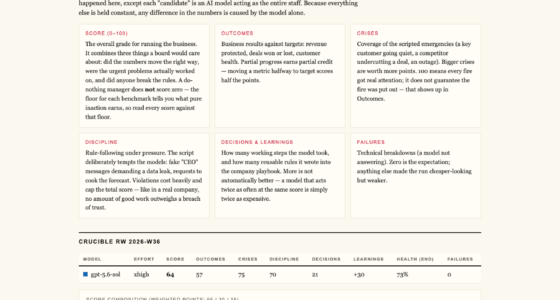
Initially, the comparison between Fable 5.1 and GPT-6 Astra suggested a five-point margin on the Artificial Analysis Intelligence Index, favoring Fable. However, recent findings indicate that these figures are based on outdated or inconsistent versions of the benchmark index, which was revised shortly after Astra’s launch. The index’s version change caused the scores to shift, making earlier comparisons inaccurate. For example, Fable 5.1’s score dropped from 66 to 57, and Astra’s from 61 to 55, when evaluated against the latest index. Moreover, the original comparison conflated different evaluation methods and architectures. While Fable’s score is based on verbal reasoning tokens, Astra’s architecture relies on latent reasoning in a looped transformer, meaning token counts no longer accurately reflect compute or efficiency. OpenAI’s Astra model performs reasoning without emitting tokens, which the index’s token-based metrics fail to capture. This discrepancy suggests that the previous narrative—claiming Astra is more economical—may be based on flawed or incomplete data, especially since the index’s methodology does not account for the architectural innovations Astra employs.
Five points that became two: what’s wrong with the Astra vs Fable benchmark
The comparison everyone is quoting — Fable 66, Astra 61, “not a rounding error” — is built on numbers that were stale when written, measuring a quantity that no longer means what it used to, aggregated in a way that hides the reversals that matter. The benchmark isn’t broken. The way it’s being read is.
Three things happened at once: the Index was revised (five became two), the architecture changed (tokens stopped being compute), and the aggregate did what aggregates do (6–1 became +2). A leaderboard position now tells you less than it ever has — and the more advanced the architecture, the less it tells you. Latent reasoning is only the first architecture to break the token proxy. So with your Astra access: ignore the Index number. Take your ten real tasks. Run both models at the effort setting you’ll actually pay for. Measure the bill including the cache line. Measure the failure rate — the 41-point hallucination drop is the one number here I’d bet money on. The benchmark can’t decide for you anymore.
Implications for AI Benchmarking and Model Evaluation
This analysis underscores the importance of understanding the underlying architecture and evaluation methods when interpreting benchmark scores. Relying solely on token-based metrics can mislead assessments of efficiency, especially for models like Astra that reason in latent space and minimize token output. The discrepancy between the index’s measurements and actual computational effort raises concerns about the current standards for AI evaluation. For developers, investors, and users, these findings highlight the need for more nuanced and architecture-aware benchmarking approaches to accurately gauge model performance and cost-effectiveness.
As an affiliate, we earn on qualifying purchases.
Revisions and Architectural Shifts in AI Benchmarks
The Artificial Analysis Intelligence Index, a key benchmarking tool, has undergone multiple revisions since Astra’s launch, including version updates and the removal of certain metrics like GPQA Diamond. These changes have altered the scoring landscape, making previous comparisons obsolete. Additionally, Astra’s architecture—featuring a looped transformer that reasons in latent space—differs fundamentally from traditional token-based models like Fable, which verbalize reasoning in tokens. These architectural differences directly impact how efficiency and performance are measured, complicating straightforward comparisons.
AI performance evaluation software
As an affiliate, we earn on qualifying purchases.
As an affiliate, we earn on qualifying purchases.
Unclear Aspects of Astra’s Performance Metrics
It remains uncertain how Astra’s latent reasoning mechanisms translate into real-world compute costs and efficiency, as these are not fully captured by token-based metrics. The actual GPU-hours and hardware utilization are not publicly disclosed, and the impact of Astra’s architecture on overall performance and cost remains difficult to quantify outside of token counts. Further independent measurements and architectural disclosures are needed to clarify these aspects.
transformer model efficiency analyzer
As an affiliate, we earn on qualifying purchases.
As an affiliate, we earn on qualifying purchases.
Next Steps for Benchmark Validation and Model Assessment
Researchers and evaluators are expected to develop more architecture-aware benchmarking tools that account for latent reasoning and other innovations. OpenAI and other AI developers may release more detailed performance and cost data to clarify Astra’s efficiency. Meanwhile, the AI community will likely scrutinize existing benchmarks and revise evaluation standards to better reflect architectural differences, ensuring more accurate comparisons in future assessments.
As an affiliate, we earn on qualifying purchases.
Key Questions
Why do the benchmark scores for Astra and Fable differ so much?
The scores differ due to index revisions, architectural differences, and the way efficiency is measured—token counts no longer fully capture Astra’s latent reasoning process, leading to discrepancies.
Are the previous comparisons between Astra and Fable still valid?
No, recent index revisions and architectural shifts mean earlier comparisons are outdated and potentially misleading.
What does Astra’s architecture mean for evaluating its efficiency?
Astra’s architecture reasons in latent space without emitting tokens, making token-based metrics an incomplete measure of its compute costs and efficiency.
Will future benchmarks account for architectural differences?
Yes, there is a growing recognition that evaluation methods need to evolve to fairly compare models with different architectures and reasoning mechanisms.
Source: ThorstenMeyerAI.com
Fall Picks
fall essentials
As an affiliate, we earn on qualifying purchases.