TL;DR

Get smart everyday buys delivered free with Prime
- Fast, free delivery on millions of items
- Prime Video, Amazon Music and more included
- Member-only deals all year
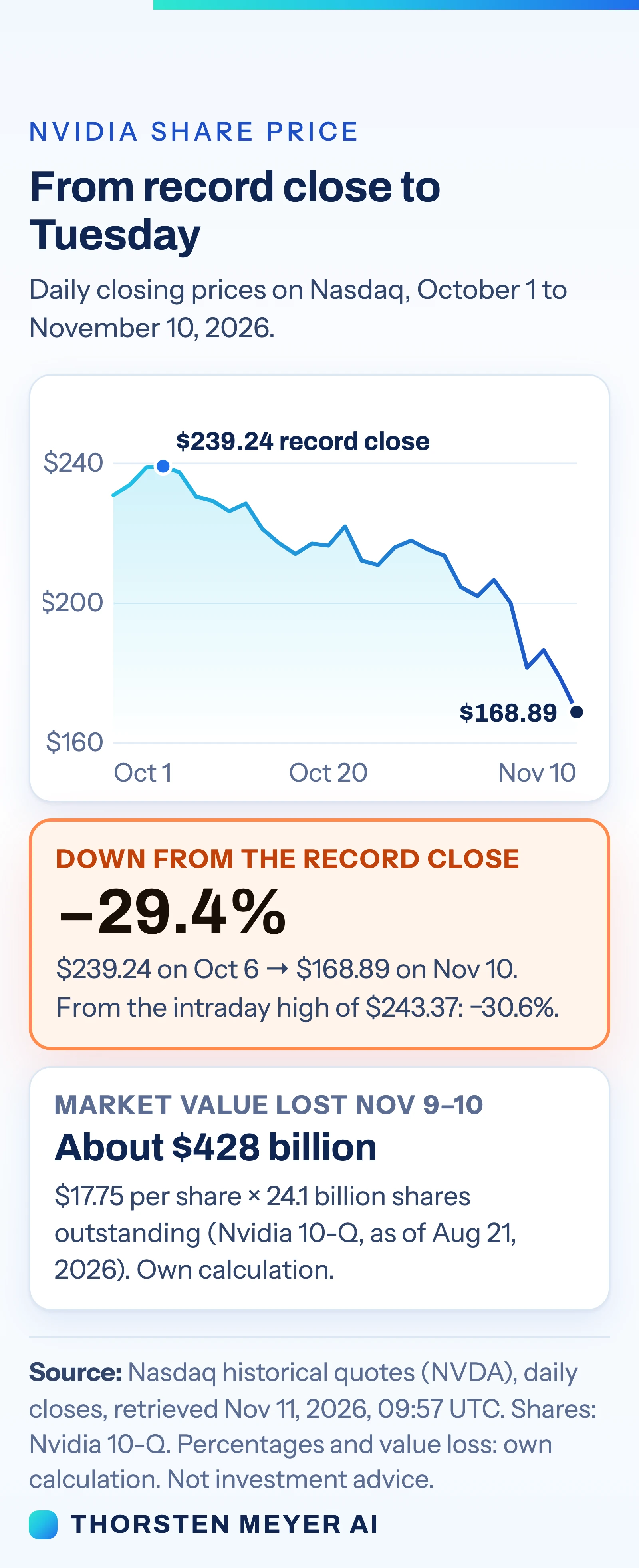
Nvidia closed at $168.89 on Nov. 10, 29.4% below its Oct. 6 record close of $239.24. The decline coincided with pressure on technology stocks, inflation data that lifted rate-hike expectations, and reports of a board investigation, a proposed shareholder lawsuit and scrutiny of a customer over export controls.
Nvidia shares closed at $168.89 on Tuesday, Nov. 10, down 29.4% from the company’s record closing price of $239.24 on Oct. 6, according to Nasdaq prices cited in the source material. The retreat reflects pressure across technology stocks as well as reported developments involving Nvidia itself, though available reporting does not establish how much each factor contributed.
The stock fell 5.47% on Nov. 10, following a 4.27% decline on Nov. 9. It had dropped 9.26% on Nov. 5, then recovered 2.78% on Nov. 6. From the Nov. 4 close through Nov. 10, Nvidia lost 15.6% across four trading sessions, based on the source’s calculations from closing prices.
From the Oct. 6 record close to Nov. 10, the share-price difference was $70.35 per share. Applying Nvidia’s reported 24.1 billion shares outstanding as of Aug. 21 gives an estimated market-value decline of about $1.7 trillion. The source also calculates that the two-session fall from the Nov. 6 close to Nov. 10 represented about $428 billion in market value. These are estimates using a fixed share count, not measures of cash leaving the company.
News reports cited in the source describe several possible pressures: fears of slower data-center construction, hotter-than-expected inflation, uncertainty about the AI outlook, and company-specific scrutiny. The source says Nvidia announced a board investigation on Nov. 8, a proposed shareholder class action was filed on Nov. 9, and a customer faced export-control scrutiny. It does not provide further details about the investigation, lawsuit or customer.
Nvidia’s Weight in Major Indexes
Nvidia’s share-price swings can affect broad stock-market measures because the company has a large weight in major indexes. As of Nov. 9, the source lists Nvidia at 6.64% of SPY, an S&P 500 tracker, and 7.10% of QQQ, a Nasdaq-100 tracker. Those figures mean a move in Nvidia can influence the funds’ performance, alongside moves in their other holdings.
CNBC reported on Tuesday that Nvidia “dragged down the three major averages.” This describes the company’s reported contribution to that day’s market declines; it does not mean Nvidia alone caused the broader market’s losses. For businesses and users, the decline is a signal of changing investor expectations around the AI sector and a company central to the supply of AI chips. The share-price move by itself does not establish a change in Nvidia’s products, customer demand or operating performance.
The market-value estimates also need careful interpretation. They multiply price changes by a reported share count, so they show an approximate change in equity value at those prices. They do not mean Nvidia paid out or lost the same amount in cash. The calculations also hold the share count constant, and the source does not provide a revised count for the November dates.
Products Worth Considering

Logitech MX Ergo S Advanced Wireless Trackball Mouse USB-C – Graphite

Logitech MX Master 4 Ergonomic Wireless Mouse with Haptic Feedback, Graphite

FLEXISPOT Electric Adjustable Workbench, 55 x 28 Inches, White
As an affiliate, we earn on qualifying purchases.
From October Peak to November Selloff
Nvidia reached a record closing price of $239.24 on Oct. 6. Yahoo Finance reported that the shares settled just below an intraday record set that day and that the company’s intraday market value reached $5.84 trillion. The source places the Nov. 10 close 30.6% below the Oct. 6 intraday high of $243.37; measured against the record close, the decline was 29.4%. The two percentages use different reference prices.
The decline accelerated in early November. After closing at $200.13 on Nov. 4, Nvidia fell to $181.60 on Nov. 5. It then rebounded to $186.64 on Nov. 6 before losses resumed on Nov. 9 and 10. Reuters reported that Microsoft briefly overtook Nvidia as the world’s second-most valuable company during Tuesday’s session. AFP reported Nvidia was back in second place behind Apple at the close.
The source describes market-wide and company-specific factors. AFP linked heavy selling across technology stocks to fears that AI data-center construction could slow after the U.S. midterm elections. The Motley Fool reported expectations that the incoming Congress could be more hostile to AI development and noted announced plans by some incoming governors for data-center construction moratoriums. These are reported market concerns and political proposals; the source does not establish that construction has slowed.
On Tuesday, inflation was another reported market pressure. CNBC said the consumer price index rose 0.4% in October, compared with economists’ 0.3% expectation. AFP reported that inflation slowed less than expected, lifting expectations of Federal Reserve rate hikes as stocks fell. Reuters also cited uncertainty about the AI outlook. The source notes that higher borrowing costs can affect financing for data-center construction, but it does not quantify the effect on Nvidia.
““has lost 30% of its value” from its all-time high”
— The Motley Fool
How Much Each Pressure Mattered
The relative effect of each reported factor is unknown. The source says no cited report assigns a precise share of the price decline to inflation, interest-rate expectations, data-center concerns, AI outlook uncertainty or Nvidia-specific developments. The timing of news and a falling share price alone cannot establish causation.
Details also remain limited on the reported board investigation, proposed shareholder class action and customer facing export-control scrutiny. The source does not identify the customer, explain the allegations or investigation’s scope, or state the status or outcome of the legal action. It also does not establish whether export controls affected Nvidia sales or shipments.
The market-value figures are estimates based on the share count reported as of Aug. 21 and the stated closing prices. The source does not update the share count for Nov. 10. The calculations therefore describe an approximate change in equity value using that fixed count, rather than an official company valuation statement or a cash loss.
Nvidia’s November 17 Results
The next dated event in the source is Nvidia’s third-quarter results, scheduled for Nov. 17. The report may provide investors with updated company figures and management commentary, but the source does not state what Nvidia is expected to report or how the company will address the investigation, lawsuit or customer scrutiny.
Until then, the stock and wider technology sector may continue to respond to inflation and interest-rate expectations, views on AI investment and any further company or regulatory disclosures. The source provides no forecast for Nvidia’s share price and no quantified outlook for data-center construction. The Nov. 10 close is a dated market snapshot, not a guide to subsequent performance.
Key Questions
How far had Nvidia shares fallen by Nov. 10?
Nvidia closed at $168.89 on Nov. 10, 29.4% below its record close of $239.24 on Oct. 6. The source calculates a 30.6% drop from the Oct. 6 intraday high of $243.37.
How much market value did Nvidia lose?
Using the reported 24.1 billion shares outstanding as of Aug. 21, the source estimates a decline of about $1.7 trillion from the Oct. 6 record close to Nov. 10. Its estimate for the two sessions from Nov. 6 to Nov. 10 is about $428 billion. Both figures apply a fixed share count to price changes.
What factors were linked to the selloff?
Reports cited in the source point to concerns about AI data-center construction, uncertainty about the AI outlook and October inflation data that raised expectations of Federal Reserve rate hikes. It also lists a board investigation, a proposed shareholder class action and scrutiny of a Nvidia customer over export controls. The contribution of each factor has not been quantified.
When is Nvidia’s next earnings report?
Nvidia is scheduled to report its third-quarter results on Nov. 17, 2026, according to the source material.
Source: Thorsten Meyer AI