A thermal leak detector can help pinpoint drafty windows, uneven insulation, and other temperature patterns that may be wasting heating or cooling energy. My shortlist spans three distinct approaches: the BLACK+DECKER TLD100 for straightforward draft checks, the 320×240 handheld thermal camera for richer visual detail, and the 240×240 camera for longer inspection sessions. The main tradeoff is simplicity versus diagnostic depth: the TLD100 is designed to make surface-temperature differences easy to spot, while the cameras show broader thermal images but ask more of the user.

Get smart everyday buys delivered free with Prime
- Fast, free delivery on millions of items
- Prime Video, Amazon Music and more included
- Member-only deals all year
I rank these around the home-energy task, not around maximum temperature range alone. For most homeowners looking to locate likely air leaks without learning thermal imaging, the TLD100 is the clearest starting point. Buyers who need to compare rooms or document suspicious patterns may prefer a camera, accepting a steeper learning curve and the need to interpret what the colors show.
Key Takeaways
- The BLACK+DECKER TLD100 is the simplest fit for checking windows, doors, and insulation because its LCD and color changes focus on surface-temperature differences.
- The 320×240 camera ranks first among the imaging options for detailed inspections, with a stated 320×240 resolution, 25Hz refresh rate, and 8GB of storage.
- The 240×240 camera is the better camera pick for extended sessions, with a stated battery life of up to 14 hours, though detailed analysis requires a PC connection.
- A thermal reading shows surface temperature patterns; it does not, by itself, prove that a draft or moisture problem exists or identify the cause.
- Choose a simple scanner for occasional energy checks, and choose a thermal camera when visual records or broader home-inspection clues justify the extra complexity.
| BLACK+DECKER Thermal Leak Detector (TLD100) |  | Best for Beginners | Brand: BLACK+DECKER | Model: TLD100 | Sensor type: Infrared | VIEW ON AMAZON | See Our Full Breakdown |
| 320×240 Thermal Camera 25Hz Handheld for Leak Detection and Home Inspection | 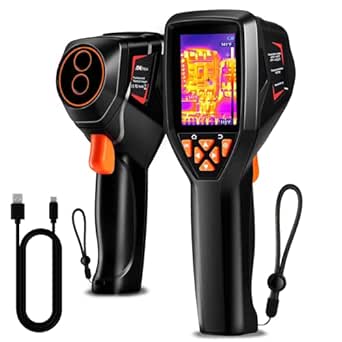 | Best Overall Thermal Camera | Resolution: 320×240 | IR resolution: 120×90 | Refresh rate: 25Hz | VIEW ON AMAZON | See Our Full Breakdown |
| 240×240 Thermal Camera 25Hz Handheld for Leak Detection HVAC |  | Best for Long Inspection Sessions | Resolution: 240×240 | Frame rate: 25Hz | Battery capacity: 3200mAh | VIEW ON AMAZON | See Our Full Breakdown |
| thermal leak detector home energy saving | Resolution | Temperature range |
|---|---|---|
| BLACK+DECKER Thermal Leak Dete | — | — |
| 320×240 Thermal Camera 25Hz Ha | 320×240 | -4°F to 1022°F |
| 240×240 Thermal Camera 25Hz Ha | 240×240 | -4°F to 1022°F |
More Details on Our Top Picks
BLACK+DECKER Thermal Leak Detector (TLD100)
For a homeowner whose main question is “where should I check for drafts?”, the TLD100 is the most direct tool in this group. Its LCD and automatic color changes show warmer and cooler surface areas without presenting a full thermal image. That narrower approach makes it less demanding than either handheld camera: you scan a wall, window, or door area and look for temperature variation rather than learning to read an image palette.
That simplicity is also its limit. The TLD100 detects surface temperature only, and the user must scan suspected areas manually. Compared with the 320×240 camera, it provides less visual detail and no stated image storage; compared with the 240×240 camera, it has fewer advanced inspection features. Still, for routine checks around windows, exterior doors, and suspected insulation gaps, a straightforward signal can be more useful than a complex image if you are not planning to document or analyze findings.
The product description says it can help identify drafts and heat leaks and includes a guide for sealing them. I would treat any claimed energy savings as dependent on the home, the source of heat loss, and the quality of repairs—not a guaranteed result from the detector. Its two-year warranty and Fahrenheit/Celsius readings add practical reassurance, but it should not be used on living beings. This is my first pick for simple, occasional energy checks, not for a user who needs broad thermal diagnostics or saved inspection records.
Pros:- LCD with automatic color changes makes warmer and cooler surface areas easier to spot.
- Designed around draft and insulation checks rather than general-purpose thermal imaging.
- Includes a guide to sealing leaks and supports Fahrenheit and Celsius.
- Can also be used to check surface-temperature patterns on appliances or vehicles.
Cons:- Manual scanning is needed, so checking a large home can take patience.
- Surface readings alone do not reveal the cause of a temperature difference.
- It lacks the stated image storage and detailed thermal views of the handheld cameras.
Best for: Homeowners who want an approachable way to scan windows, doors, and other surfaces for temperature differences before deciding where to investigate or seal.
Not ideal for: Buyers who need detailed thermal images, saved visual records, hands-free scanning, or measurements beyond surface temperature.
- Brand:BLACK+DECKER
- Model:TLD100
- Sensor type:Infrared
- Display:LCD screen
- Temperature units:Fahrenheit and Celsius
- Warranty:2 years
Our verdict“I recommend the TLD100 for first-time users who want simple draft checks, while camera buyers should pay more attention to the two imaging models.”
320×240 Thermal Camera 25Hz Handheld for Leak Detection and Home Inspection
Among these three, this model makes the strongest case for homeowners who want more than a pass-or-check signal. Its stated 320×240 resolution and 25Hz refresh rate support a more detailed, fluid thermal view than the TLD100’s LCD color-change approach. That can help when comparing a wider section of wall or tracing uneven temperature patterns around a window, although a camera still shows surface conditions rather than confirming the source of a leak.
It also stands out for documentation. The stated 8GB of built-in storage can hold over 20,000 images and videos according to the supplied product details, giving a homeowner a way to save areas for later comparison or share findings with a contractor. The 240×240 camera also provides thermal imaging, but this 320×240 option has the higher stated resolution and does not list a PC connection as a requirement for detailed analysis. That difference makes it my preferred camera for a home inspector or engaged DIYer who wants an inspection record without making the computer-based workflow central.
The tradeoff is the learning curve. Unlike the TLD100, a thermal camera asks you to interpret an image and distinguish meaningful patterns from ordinary temperature variation. It is also the heaviest option with a stated weight of 15.5 ounces, and its broad temperature range is more relevant to varied safety checks than to ordinary energy-saving scans. I would choose it when visual detail and stored records matter; casual users who only want to find likely drafts may get a clearer, simpler experience from BLACK+DECKER.
Pros:- Stated 320×240 resolution provides the highest listed image resolution in this lineup.
- 25Hz refresh rate supports smooth real-time viewing while scanning.
- 8GB built-in storage is listed as holding over 20,000 images and videos.
- Broad temperature range supports checks beyond basic home energy inspections.
Cons:- Thermal images require interpretation and are less straightforward than the TLD100’s color-change feedback.
- At 15.5 ounces, it is heavier than a small single-purpose scanner may feel for repeated overhead checks.
- Its wider diagnostic range may be unnecessary for buyers focused only on occasional drafts.
Best for: DIY inspectors and homeowners who want a detailed thermal image and built-in storage for documenting suspected insulation gaps, moisture patterns, or other inspection findings.
Not ideal for: Casual users seeking the simplest possible draft check, or buyers who do not want to learn how to interpret thermal images.
- Resolution:320×240
- IR resolution:120×90
- Refresh rate:25Hz
- Temperature range:-4°F to 1022°F
- Storage:8GB built-in
- Weight:15.5 ounces
- Dimensions:8.07 × 3.15 × 2.95 inches
- Battery:1 lithium-ion battery included
Our verdict“I would choose this camera for the most capable, self-contained imaging workflow in the group, but not for a buyer who values simplicity over detail.”
240×240 Thermal Camera 25Hz Handheld for Leak Detection HVAC
This camera is the endurance pick for someone who expects to inspect several rooms, HVAC areas, or electrical hotspots in one session. Its stated up to 14 hours of battery life and 3200mAh battery capacity are its clearest differentiators. That makes it a more natural fit for extended rounds than a simple TLD100 scan, especially if energy checks are only one part of a broader home-maintenance inspection.
Its 240×240 thermal resolution and 25Hz frame rate put it in the same general category as the 320×240 camera, but the latter has the higher listed resolution and built-in 8GB storage. The supplied description also says detailed analysis for this model requires a PC connection, a meaningful workflow drawback if you want to review findings on the spot or keep a self-contained record. Smart alerts and a stated accuracy of ±3.6°F or ±2% add useful context for readings, though neither changes the fact that the device needs an informed user to interpret patterns.
For home energy savings, I would not rank this ahead of BLACK+DECKER for a beginner: the TLD100 is simpler for locating suspicious temperature differences at common leak points. Nor would I put it ahead of the 320×240 camera for buyers who prioritize image detail and listed storage. Its niche is clearer: long sessions and mixed diagnostic tasks, with enough battery capacity for extended use, provided the buyer is comfortable moving analysis to a PC.
Pros:- Stated battery life of up to 14 hours suits extended inspection sessions.
- 25Hz frame rate supports real-time scanning.
- Temperature range covers a broad set of home inspection and troubleshooting tasks.
- Smart alerts and stated accuracy provide additional measurement context.
Cons:- Detailed analysis requires a PC connection, limiting the self-contained workflow.
- Its 240×240 resolution is lower than the 320×240 camera in this lineup.
- Thermal patterns still require interpretation and do not identify a leak’s cause on their own.
Best for: Homeowners or maintenance-focused users who plan extended inspections across multiple rooms and want a camera that also serves HVAC or electrical troubleshooting.
Not ideal for: Beginners who want immediate, simple draft feedback, or users who want detailed analysis and review without connecting to a PC.
- Resolution:240×240
- Frame rate:25Hz
- Battery capacity:3200mAh
- Battery life:Up to 14 hours
- Temperature range:-4°F to 1022°F
- Accuracy:±3.6°F or ±2%
- Analysis:PC connection required for detailed analysis
Our verdict“I recommend this camera for endurance and multi-purpose inspections, while the 320×240 model is a stronger choice for listed image detail and the TLD100 for easy draft checks.”

How We Picked
I ranked these three products by how directly they support the goal in the title: finding likely sources of home heat loss so a homeowner can decide where to investigate or seal. I gave the most weight to ease of interpreting temperature differences, usefulness for inspecting common leak locations, and the amount of information each tool can provide without additional equipment. A tool that is accessible for a first-time user can be more helpful for basic draft hunting than a higher-resolution camera whose images need interpretation.
I also compared the practical tradeoffs stated for each product: display and alert approach, imaging resolution and refresh rate, storage, battery life, temperature range, and analysis requirements. Since the TLD100 is a surface-temperature scanner while the other two are thermal cameras, they do not serve identical workflows. I treat the cameras’ broad diagnostic potential as an advantage for buyers with more inspection needs, not as proof that they are automatically better at finding energy leaks.
Product descriptions do not establish that any device can identify the source of a leak, calculate energy savings, or replace a professional inspection. I therefore avoid ranking on unverified savings claims. My order favors practical usefulness for a typical homeowner, then differentiates the camera options by image detail, portability of the workflow, and endurance.
Factors to Consider When Choosing Thermal Leak Detector Home Energy Savings
I would choose a thermal leak detector by starting with the kind of decision I need to make. If the goal is to find a few likely drafts before sealing them, a simple surface scanner may be enough. If I want visual documentation or plan to inspect several kinds of home systems, a thermal camera can offer more context, but only if I am prepared to interpret its images.
Match the tool to the inspection
For windows, doors, baseboards, and suspected insulation gaps, the TLD100 offers the most direct workflow in this set: scan the surface and watch for color changes. A camera is more useful when I want to see the shape and extent of a temperature pattern across a larger area. Neither device proves that a draft is present by itself. Surface temperature can be influenced by indoor and outdoor conditions, sunlight, airflow, and the materials in the wall.
Choose simplicity or image detail
The BLACK+DECKER detector is aimed at users who want a clear signal without sorting through a thermal image. The 320×240 model is the strongest camera pick for detail and listed image storage, while the 240×240 option trades some listed resolution for a stated long battery life. A camera is not automatically the better energy-saving tool: if its display is hard to interpret, the simpler scanner may lead to a more practical inspection for an occasional user.
Treat temperature readings as clues
Thermal tools show surface temperature patterns, not hidden air movement or the source of a problem. I would use them to flag areas for closer checking, then confirm suspicions with other observations, such as feeling for airflow or inspecting visible seals and insulation. A cool patch might suggest a problem, but it can also reflect a material difference or recent exposure to outside conditions. Avoid treating one image or reading as a repair diagnosis.
Think about records and workflow
Saved images matter if I want to compare a room before and after a repair or share findings with a contractor. The 320×240 model lists 8GB of built-in storage, giving it an advantage for a documented inspection. The 240×240 camera calls for a PC connection for detailed analysis, which may suit a user who already reviews inspection data on a computer but adds a step for everyone else. The TLD100 keeps the task simple, though it does not list image storage.
Plan for safe, realistic energy savings
A detector can guide attention toward possible heat loss, but it does not calculate a household’s future energy bill or guarantee a particular reduction. Savings depend on the home, the size and cause of the leak, local weather, energy use, and the repair. Follow product instructions, do not use the TLD100 to measure living beings, and seek qualified help for electrical hazards, suspected moisture damage, or repairs that exceed your skills.
Frequently Asked Questions
Can a thermal leak detector find drafts?
It can help identify temperature differences around likely leak locations, such as windows, doors, or wall edges. A surface-temperature pattern is a clue rather than direct proof of moving air, so I would confirm a suspected draft with a separate airflow check and inspect seals or insulation before deciding on a repair.
Which product is easiest for a first-time homeowner?
The BLACK+DECKER TLD100 is the easiest starting point in this comparison because its LCD and automatic color changes are designed to make warmer and cooler surface areas simple to scan. The two cameras can show more visual information, but they require more judgment to interpret and suit buyers who want broader inspection detail.
Should I choose a thermal camera over the TLD100?
I would choose a camera if I need thermal images, saved records, or a tool for several types of home inspection. The 320×240 model is the stronger option for listed resolution and built-in storage, while the 240×240 model is aimed at longer sessions. If I only need to check a few common draft locations, the TLD100 is simpler and more directly focused on that task.
Will using one of these detectors guarantee lower energy bills?
No. A detector can help locate areas worth investigating, but it cannot guarantee that a repair will reduce bills by a specific amount. The result depends on whether the suspected issue is real, how much energy it wastes, the repair quality, and household conditions. I would treat readings as information for prioritizing inspection and sealing work, not as a savings forecast.
Can these devices diagnose moisture or electrical problems?
Thermal patterns may help flag unusual areas for follow-up, but they do not independently diagnose moisture, wiring faults, or the cause of a hot or cold spot. The product descriptions position the cameras for broader inspection tasks, yet any concerning moisture pattern or electrical hotspot should be checked with suitable methods and, where needed, a qualified professional.
Conclusion
For most homeowners focused on finding drafts without a steep learning curve, I recommend the BLACK+DECKER TLD100. Choose the 320×240 thermal camera if visual detail and saved inspection images matter more than simplicity. Pick the 240×240 camera if extended battery life and mixed home-maintenance inspections are your priority, and you are comfortable using a PC for detailed analysis. Whichever tool you select, use its readings to guide further checks rather than treating a temperature pattern as a complete diagnosis or a promise of energy savings.