
📊 Full opportunity report: Workflow Audit: See Where Automation May Fit on IdeaNavigator AI — validation score, market gap, and execution plan.

Get smart everyday buys delivered free with Prime
- Fast, free delivery on millions of items
- Prime Video, Amazon Music and more included
- Member-only deals all year
TL;DR
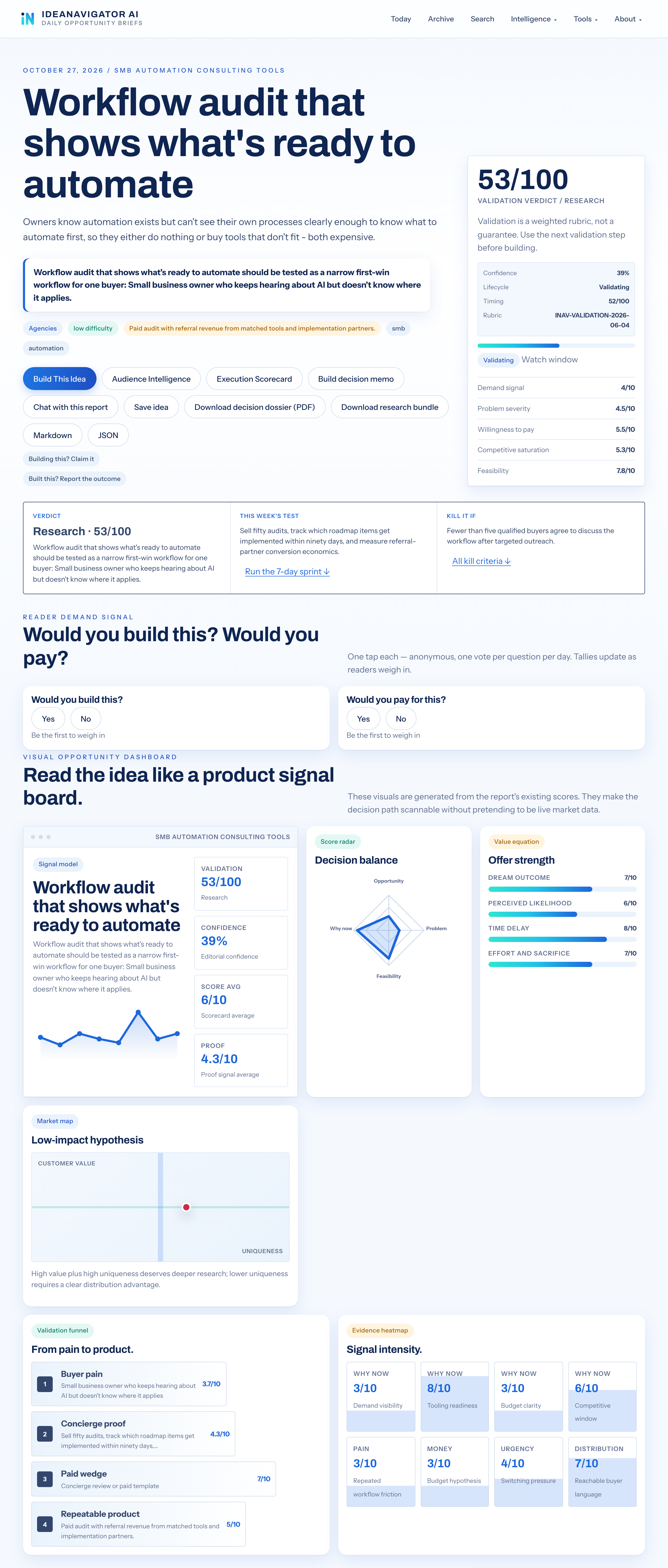
IdeaNavigator AI has outlined a proposed workflow-audit product for small-business owners who are unsure where automation might fit. The concept would interview owners, map processes, score potential automation opportunities and produce a 90-day roadmap; its viability remains untested, with 50 paid audits proposed as a validation step.
IdeaNavigator AI has outlined a proposed workflow-audit service to help small-business owners identify which tasks may be suitable for automation, addressing a gap between growing interest in AI tools and uncertainty about how to use them. The concept would turn an interview about a business’s operations into a scored process map and a sequenced 90-day implementation roadmap; no launch, customer results or validated financial returns have been reported.
The proposed audit would guide an owner through questions about daily operations and use the answers to map smarter workflows. It would then assess candidate tasks against automation readiness, potential return on investment and implementation difficulty. The proposal does not define the scoring method or say how estimates would be checked against each business’s actual costs and results.
Each audit would produce a prioritized plan covering possible next steps over 90 days, along with tool suggestions matched to individual steps. The business model described combines payment for the audit with potential referral revenue from software providers and implementation partners. No pricing, partner agreements or specific tools are identified.
The proposal is aimed at owners who know automation tools exist but cannot easily see which of their own processes might benefit. It argues that poor visibility can lead businesses either to postpone decisions or buy tools that do not fit their needs. Those are the problem and market rationale presented for the product, not findings from a reported customer study.
A Practical Test for Automation Demand
The concept focuses on a decision that often comes before software selection: which workflow, if any, should a business automate first? For a small company with limited time and budget, a process map and ordered recommendations could offer a more concrete starting point than choosing tools based on general claims about AI. Whether the audit delivers that value will depend on the accuracy and usefulness of its guidance.
The proposed referral model also creates a need for transparency. Recommendations could lead to revenue for the audit provider if a customer buys a matched tool or hires an implementation partner. The proposal does not explain how it would disclose those financial relationships, separate commercial incentives from assessment results, or present alternatives when a paid tool is not needed. These details could affect how owners judge the recommendations.
For the wider small-business automation market, the idea is a test of whether owners will pay for guidance before purchasing or implementing technology. A paid audit could also reveal whether structured interviews produce plans that businesses can act on. At present, these are potential outcomes rather than demonstrated benefits.
Products Worth Considering

Logitech MX Mechanical Mini Mac Wireless Keyboard Low-Profile – Space Grey

HP Sprocket Photo Booth Instant Color Printer Bundle

Logitech MX Master 4 for Mac, Ergonomic Bluetooth Mouse with Haptic Feedback, Ultra-Fast Scrolling, USB-C Charging, for MacOS, iPadOS, Windo
As an affiliate, we earn on qualifying purchases.
From Tool Choice to Process Mapping
The proposal describes a mismatch between the availability of AI tools and the ability of business owners to identify suitable uses within their own operations. It says that an expanding range of tools has contributed to decision paralysis, while owners may lack a clear map of how work currently gets done. Its suggested response is to start with the workflow rather than a particular product.
It also argues that guided process-mapping interviews may now be easier to automate with large language models. That is the proposal’s explanation for why this kind of service could be timely; no technical evaluation, comparison with human-led consulting or evidence of interview accuracy is supplied. The proposed market is small-business automation consulting tools, but the material gives no market-size estimate or competitor analysis.
The concept remains at the product-planning stage in the information available. It describes an intended minimum viable product, a target customer and a validation plan, but does not report that the audit is operating or that businesses have completed it.
Product Evidence and Incentives Await
It is not clear whether the service has launched, whether any audits have been sold, or who would conduct or review the assessments. The proposal reports no customer interviews, implementation rates, revenue figures or evidence that roadmap recommendations improve business outcomes.
Several practical details are also unspecified: the audit’s price, the data owners would be asked to provide, how sensitive business information would be handled, and what criteria would determine readiness, ROI or difficulty. The proposal does not explain how estimates would account for setup costs, staff time, ongoing subscriptions or the need to change processes before automating them.
The suggested tool and partner referrals raise another unanswered point: whether recommendations would be ranked independently of referral payments. Without disclosed policies and evaluation methods, readers cannot tell how the service would manage that potential conflict. No timeframe is given for a launch or for completing the proposed validation.
Fifty Paid Audits Proposed
The next stated step is to sell 50 audits and monitor which items on customers’ roadmaps are implemented within 90 days. The proposal also calls for measuring conversion economics for referral partners, which could show whether recommendations generate commercial activity. These are planned validation measures; no evidence is provided that the test has begun.
For that test to clarify whether the product works, results would need to distinguish between recommendations customers accept, tasks they actually implement and changes that produce measurable benefits. The proposal does not specify how it would measure ROI, compare outcomes with a baseline, or account for businesses that do not implement a recommendation.
Until those details and results are available, the audit should be understood as a product concept, not a proven way to reduce costs or improve operations. The available information names no launch date, pricing announcement or later milestone beyond the proposed 50-audit test.
Key Questions
What is the proposed workflow audit?
It is a proposed service that would interview a small-business owner, map operational processes and score possible automation opportunities by readiness, potential ROI and difficulty.
What would customers receive?
The planned output is a process map, suggested tools for potential steps and a prioritized 90-day roadmap. The proposal does not give a sample report or specify how its scores would be calculated.
Is the audit available now?
The available information does not confirm a launch or say that audits have been sold. It describes a product concept and a proposed validation plan.
How would the idea be tested?
The stated plan is to sell 50 audits, track roadmap items implemented within 90 days and measure referral-partner conversion economics. No results from that test are reported.
How would the service make money?
The proposed model combines fees for audits with possible referral revenue from recommended tools and implementation partners. Pricing and policies for disclosing or managing those referrals have not been provided.
Source: IdeaNavigator AI