📊 Full opportunity report: What Goes Into A Parental Consent Management Process? on IdeaNavigator AI — validation score, market gap, and execution plan.

Get smart everyday buys delivered free — and shop member deals
- Fast, free delivery on millions of items
- Access to Prime Big Deal Days deals on October 6–7
- Prime Video, Amazon Music and more included
TL;DR
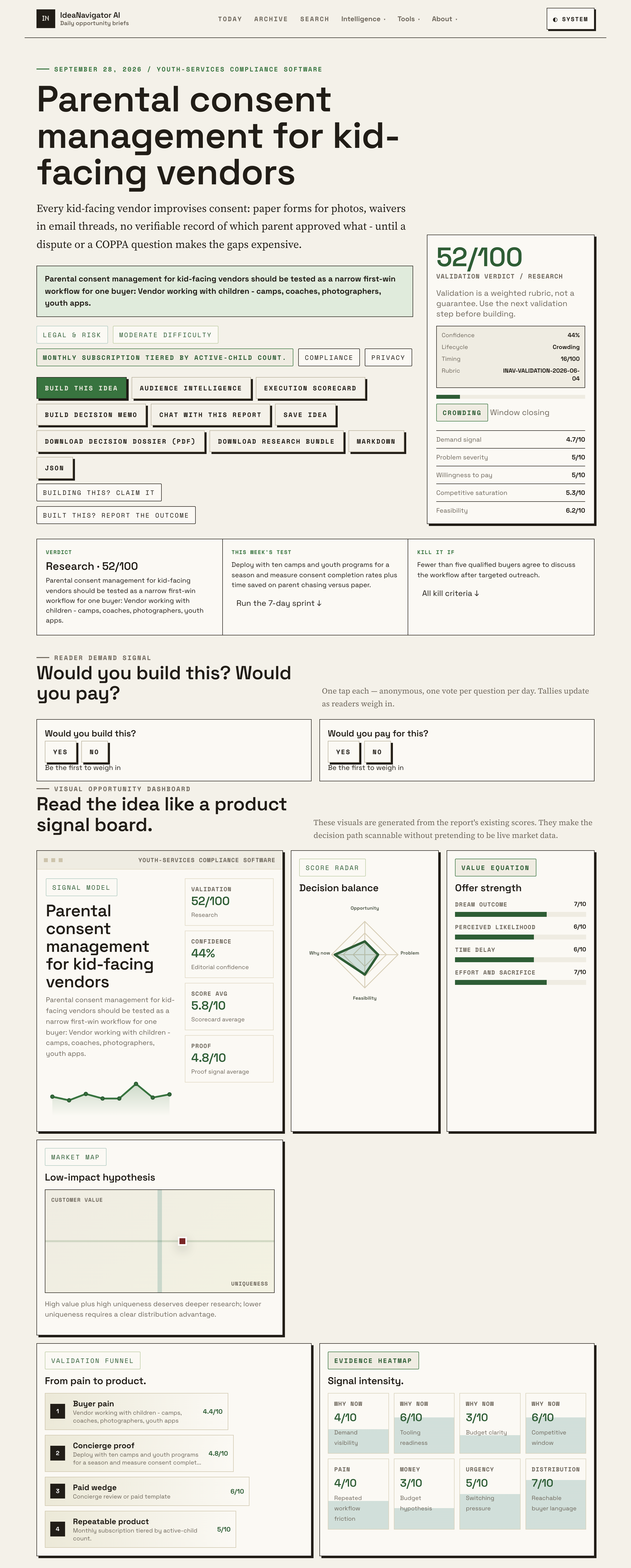
A proposal outlines a phone-based parental consent process for camps, coaches, photographers and youth apps, with records organized by child and consent type. It recommends testing the approach with ten youth programs for one season; no pilot results or adoption figures are provided.
The proposed product would let parents complete vendor-branded consent forms on their phones. Forms could cover photo use, data collection, medical information and liability, with the service keeping approvals in a record for each child. The proposal also includes consent expiry tracking and an option to export records for audits.
Identity checks would vary according to the risk level of the consent, though the proposal does not specify verification methods or define those tiers. It suggests charging vendors a monthly subscription based on the number of active children. Pricing, operating costs and demand have not been reported.
To evaluate the idea, the proposal recommends a one-season trial with ten camps and youth programs. Suggested measures are consent completion rates and staff time spent chasing parents compared with paper forms. The proposal does not say that vendors have signed up or that a trial is underway.
A Record for Each Child’s Approvals
For a vendor, a single record of which parent approved which use could make it easier to check permissions before taking or sharing a photograph, collecting information, or relying on a medical or liability form. Expiry tracking could also help staff identify permissions that need renewal. These are intended benefits of the proposed workflow; measured effects have not been published.
The idea addresses a practical recordkeeping problem: permissions may be scattered across paper forms and email threads. If a parent disputes a use or an organization is asked to show its records, staff may have difficulty finding the relevant approval. A digital ledger and audit export are proposed as ways to organize that information. Whether they would resolve those problems depends on how reliably parents complete forms and vendors maintain accurate child records.
The proposal also points to children’s privacy rules and parent concerns as reasons vendors may seek more defensible records. It does not identify a specific enforcement action or quantify compliance costs. A product’s recordkeeping features alone would not establish that a vendor meets every legal obligation.
Paper Forms Prompt the Proposal
The proposal describes current consent practices among child-facing vendors as improvised: photo permissions may be collected on paper, while waivers can be buried in email. It says vendors may lack a verifiable record connecting a parent’s approval to a particular child and purpose. These are presented as the problem the product is intended to address, rather than findings from a disclosed survey.
Potential customers span different kinds of youth services, from camps and coaches to photographers and apps. Their consent needs and risks may differ: permission to use a photo, for example, is distinct from permission to collect personal data or record medical details. The proposed system groups these forms in one workflow but provides no implementation details about how vendors would tailor them.
The commercial concept is a subscription for youth-services compliance software, with monthly charges tiered by active-child count. The suggested pilot is meant to test use during a season before the idea is evaluated further. No market-size estimate, customer research or financial results are included in the proposal.
Pilot and Safeguards Remain Unreported
It is not clear whether development or a pilot has begun, which vendors might participate, or what would count as a successful trial. The proposal sets out measures—completion rates and staff time spent following up—but gives no targets, baseline, results or comparison method.
Details about identity verification, data security and record access are also unspecified. The plan does not explain how a parent’s identity would be checked, who at a vendor could view a child’s information, how long records would be retained, or how errors and withdrawn permissions would be handled. It also does not state how the system would account for different legal requirements across jurisdictions.
No statements from vendors, parents, regulators or independent experts accompany the proposal. The cited pressure from privacy rules and parent challenges is not supported here by enforcement figures or survey data, so its scale and effect on purchasing decisions remain uncertain.
A Ten-Program Season Trial
The next step proposed is to deploy the workflow with ten camps and youth programs for one season. The operators would track how often parents complete consent forms and compare staff time spent pursuing approvals with the paper process. The proposal does not give a start date, participating organizations or a published timeline for reporting findings.
If a trial proceeds, its results could show whether vendors and parents can use the phone-based flow and whether the records reduce follow-up work. Details about consent accuracy, identity checks, privacy safeguards and subscription pricing would also be needed to assess the product. At present, the proposal describes a potential service and a way to test it, not a launched or validated business.
Source: IdeaNavigator AI
Key Questions
What is the proposed service?
It would let parents complete vendor-branded consent forms on their phones and maintain per-child approval records for uses such as photos, data collection, medical information and liability.
Who is the service intended for?
The proposal targets organizations working with children, including camps, coaches, photographers and youth apps.
Has the service been tested?
No test results are reported. The proposal recommends a one-season pilot with ten camps and youth programs, but does not say that the pilot has started.
How would the proposed service make money?
The proposed model is a monthly subscription tiered by the number of active children. Prices and customer demand have not been provided.
Source: IdeaNavigator AI
Evergreen bestsellers Picks
bestsellers
As an affiliate, we earn on qualifying purchases.