
TL;DR
Federal Reserve Governor Christopher Waller said the Fed should consider a half-percentage-point rate increase at its December 8-9 meeting unless it clearly signals another increase in January. The proposal is his view, not a committee decision; inflation and employment data due before the meeting will help shape the debate. Higher rates could restrain inflation while adding pressure to hiring and debt-funded AI investment.
Federal Reserve Governor Christopher Waller said on November 18 that the central bank may need to raise its benchmark rate by half a percentage point at its December 8-9 meeting unless it clearly signals another increase in January. The proposal reflects Waller’s view, not a decision by the Federal Open Market Committee, and could matter for employers, workers and AI companies because higher borrowing costs can weigh on hiring and investment.

Get smart everyday buys delivered free with Prime
- Fast, free delivery on millions of items
- Prime Video, Amazon Music and more included
- Member-only deals all year
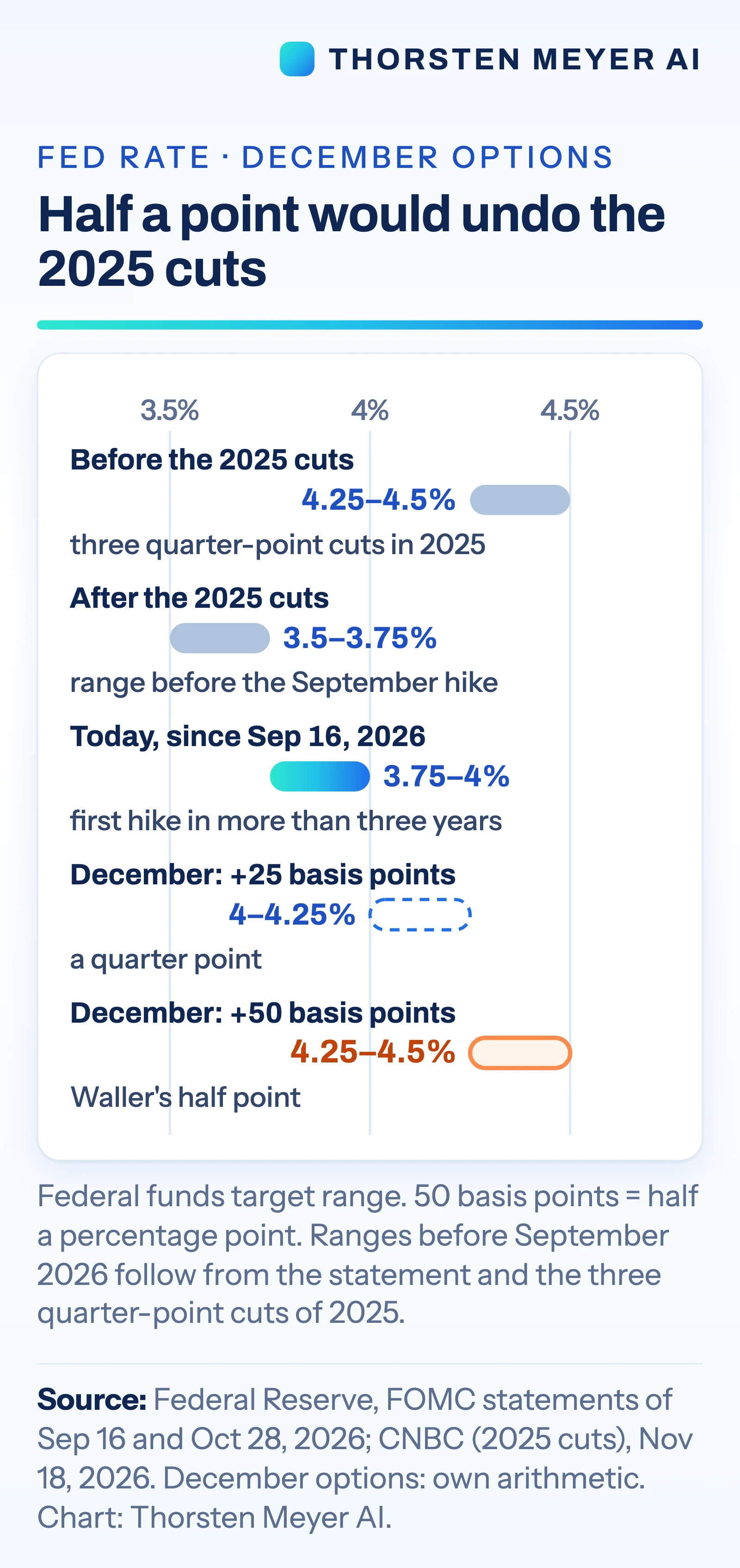
In a live CNBC interview, Waller said that if policymakers do not signal clearly that they are “going in January,” “you have to go 50 [basis points] in December.” A basis point is one-hundredth of a percentage point. He also described an alternative: a quarter-point increase in December paired with a clear signal that another move would follow in January. CNBC reported the interview; the Fed’s speech listing, checked November 19, did not include a transcript.
Waller cited inflation as the reason for a faster increase. He told CNBC, “I’m very, very concerned about inflation. It’s kind of headed in the wrong direction, and it’s spreading out.” The source material reports that the personal consumption expenditures price index, the Fed’s preferred inflation gauge, was 3.6% higher year over year in September, compared with the Fed’s 2% goal. In a November 10 speech, Waller said a half-point move should be considered if core consumer prices rose around 0.3% in October; the reported October core CPI increase was 0.3%.
The committee has not endorsed his proposal. Minutes from its October meeting said “a couple of participants” thought a move larger than 25 basis points could warrant consideration if inflation data were unfavorable. New York Fed President John Williams said, “I don’t think the situation calls for dramatic action.” Waller is one of 12 FOMC voters, and his stated views are his own.
Rate Pressure on Jobs and AI
A higher federal funds rate can feed through to more expensive borrowing for households and businesses. That can lead companies to defer projects or hiring as financing costs rise. The effect on any particular employer or worker is uncertain, but the proposed increase would come as officials describe a labor market with low hiring and low firing. The source reports unemployment at 4.1% in October and says people who lose jobs are taking longer to find new ones.
AI infrastructure is one area exposed to financing costs. Fed Vice Chair for Supervision Michelle Bowman said AI-related debt was “on track to exceed $800 billion this year” and that higher rates already “appear to be holding back investment” at newer and medium-sized AI firms. Those are Bowman’s assessments, not a forecast of how a December move would affect the sector. Higher borrowing costs may curb demand and price increases while also weighing on investment and a slow-moving job market.
Products Worth Considering

Apple iPad 11-inch (A16 Chip, 128GB, Wi-Fi, Silver)

Apple Mac mini Desktop Computer with M6 Chip (2026)

Logitech MX Mechanical Mini for Mac Wireless Keyboard, Space Gray
As an affiliate, we earn on qualifying purchases.
Inflation Debate Before December
Waller had set out a conditional case before his CNBC interview. In a November 10 speech published by the Fed, he said officials should consider a 50-basis-point increase if core consumer prices rose about 0.3% in October. The reported October core CPI reading met that threshold. Waller’s interview then connected the size and timing of a December move to whether the Fed would signal another increase in January.
Waller also referred to the Fed’s three quarter-point rate cuts in 2025 as “insurance cuts,” arguing they should be taken back and that further increases could be needed. His view sits within a broader committee discussion: the October meeting minutes recorded that a couple of participants saw a larger-than-25-basis-point move as a possibility under unfavorable inflation data. The minutes and Williams’s remarks also show that the committee’s discussion includes views favoring caution.
“If you’re not going to signal this very clearly to markets, you’re going in January, my view is then you have to go 50 [basis points] in December to put it in place and get it done.”
— Christopher Waller, in a November 18 CNBC interview
Vote and Economic Signals Unsettled
No December rate decision has been made. Waller’s proposal is his own, and the available source material does not establish how the other voting members will decide or whether the committee will adopt either path he described. The October meeting minutes show some openness to a larger increase if inflation data disappoint, while Williams argued against dramatic action.
Key information is still due before the meeting, including October PCE inflation data on November 25 and the November jobs report. The source does not give the jobs report’s release date or forecast its results. It also does not quantify how a half-point increase would affect employment, AI financing, or the pace of price growth. Bowman’s debt estimate is attributed to her, and the source supplies no detailed methodology or comparison baseline.
Data Ahead of the December Meeting
The next cited inflation milestone is the release of October PCE data on November 25, followed by the November jobs report. Those readings will arrive before the FOMC meets on December 8-9. They may inform the committee’s assessment of inflation and employment, but the source does not say how officials will weigh each report or whether Waller will change his position.
At the meeting, the FOMC will decide whether to adjust the federal funds rate and what guidance, if any, to give about January. Until then, Waller’s half-point proposal remains one official’s stated position rather than confirmed Fed policy.
Key Questions
Has the Fed decided to raise rates by half a point in December?
No. Waller proposed that possibility, but the FOMC will make the decision at its December 8-9 meeting.
What condition did Waller attach to his proposal?
He said a half-point December increase would be needed in his view if the Fed did not clearly signal that it would raise rates again in January. He also described a quarter-point December move paired with that signal.
Why is Waller concerned about inflation?
He said inflation was moving in the wrong direction and spreading. The source reports September PCE inflation at 3.6% year over year, above the Fed’s 2% goal.
How could higher rates affect jobs and AI investment?
Higher borrowing costs can make projects and hiring more expensive to finance. Bowman said elevated rates already appear to be holding back investment at newer and medium-sized AI firms; the source does not quantify the effect of a possible December increase.
What information is due before the Fed meeting?
The source identifies October PCE inflation data, due November 25, and the November jobs report as upcoming inputs before the December 8-9 meeting.
Source: Thorsten Meyer AI