📊 Full opportunity report: Phone-based injury-risk movement screening for hiring on IdeaNavigator AI — validation score, market gap, and execution plan.
TL;DR
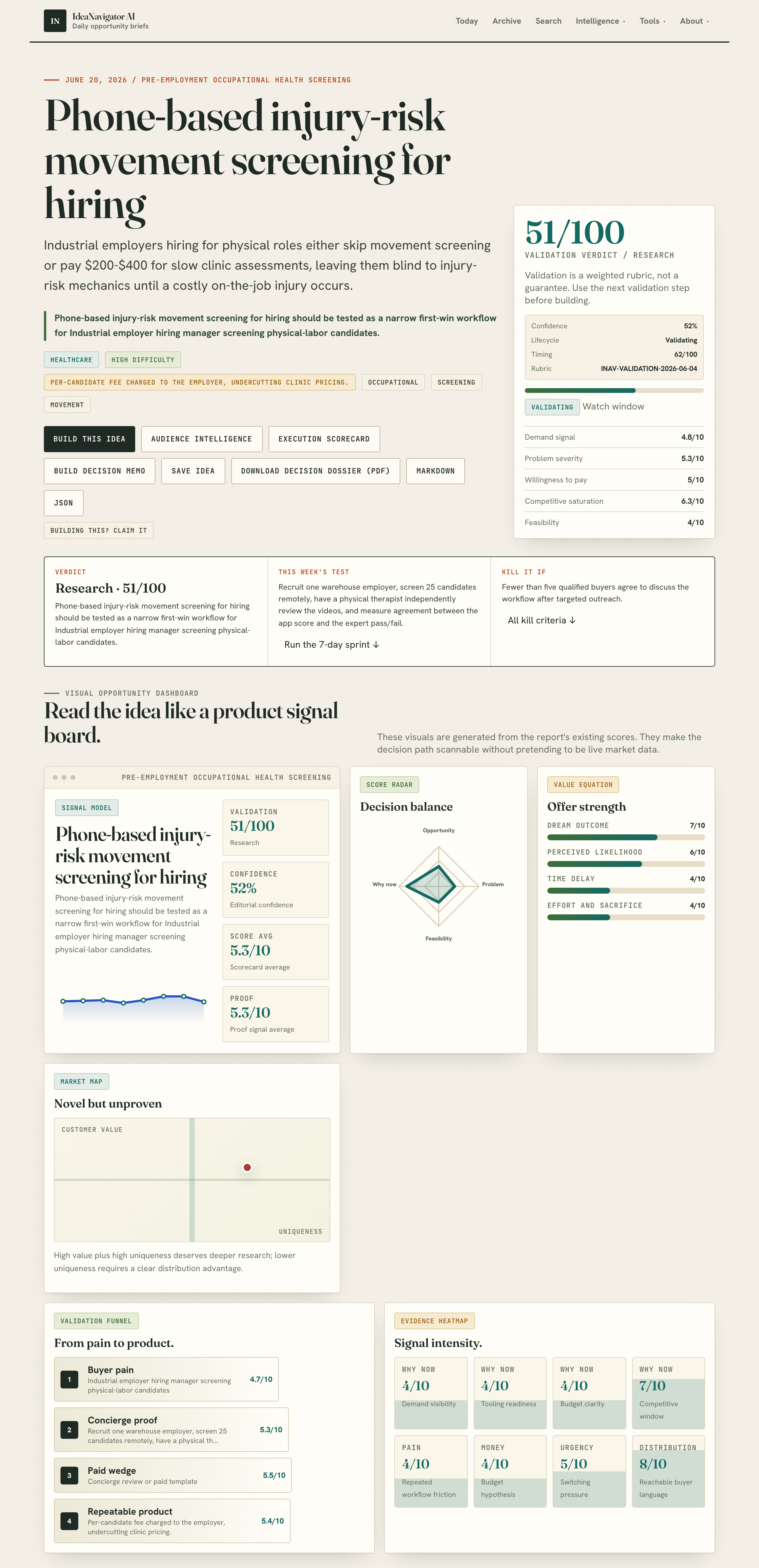
A pilot initiative is evaluating a phone-based movement screening tool for screening physical-labor candidates remotely. The approach aims to identify injury risk early, potentially saving employers money and reducing on-the-job injuries. Results from the pilot will determine its effectiveness and feasibility.
A pilot program is testing a phone-based movement screening tool designed for remote assessment of physical-labor job candidates, aiming to help employers identify injury risks before hiring. This approach could reduce costly on-the-job injuries and lower screening expenses, addressing longstanding gaps in pre-employment occupational health evaluations.
The initiative involves a guided phone capture process where candidates perform 5-7 movements, such as squats, reaches, and balance holds, which are analyzed using pose estimation technology. The system provides a pass/fail injury-risk score within 24 hours, costing between $30 and $50 per candidate. The pilot will involve screening 25 warehouse candidates, with physical therapists independently reviewing the videos to assess the app’s accuracy in predicting injury risk. The goal is to validate whether this remote approach can reliably match expert assessments and serve as a scalable, cost-effective alternative to clinic-based evaluations.
Currently, industrial employers often skip movement screening or rely on expensive, slow assessments costing $200-$400. The rise of phone cameras and pose estimation makes remote screening feasible, and rising workers’ compensation costs incentivize proactive injury prevention. The pilot aims to test this new workflow’s accuracy and operational viability before broader adoption.
Potential Impact on Industrial Hiring Practices
If successful, this phone-based screening could transform pre-employment injury prevention by providing a quick, affordable, and scalable method for assessing physical risk. Employers could identify high-risk candidates early, reducing the likelihood of costly injuries and associated workers’ compensation claims. This approach also offers the potential to standardize injury risk assessments across industries, improving overall workplace safety and lowering insurance premiums. However, it remains uncertain how well the app’s scores will align with expert evaluations and whether it can be adopted widely without significant technical or operational hurdles.
As an affiliate, we earn on qualifying purchases.
Current Limitations in Pre-Employment Injury Screening
Industrial employers traditionally rely on clinic-based assessments or skip movement screening altogether due to high costs and logistical challenges. These assessments, which can cost between $200 and $400 per candidate, are often slow, delaying hiring decisions and leaving employers blind to injury risks until after an injury occurs. Rising workers’ compensation costs have increased the urgency for more proactive screening methods. Advances in phone camera technology and pose estimation algorithms now make remote movement analysis feasible, opening new possibilities for scalable pre-employment screening.
“Using phone cameras and pose estimation, remote movement screening could become a practical tool for early injury risk detection in industrial hiring.”
— an anonymous researcher
pose estimation phone app for injury risk
As an affiliate, we earn on qualifying purchases.
As an affiliate, we earn on qualifying purchases.
Uncertainties in App Accuracy and Adoption
It is not yet clear how accurately the phone-based system will predict injury risk compared to expert assessments. The pilot’s results are pending, and questions remain about the system’s reliability across diverse candidate populations and job roles. Additionally, the scalability and acceptance of this technology by employers and candidates are still uncertain, as are potential regulatory or privacy concerns related to remote video analysis.
remote worker injury assessment tool
As an affiliate, we earn on qualifying purchases.
As an affiliate, we earn on qualifying purchases.
Next Steps for Validation and Broader Implementation
The pilot will involve screening 25 candidates, with independent review by physical therapists to validate app scores. Results are expected within a few months, which will determine whether the technology can be scaled for wider use. If validated, the next phase may include larger trials across different industries and integration into existing hiring workflows. Further development will focus on improving app accuracy, user experience, and addressing regulatory considerations.
pre-employment movement screening device
As an affiliate, we earn on qualifying purchases.
As an affiliate, we earn on qualifying purchases.
Key Questions
How reliable is the phone-based movement screening compared to traditional assessments?
The reliability is still under evaluation. The pilot aims to compare app scores with expert reviews to determine accuracy, but conclusive results are not yet available.
What types of movements are candidates asked to perform?
Candidates will perform 5-7 movements, including squats, reaching, lifting simulations, and balance holds, to assess different injury risk factors.
Will this screening method replace in-person assessments entirely?
It is too early to say. The goal is to provide a scalable, cost-effective alternative that can supplement or partially replace traditional assessments if proven reliable.
Are there privacy concerns with remote video analysis?
Privacy considerations are being addressed, with data handling and consent protocols under development. The pilot will help evaluate these issues in practice.
When will this technology be available for wider use?
If the pilot confirms effectiveness, broader deployment could occur within the next year or two, pending validation and regulatory approval.
Source: IdeaNavigator AI