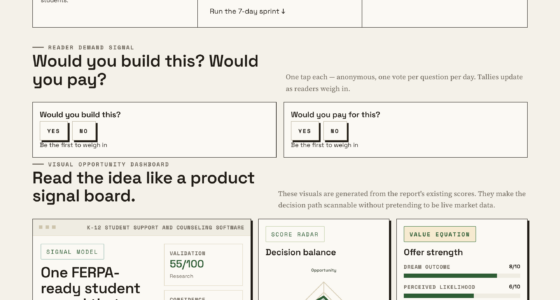
📊 Full opportunity report: What You Need To Know About Benefit Check Bots And Public Benefits Access on IdeaNavigator AI — validation score, market gap, and execution plan.

Get smart everyday buys delivered free with Prime
- Fast, free delivery on millions of items
- Prime Video, Amazon Music and more included
- Member-only deals all year
TL;DR

Benefit check bots are emerging as a tool for healthcare systems and nonprofits to efficiently identify eligible low-income clients for benefits like SNAP and Medicaid. This development responds to gaps left by nonprofit closures and increased redeterminations. The technology is still being tested and validated for accuracy and impact.
Benefit check bots are being developed and piloted to help healthcare providers, clinics, and nonprofits quickly identify low-income clients likely eligible for multiple public benefits. This innovation aims to address longstanding challenges in benefits access, especially after the shutdown of a major nonprofit and the surge in eligibility redeterminations following the pandemic.
The benefit check bot is a white-label conversational screening tool that can be embedded on websites or used via SMS, asking clients a series of yes/no and multiple-choice questions. It then provides a list of likely-eligible programs such as SNAP, Medicaid, EITC/CTC, WIC, and LIHEAP, along with estimated benefits and next-step application links. The tool is designed for use by clinics, community nonprofits, and benefits navigators, with initial testing planned in two states over 4 to 6 weeks.
Its development comes after the closure of Benefits Data Trust, a 20-year nonprofit that had been screening and enrolling clients across seven states, leaving a significant gap in benefits access capacity. Meanwhile, post-pandemic Medicaid redeterminations have led to millions of eligibility checks, increasing demand for efficient screening solutions. The conversational AI technology makes it feasible to deliver multilingual, multi-program screening at near-zero marginal cost, reducing reliance on expensive human call centers.
Early validation efforts will measure whether the bot reduces screening time, increases identification of eligible clients, and maintains accuracy compared to manual screening. The goal is to secure at least three paid pilot organizations willing to test the tool and provide feedback on its performance and usability.
Why Benefit Check Bots Matter for Public Benefits Access
This development is significant because it addresses a critical gap in benefits access for low-income families, who leave over $100 billion in eligible benefits unclaimed each year, according to estimates. By automating and streamlining eligibility screening, these bots could dramatically improve the efficiency and reach of benefits programs, reducing administrative burdens on clinics and nonprofits while increasing client enrollment in vital assistance programs.
Furthermore, the shift away from reliance on nonprofit screening agencies—many of which have shuttered—places greater importance on scalable, automated solutions. The use of conversational AI could also enhance multilingual access, helping non-English speakers navigate complex eligibility rules more effectively. Overall, this innovation could lead to higher benefit uptake, better health and economic outcomes for vulnerable populations, and more efficient use of public resources.
As an affiliate, we earn on qualifying purchases.
Background on Benefits Access Challenges and Technological Innovation
Over the past decade, low-income families have faced fragmented eligibility rules across federal, state, and local programs, making benefits access cumbersome. The shutdown of Benefits Data Trust in 2024 removed a key capacity for screening and enrollment, exacerbating existing gaps. Concurrently, the pandemic prompted a surge in Medicaid redeterminations, with tens of millions of Americans undergoing eligibility reviews, often leading to temporary or permanent disenrollment from Medicaid and other programs.
Traditional screening methods rely heavily on manual processes, caseworker intervention, and paper-based applications, which are time-consuming and prone to errors. The advent of conversational AI and SaaS-based screening tools offers a promising alternative, enabling real-time, multilingual, and multi-program eligibility assessments at minimal cost. Pilot programs and early testing are underway to evaluate these tools’ effectiveness in real-world settings, with initial focus on two states and a handful of clinics and nonprofits.
Medicaid application assistance software
As an affiliate, we earn on qualifying purchases.
As an affiliate, we earn on qualifying purchases.
Uncertainties About Accuracy and Adoption Rates
It is not yet clear how accurately the benefit check bots will perform across diverse populations and complex eligibility rules. Early validation efforts will assess whether the tool can reliably identify clients who are likely eligible for benefits and whether it can replace or supplement manual screening without significant errors. Additionally, the level of adoption by clinics, nonprofits, and government agencies remains uncertain, as organizations may face barriers related to integration, training, and trust in AI-based tools.
As an affiliate, we earn on qualifying purchases.
Next Steps in Pilot Testing and Evaluation
The next phase involves deploying the benefit check bot in 5-10 benefits navigation settings across two states, with each organization screening over 100 clients. Data collected will evaluate the tool’s impact on screening time, accuracy, and client outcomes. Based on results, developers plan to refine the technology, expand to additional states, and develop broader deployment strategies. Success in pilot testing could lead to wider adoption and integration into existing benefits access workflows.
As an affiliate, we earn on qualifying purchases.
Key Questions
How does the benefit check bot improve current screening methods?
The bot automates the screening process by asking clients questions and providing instant eligibility estimates, reducing time and manual effort compared to traditional paper or call-based methods.
Will the benefit check bot work for non-English speakers?
Yes, the technology is designed to support multilingual screening, which can help non-English speakers access benefits more easily.
What programs can the bot screen for?
Initially, the bot will focus on programs like SNAP, Medicaid, EITC/CTC, WIC, and LIHEAP, with plans to expand coverage based on pilot results and user feedback.
When will the benefit check bot be widely available?
Wider deployment depends on pilot outcomes, but if successful, developers aim to expand to additional states and organizations within the next year.
Are there concerns about the accuracy of AI-based screening?
Yes, accuracy is a key focus of ongoing validation efforts. Early results will determine whether the tool can reliably identify eligible clients or if manual checks are still necessary.
Source: IdeaNavigator AI
Halloween Picks
halloween
As an affiliate, we earn on qualifying purchases.