🔍 Read the full analysis: How To Choose Among The 10 Best External GPUs For AI In 2027 on ThorstenMeyerAI.com

Get smart everyday buys delivered free with Prime
- Fast, free delivery on millions of items
- Prime Video, Amazon Music and more included
- Member-only deals all year
TL;DR
A buyer’s guide from ThorstenMeyerAI.com compares 10 external GPU options for AI workloads, emphasizing the tradeoff between Thunderbolt compatibility and OCuLink bandwidth. Its rankings and throughput figures are claims in the guide, not independently verified results; current 2027 availability, pricing and AI benchmarks remain unclear.
ThorstenMeyerAI.com has published its original external GPU guide, recommending buyers match a dock or enclosure to their computer’s connection before paying for a graphics card. The guide favors the Razer Core X V2 for broad Thunderbolt compatibility, while identifying OCuLink-based docks as higher-bandwidth choices for compatible systems; its ranking and performance figures have not been independently verified in the source material.
The guide’s central distinction is between enclosures that need a separate graphics card and integrated systems that arrive with a GPU. It names the Razer Core X V2 as its general-use pick, the ASUS ROG XG Mobile as a proprietary integrated option, and the MINISFORUM DEG1 as a lower-cost OCuLink dock aimed at technical users. Each choice carries a different mix of compatibility, upgrade flexibility and setup effort.
ThorstenMeyerAI.com says Thunderbolt 4 is rated at 40Gbps, with an effective data rate of 32Gbps, while its guide describes OCuLink as a PCIe 4.0 x4 connection offering up to 63Gbps. Those figures concern connection bandwidth, not guaranteed AI throughput. The article does not provide a reproducible benchmark method or task-specific results for model training, inference or other AI workloads.
The remaining names in the guide’s 10-item lineup are the NIMO RX 7600M XT, OwlTree and RGEEK docks, plus four other products not identified in the supplied source material. The guide characterizes the NIMO as a ready-to-use AMD-based box and OwlTree and RGEEK options as DIY docks requiring separate components. Because the source excerpt does not name all 10 picks, a complete product-by-product comparison cannot be established from it.
The 10 picks
- 1
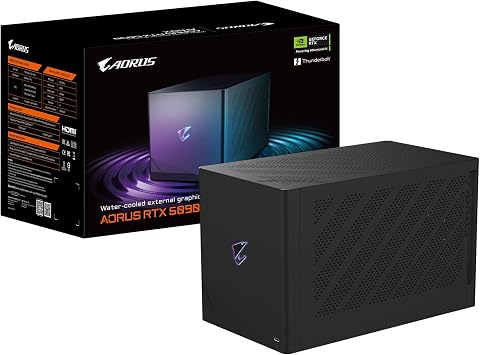 GIGABYTE AORUS RTX 5090 AI Box External GPUView on Amazon →
- 2
 ASUS ROG XG Mobile (2025) External Graphics Card with NVIDIA GeForce RTX 5090View on Amazon →
- 3
 NIMO External Graphics Card Enclosure with AMD Radeon RX 7600M XTView on Amazon →
- 4
 NIMO External GPU Docking Station with AMD Radeon RX 7600M XT 8GB GDDR6View on Amazon →
- 5
 Razer Core X V2 External Graphics Enclosure (eGPU)View on Amazon →
- 6
 MINISFORUM DEG1 OCuLink eGPU DockView on Amazon →
- 7
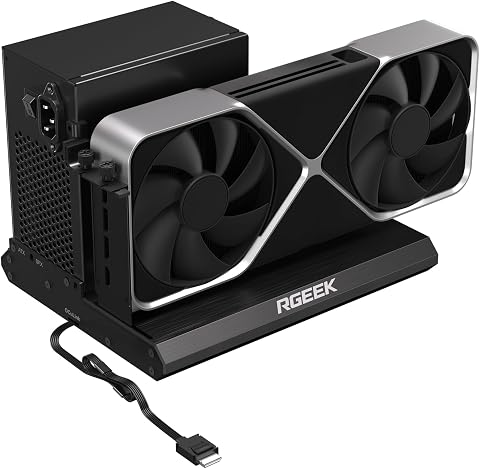 RGEEK PCIe 5.0 OCuLink eGPU Dock for External Graphics CardsView on Amazon →
- 8
 OCuLink PCIe 4.0 x4 eGPU Dock with 19.7-Inch CableView on Amazon →
- 9
 OwlTree PCIe 4.0 x4 eGPU Dock with OCuLink CableView on Amazon →
- 10
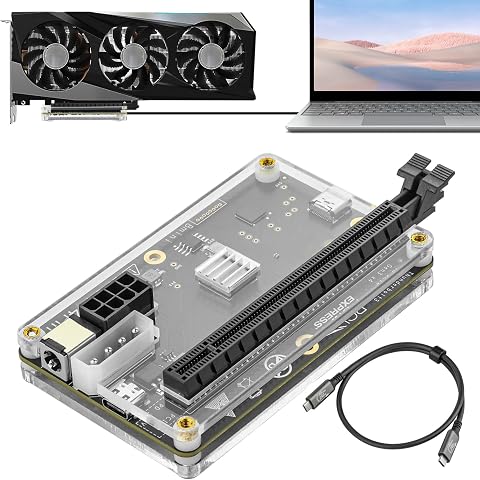 OwlTree PCIe 3.0 x16 eGPU Dock with Thunderbolt 4 CableView on Amazon →
Connection Limits Shape AI Setups
The guide highlights a practical purchasing issue: an external GPU’s performance depends not only on the GPU but also on the connection to the host computer. A high-end card connected through a bandwidth-limited interface may not deliver the performance a buyer expects, while a faster OCuLink dock is useful only if the laptop or mini PC has a compatible port.
For AI users, the decision also affects cost and upgradeability. A bare dock can leave buyers paying separately for the GPU, power supply and cables; an integrated device is simpler but may restrict future upgrades. The guide’s advice is useful as a checklist, but buyers should seek AI-specific benchmarks and confirm compatibility before treating its rankings as evidence of performance.
Products Worth Considering

Samsung 34-Inch Odyssey G5 Curved Ultra WQHD Gaming Monitor, 180Hz

Dell UltraSharp 27 Thunderbolt Hub Monitor (U2726DER), QHD

Logitech MX Master 4 for Mac
As an affiliate, we earn on qualifying purchases.
How the Guide Frames Its Picks
ThorstenMeyerAI.com says it assessed products using bandwidth, compatibility and total cost of ownership. Its stated ranking approach gives ease of use priority for general buyers, while placing more emphasis on connection speed for enthusiasts with OCuLink-capable hardware. Integrated devices are judged partly on their performance relative to size, despite restrictions on upgrades.
The guide also advises checking power delivery and portability. Some Thunderbolt setups can charge a laptop through the connection, but buyers need to confirm their computer and cable support the required power level. OCuLink docks generally use separate power and may require a separate laptop charger. Larger enclosures and exposed DIY docks may be better suited to a fixed desk than regular travel.
“The Razer Core X V2 stands out as the best overall choice for most users due to its universal Thunderbolt 4 compatibility and robust build, though it requires a separate graphics card.”
— ThorstenMeyerAI.com guide
Prices and Benchmarks Need Checking
The supplied material does not identify all 10 products, provide a publication date, list current prices, or establish whether each model will be sold in 2027. It also does not show independent test results for AI workloads, including memory capacity, software compatibility, sustained performance or power use. The cited bandwidth figures are presented by the guide, and the excerpt does not explain their measurement method; its stated 15–20% bottleneck estimate for some Thunderbolt setups also lacks a named test or workload.
It is also unclear whether every device supports the reader’s particular laptop, operating system and GPU configuration. Buyers should verify port type, firmware and driver support, power requirements, GPU dimensions and return terms with manufacturers or sellers. The article’s use of “best” represents its editorial ranking, not a universal result.
Verify Before You Buy
The next step for readers is to compare the guide’s recommendations with current manufacturer specifications and local listings, then confirm that the host computer has the required Thunderbolt, USB4 or OCuLink connection. AI users should look for benchmarks using their intended software and workload rather than relying on connection bandwidth alone.
A more complete comparison would name all 10 products, report prices and test conditions, and measure supported AI tasks across compatible systems. Until those details are available, the guide is best treated as a starting point for checking fit and costs, not a definitive 2027 performance ranking.
Key Questions
Which external GPU does the guide recommend for most users?
ThorstenMeyerAI.com names the Razer Core X V2 as its general-use choice, citing Thunderbolt 4 compatibility. It is an enclosure, so buyers must also obtain a compatible graphics card.
Is OCuLink faster than Thunderbolt 4 for an external GPU?
The guide describes OCuLink as a higher-bandwidth connection, citing up to 63Gbps against Thunderbolt 4’s 40Gbps rating. That comparison is not an AI benchmark, and OCuLink requires a compatible port on the host computer.
Does the source identify all 10 products?
No. The supplied excerpt names the Razer Core X V2, ASUS ROG XG Mobile, MINISFORUM DEG1, NIMO RX 7600M XT, OwlTree and RGEEK options, but does not identify four other picks.
What should AI buyers verify before purchasing?
Check the computer’s port and compatibility, the GPU’s memory and software support, power and charging requirements, total cost, and benchmarks for the intended AI workload. The guide does not provide enough test detail to confirm its rankings for every use case.
Source: ThorstenMeyerAI.com