🔍 Read the full analysis: 12 AI Tools To Help Simplify Your Workflows In 2027 on ThorstenMeyerAI.com

Get smart everyday buys delivered free with Prime
- Fast, free delivery on millions of items
- Prime Video, Amazon Music and more included
- Member-only deals all year
TL;DR
A roundup published by ThorstenMeyerAI.com presents 12 AI productivity tools and learning resources for tasks such as writing, meeting notes and workflow planning. It names Google Gemini AI Workspace as its broad workflow pick and Conference Notes App as its focused meeting option, while emphasizing that fit depends on the task and setup. The source does not provide independent performance tests, pricing, or detailed feature verification for every pick.
ThorstenMeyerAI.com has published a 12-pick guide to AI productivity tools and learning resources for writing, meeting notes, prompt development and workflow planning, as detailed in the original analysis. The roundup names Google Gemini AI Workspace as its leading workflow-oriented choice and Conference Notes App as a more task-specific option. It says the appropriate choice depends on the work a reader wants to address.
The guide treats the picks as different kinds of solutions, rather than presenting all 12 as interchangeable apps. It describes AI Writer Pro as a writing-focused choice and SmartPrompt as a tool for improving the instructions used to generate text. It also includes a conference-notes product, a broad Google Gemini workflow resource, an AI workflow automation roundup, and handbooks about Gemini and Microsoft 365. The source material does not name every pick or give a complete product-by-product feature list.
ThorstenMeyerAI.com says it ranked options by how clearly they support a repeatable productivity task, the practical guidance they provide and whether their scope matches the work they claim to help with. It says focused use cases received more weight than broadly named assistants whose roles were less clear from the available information. The order is described as a judgment about usefulness across common work needs, not a claim that one choice suits everyone.
The guide also distinguishes software from learning resources. An app may assist during a task; a handbook or directory can help someone plan or learn a process, much like guides to AI workflow automation, but the reader still has to apply that material. It advises testing a tool on a real draft, meeting or workflow and judging the finished result, including the time required to review and correct it.
The 12 picks
- 1
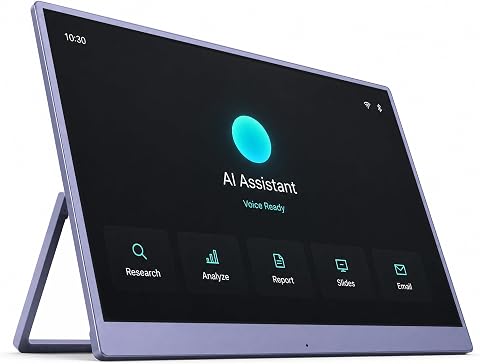 VAIMI AI Companion Hub with 15.6-Inch DisplayView on Amazon →
- 2
 The Complete Microsoft 365 and Copilot Handbook, Volume I: Core Apps and AI-E…View on Amazon →
- 3
 Aulax Smart AI Productivity, Writing, and Assistant AppView on Amazon →
- 4
 The Google Gemini AI Workspace: Build Smart AI Workflows, Automate Tasks, Cre…View on Amazon →
- 5
 The Complete Guide: The Ultimate Directory of 5,000+ Apps in 500+ Categories…View on Amazon →
- 6
 AI Writer Pro: Write SmartView on Amazon →
- 7
 SmartPrompt – AI Prompt Generator & EnhancerView on Amazon →
- 8
 AI NotebookView on Amazon →
- 9
 AIO AI ApexView on Amazon →
- 10
 GPT AI Chatbot: Chat, RPG Games, and AI AssistantView on Amazon →
- 11
 AI AssistantView on Amazon →
- 12
 Conference Notes AppView on Amazon →
Choosing Tools Around Daily Tasks
The roundup identifies workflow fit as a selection factor. A general assistant may support varied tasks, while users may need to develop prompts and routines to use it for specific work. A focused product may have a more defined role for people seeking meeting-note or writing support. The guide recommends considering whether a tool reduces work or adds setup and review.
The guide also highlights practical adoption questions: whether a tool fits existing documents and calendars, how information can be moved in and out, and how much ongoing maintenance is required. It recommends checking data handling terms and workplace rules before submitting sensitive meeting details or internal drafts. These are selection criteria in the source, not claims that any named product meets a particular privacy or security standard.
Products Worth Considering

Dell XPS 13 9345 Laptop, 13.4-Inch FHD+ 120Hz, Snapdragon X Elite, 32GB RAM, 1TB SSD

Dell XPS 13 9350 Laptop, 13.4-Inch WUXGA Display, Intel Core Ultra 7 256V, 16GB RAM, 1TB SSD

LG PuriCare AeroHit Smart Air Purifier for Large Rooms up to 1000 sq ft, True HEPA Filter with 360° Airflow, PM1.0 Sensor & LED Air Quality
As an affiliate, we earn on qualifying purchases.
How the Roundup Ranks Its Picks
The source frames this as a buyer’s guide, not a test of verified performance. Its stated method favors products or resources with a defined use case, while accounting for setup effort, overlap with existing software and uncertainty about broadly described products. The author says product names alone are not enough to infer capabilities and avoids assuming features that are not specified.
That limitation shapes what readers can take from the list. The source offers selection guidance and identifies several examples, but the supplied material does not include pricing, benchmark results, trial outcomes or a full list of all 12 names. Readers therefore cannot use it alone to compare every product on cost or demonstrated performance.
“The order reflects usefulness across common work needs, not a claim that one tool suits everyone.”
— ThorstenMeyerAI.com
What Product Details Are Missing
The supplied source material does not identify all 12 selections, provide detailed specifications for each, or state prices, release information or independent test results. It is also unclear which exact features and integrations are available in the products, and whether any have changed for 2027. The guide’s rankings and descriptions should therefore be read as its own assessment, not as independently verified product comparisons.
Readers should check current product documentation before making a decision, particularly for data handling, integrations and export options. The source recommends those checks but does not report findings for every provider.
Test a Real Work Task
The guide recommends choosing one recurring task, then testing a candidate tool with the reader’s own material. For a writing product, compare the draft and the time spent correcting it; for meeting notes, verify names, decisions and action items. A useful comparison includes the full process, from setup through review, rather than just the first output.
Before adopting a tool, users can check how it fits current software, whether results can be retrieved or exported, and whether its data practices meet workplace requirements. The source does not announce a follow-up test or a next publication date, so no further milestone is specified.
Key Questions
Which tool does the roundup rank as its leading workflow choice?
The source names Google Gemini AI Workspace as its leading workflow-oriented pick, describing it as focused on building a personal system with Google Workspace. It does not claim the option suits every user.
Which pick is aimed at meeting notes?
Conference Notes App is described as the most task-specific option in the lineup, particularly for frequent note-takers. The supplied material does not provide detailed feature specifications.
Are all 12 picks software apps?
No. The roundup includes learning resources, including an automation directory and Gemini and Microsoft 365 handbooks. Those can inform planning but do not perform tasks as software does.
How should readers decide whether a tool is useful?
Test it on a real recurring task and count the time needed for setup, corrections and review. The guide says to judge the finished, usable result rather than the speed of the initial response alone.
Source: ThorstenMeyerAI.com