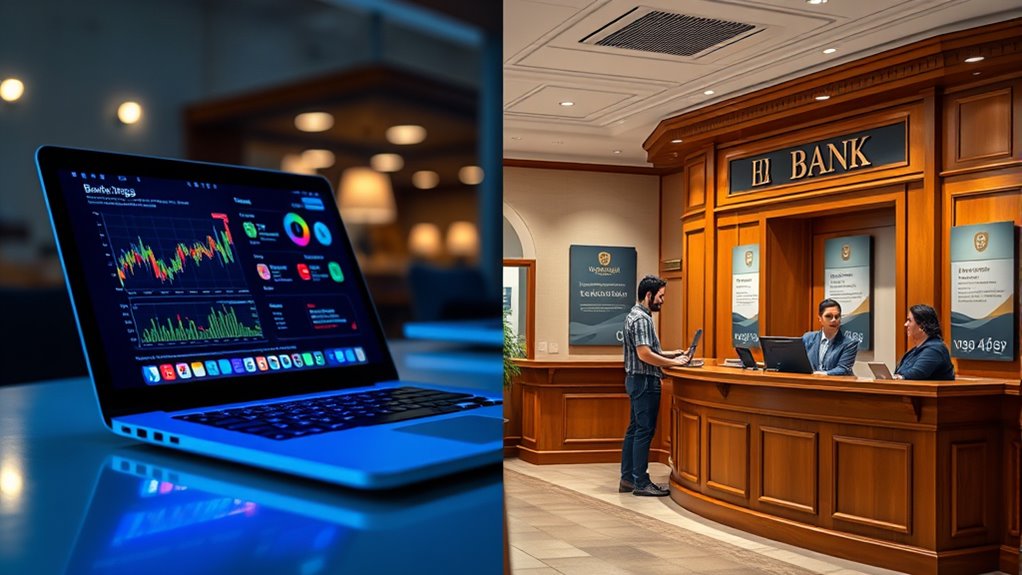

Choosing between online banks and traditional banks depends on what you value most. If you want lower fees, higher interest rates, and 24/7 digital access, online banks are a great fit. But if you prefer in-person service, all-inclusive financial products, and more cash handling options, a traditional bank might suit you better. Consider your priorities, and if you’re curious about the pros and cons of each, there’s plenty more to explore below.

Get smart everyday buys delivered free with Prime
- Fast, free delivery on millions of items
- Prime Video, Amazon Music and more included
- Member-only deals all year
Key Takeaways
- Online banks offer higher interest rates and lower fees, making them ideal for savers and cost-conscious customers.
- Traditional banks provide in-person services and extensive branch networks for personalized, face-to-face assistance.
- Online banks enable 24/7 account access and instant digital transactions, suitable for tech-savvy users.
- Traditional banks often have a broader range of financial products like mortgages and loans, with physical service options.
- Choose based on your preference for convenience and digital tools versus in-person support and comprehensive services.

When choosing between online banks and traditional banks, understanding their key differences can help you make an informed decision. Traditional banks rely on physical branches and extensive ATM networks, making it easy for you to visit in person, deposit cash, or access safe deposit boxes. You can walk into a branch for personalized service, speak directly with a banker, and handle complex transactions face-to-face. They also offer in-person customer support and a variety of financial products like mortgages, loans, and investment services. However, their infrastructure costs lead to higher fees, and their service can sometimes be slower due to legacy systems. Traditional banks also often require minimum balances or charge maintenance fees, which can add to your costs over time.
Traditional banks offer in-person service, physical branches, and comprehensive financial products but tend to have higher fees and slower service.
Online banks, on the other hand, operate exclusively through digital platforms—websites and mobile apps. They don’t have physical branches, which means you can’t visit a branch, but they provide 24/7 access to your accounts from any device connected to the internet. While cash handling is more complicated—requiring workarounds like partner networks or third-party ATMs—they often reimburse ATM fees nationwide, giving you more flexibility. Because they lack physical infrastructure, online banks typically charge lower fees or no monthly maintenance fees at all, and they often have no minimum balance requirements. This makes them more affordable, especially if you’re trying to avoid monthly fees or maintain a lower balance.
Interest rates and savings are another significant difference. Traditional banks tend to offer very low APYs—sometimes as low as 0.01%—which means your savings grow slowly over time. Online banks, however, usually provide high-yield savings accounts with APYs around 4%, thanks to their lower overhead costs. This can make a big difference in your savings growth, especially over the long term, thanks to the power of compound interest. Both types of banks are insured by the FDIC up to $250,000 per depositor, so your money remains protected regardless of where you bank.
Customer service experiences also differ. Traditional banks offer face-to-face interactions, allowing you to get personalized advice or resolve complicated issues directly at a branch. They also provide a full suite of services like safe deposit boxes, cashier’s checks, and notary services. Online banks rely on digital support—chat, email, or phone—and don’t have physical locations. They may lack certain services, especially for business banking, but they excel in speed, innovation, and digital tools. Many online banks integrate with accounting software and payment platforms, offering features like real-time notifications and instant transfers, making your banking experience more seamless.
In essence, choosing between an online or traditional bank depends on your priorities—whether you value in-person service, cash handling, and a broad product range, or prefer lower fees, higher interest rates, and digital convenience.
Frequently Asked Questions
How Do Online Banks Handle Customer Service Issues?
Online banks handle customer service issues through various channels like live chat, email, and phone support. You can usually access help quickly via their mobile apps or websites, and many offer 24/7 support for urgent concerns. While they may not have physical branches, they prioritize prompt responses and efficient problem-solving to guarantee your banking experience remains smooth and convenient.
Are Online Banks Insured Like Traditional Banks?
Yes, online banks are insured, just like traditional banks. You’re protected by the same safeguards, such as FDIC insurance in the U.S., which insures deposits up to $250,000. This means your money stays safe and secure, whether you bank online or in person. You can confidently connect with online banks, knowing your funds are protected by the same steadfast safeguards that secure traditional banking treasures.
What Are the Best Online Banks for Small Business Accounts?
You should consider online banks like BlueVine, Novo, and Azlo for your small business accounts. They offer low or no fees, easy digital management, and often integrate seamlessly with accounting software. These banks focus on small businesses, providing features like free checking, quick approval processes, and excellent customer support. While choosing, verify they meet your specific needs, such as payroll services, payment processing, or international transactions.
Can I Access All ATM Networks With Online Banks?
You might not have access to all ATM networks with online banks, but many partner with major networks like Visa or Mastercard to offer extensive ATM coverage. Check your chosen online bank’s ATM network partnerships before opening an account. Often, they waive ATM fees for certain ATMs or reimburse fees from other networks. So, while you may not get unlimited access everywhere, you’ll typically find plenty of convenient options nearby.
How Do Online Banks Protect Against Cyber Fraud?
Online banks protect against cyber fraud like a fortress guards its treasure. They use multi-layered security measures such as encryption, two-factor authentication, and real-time fraud monitoring. You’re prompted to verify your identity with unique codes or biometric data, making unauthorized access nearly impossible. These banks also regularly update their security protocols to stay ahead of threats, ensuring your money and personal information stay safe from cybercriminals.
Conclusion
Ultimately, whether you choose an online bank or a traditional one depends on what suits your needs best. Online banks offer convenience and often better rates, making them perfect for tech-savvy folks like yourself. Traditional banks provide face-to-face service and a sense of security, akin to the trusty steed in a medieval quest. Whichever path you take, just remember, in this digital age, flexibility and comfort should guide your decision—no need to saddle up for a journey you’re not prepared for.
Fall Picks
fall essentials
As an affiliate, we earn on qualifying purchases.