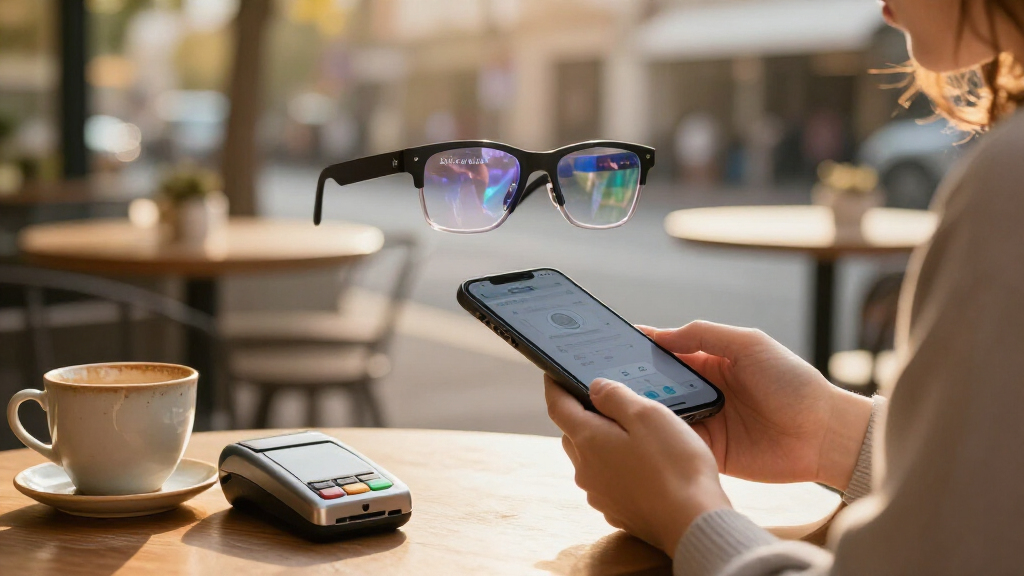

🔍 Read the full analysis: XREAL AURA And Google’s Android XR Glasses: Uses, Costs, And Privacy on ThorstenMeyerAI.com

Get smart everyday buys delivered free with Prime
- Fast, free delivery on millions of items
- Prime Video, Amazon Music and more included
- Member-only deals all year
TL;DR
Google and XREAL launched AURA on October 28, 2026, as wired glasses running Android XR, with Gemini features and prices starting at $1,099 through December. The glasses are available for order in a limited set of markets, but battery life and details about XREAL’s always-on visual processing remain unclear.
Google and XREAL launched AURA on October 28, a pair of wired, see-through glasses running Google’s Android XR operating system. The device starts at $1,099 during a limited-time offer and includes Gemini features that can respond to the wearer’s view when sharing is enabled, bringing both practical questions about everyday use and privacy concerns into focus.
AURA places two small displays in glasses that let users look directly through the lenses at the surrounding room. The frames weigh under 95 grams; a separate, wired puck weighing 265 grams houses the processor, battery, fan and controls. XREAL lists a 70-degree field of view and Sony micro-OLED displays with 1,920-by-1,200-pixel resolution per eye and refresh rates up to 120 Hz. The glasses use Qualcomm’s Snapdragon Reality Elite chip, according to the supplied product information.
Google and XREAL describe AURA as a device for work, entertainment and XR apps. Users can place Android apps around them, connect a keyboard and mouse, watch video on a virtual screen or connect a laptop by USB-C. XREAL says its Wired Mirroring feature can show a laptop display in a movable window without installing software. The product supports Android apps from Google Play as well as more than 150 apps made for XR, according to the companies.
Gemini can help organize apps or answer questions about digital content. If users turn on view sharing in the Gemini app, Gemini Live can also receive what is visible through the device and respond to questions about the room. Google’s help page gives asking which fruit has the most fiber as an example; Gemini may mark a relevant item with a box. The company advises users to get permission before including other people in a shared view.
The promotional prices through December 2026 are $1,099 for 12 GB of memory and 256 GB of storage, and $1,299 for the 16 GB/512 GB model. XREAL’s regular prices are listed as $1,279 and $1,499. The company says customers who bought at the earlier prices will receive the difference. Orders opened October 28 in the United States, Canada and South Korea; Japan orders are due to open November 2. Shipping is scheduled to begin in mid-November, and buyers must be at least 18.
Infographic 01 · XREAL AURA in plain words
Light glasses, a heavy puck, and Gemini in between.
AURA splits the device in two: what has to sit on your face, and what can ride in your pocket. All figures are XREAL’s and Google’s own.
On your head: the glasses
You see the real room through the lenses. The apps float on top.
- Two Sony micro-OLED displays, 1920 × 1200 pixels per eye, up to 120 Hz
- Lenses darken in five steps, by hand or automatically
- Two tracking cameras for your hands and position
- One high-resolution camera with a privacy LED
- Speakers next to each ear, four microphones
- Two sizes for the distance between your eyes, prescription lenses possible
In your pocket: the puck
The heavy parts, on a cable.
- Qualcomm Snapdragon Reality Elite chip (debuts in AURA)
- 12 GB / 256 GB or 16 GB / 512 GB
- 4,455 mAh battery, a small fan
- Touchpad and fingerprint button
- Second USB-C port: power, or a laptop’s video signal (“Wired Mirroring”)
What Gemini does
- Helps across your apps and windows
- With view sharing on: sees your screens and the room
- Can mark an object with a box
Google docs
Makers’ claims
- “3 ms” motion-to-photon latency
- “48 TOPS” of AI processing
- “Always-on AI visual processing” in the X1S chip, not explained
vendor figures
Not published
- An official battery-life figure
- Independent full reviews (only demos so far)
- Prices in Canada, Japan, Korea in this article
XREAL told Android Authority: about 4–5 h of streaming (single source).
A laptop screen you wear like sunglasses, with the computer in your pocket.Thorsten Meyer · my reading
Sources: XREAL specs, accessed 29 Oct 2026; XREAL, 28 Oct 2026; Google, 28 Oct 2026; Android Authority, 6 Sep 2026.
Powered by Thorsten Meyer AI
A Lighter Alternative With Trade-Offs
AURA offers a different approach from enclosed mixed-reality headsets: users see the actual room through transparent lenses rather than a camera feed of it. Its sub-95-gram glasses are much lighter to wear than headset-style devices, but the system still includes a separate 265-gram puck and a cable connecting it to the glasses. The product’s overall portability depends on whether users find that arrangement comfortable in daily use.
The launch price is below the listed starting prices for Apple Vision Pro, at $3,699, and Samsung Galaxy XR, at $1,799.99, according to the supplied source material. Those comparisons do not establish equivalent features or performance. AURA is a first-generation product, and the available hands-on reports described in the source were supervised demonstrations using pre-release units. There is not yet an official battery-life figure.
For workplaces, the camera and view-sharing feature make device policies a practical issue, not just a product preference. An employee may capture colleagues, documents or screens if sharing is active. Companies will need to decide where camera glasses are allowed and how people should give consent before the devices become part of routine work.
Products Worth Considering

Logitech MX Keys S Combo Wireless Keyboard and Mouse, Graphite

Dell XPS 13 13.4-Inch Touchscreen Laptop, Intel Core 5 320, 16GB RAM, 512GB SSD

Logitech MX Mechanical Wireless Illuminated Keyboard, Tactile Quiet, Graphite
As an affiliate, we earn on qualifying purchases.
How AURA Handles What It Sees
AURA differs from enclosed headsets such as Apple Vision Pro and Samsung Galaxy XR because its clear lenses let the wearer see the physical environment directly. Small displays overlay digital windows on that view. The electronics and battery sit in the wired puck rather than in the frames, a design that helps keep weight off the wearer’s head but requires carrying and connecting another device.
Google describes two distinct kinds of camera-related processing. Its Android XR help information says images used by the system’s hand-tracking feature are processed in real time and deleted, and are not stored on the device or sent to Google. Gemini view sharing is a separate, user-enabled feature: Google says it can include both digital content on the device and the physical space visible through it. For sharing the room on these wired glasses, the lenses must be clear rather than dimmed.
The launch follows XREAL’s October 7 announcement of a $1,279 starting price. At launch, the company introduced lower promotional pricing through December 2026. XREAL says it plans to expand availability to more countries in 2027, but has not provided dates in the supplied material.
“Users should ask people for permission before including them in their view.”
— Google’s help page
Camera Processing Needs More Detail
Some privacy controls are described: view sharing is off until users turn it on, can be switched off, and may require renewed consent after being disabled in Gemini settings. The source also says the device has a privacy light and reports that Gemini activity is kept for 18 months by default. The supplied material does not specify exactly when the light activates or provide a full explanation of the activity-retention setting and its scope.
A separate question concerns XREAL’s description of the X1S chip as handling “always-on AI visual processing.” The supplied source reports no explanation from XREAL about whether that processing uses the camera continuously, what data it handles, or how it relates to the privacy light and Gemini. Google’s statement about deleted hand-tracking images does not resolve those questions because it addresses a specific tracking function. Battery life, performance outside supervised demonstrations and the date of wider international availability also remain unconfirmed.
Shipping and Further Privacy Answers
Orders are scheduled to open in Japan on November 2, with shipping expected to start in mid-November. The limited-time prices are set to run through December 2026. XREAL has said availability will expand to additional countries in 2027 but has not announced a schedule.
Buyers and organizations evaluating AURA will need further information about battery life and the X1S chip’s visual processing. Until XREAL provides more detail, the precise camera behavior and data handling beyond the functions described by Google remain open questions. Businesses considering the glasses will also need rules for camera use, view sharing and consent in shared spaces.
Key Questions
What is XREAL AURA?
AURA is a wired pair of see-through XR glasses running Google’s Android XR software. Its displays overlay apps on the wearer’s view of the real room, while a separate puck holds the main electronics and battery.
How much does AURA cost?
Through December 2026, the listed promotional prices are $1,099 for the 12 GB/256 GB model and $1,299 for the 16 GB/512 GB model. XREAL lists regular prices of $1,279 and $1,499, respectively.
Can Gemini see through the glasses?
Gemini can receive the wearer’s view when view sharing is enabled in the Gemini app. Google says this may include digital content and physical surroundings; users can turn sharing off and should ask permission before including other people.
Where and when can customers order AURA?
Orders opened October 28 in the United States, Canada and South Korea. Japan orders are scheduled to open November 2, with shipping expected to begin in mid-November. XREAL has not given dates for additional markets planned for 2027.
What privacy details are still unknown?
XREAL has not explained what its description of the X1S chip’s “always-on AI visual processing” means for camera activity, the privacy light or data handling. The source also reports no official battery-life figure.
Source: ThorstenMeyerAI.com