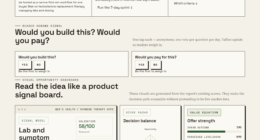

📊 Full opportunity report: Should You Use Mistral Forge? A Buyer’s Decision Guide on ThorstenMeyerAI.com — validation score, market gap, and execution plan.

Get smart everyday buys delivered free — and shop member deals
- Fast, free delivery on millions of items
- Access to Prime Big Deal Days deals on October 6–7
- Prime Video, Amazon Music and more included
TL;DR
Mistral Forge is a powerful, full-lifecycle AI development platform suited for specific high-stakes use cases. Most organizations should not choose it unless they meet four strict conditions, including data sovereignty and technical maturity. This guide helps buyers determine if Forge is right for them.
Mistral Forge is a high-end, sovereign AI model development platform designed for specific use cases. However, most organizations should not use it, as it is best suited for entities with strict data sovereignty needs, mature data management, and complex proprietary knowledge. This guide explains who Forge fits, when alternatives are better, and red flags indicating it’s not the right choice.
According to industry analysts, most organizations should avoid Mistral Forge unless they meet four specific conditions: their data is too sensitive for third-party APIs, they require strict sovereignty (on-premises, non-US vendor, or data residency), their proprietary knowledge must genuinely influence model reasoning, and they possess the data maturity to manage training and evaluation processes. Forge is a capable, full-lifecycle platform that excels in high-consequence, regulated environments such as government, finance, or industrial sectors.
However, for organizations lacking these conditions, Forge is likely an unnecessary expense. Cheaper and simpler tools, like retrieval-augmented generation (RAG) or fine-tuning with open-source models, often suffice for internal knowledge management, document search, or support functions. The platform’s sophistication makes it suitable only for specific, high-stakes use cases where deep domain adaptation and strict data control are essential.
Should you use Mistral Forge? A buyer’s decision guide
Forge isn’t overrated — it’s over-reached-for. A scalpel for a specific, high-value incision, wrong for most jobs. Here’s the honest filter: who it fits, what to use instead, and the red flags that mean “not this, not now.”
- Gov / defense — language, law, process; air-gapped
- Regulated finance — compliance internalized
- Industrial / mfg — specialist constraints & data
- Telecom · deep-code tech — proprietary specs / codebase
- …but only the data-mature, high-consequence, sovereign ones
- You want an assistant / doc-search / support bot → RAG
- Knowledge changes often or must be cited/deleted → RAG
- Low data maturity — fix the data first
- You need cheap, fast, easily updatable
- Small org · no ML capacity · no sovereignty need
- Can’t answer IP / portability / lock-in questions
- No PoC beating a RAG + fine-tune baseline
Forge is a precise instrument for deep domain reasoning + sovereignty + lifecycle control, for orgs mature enough to wield it. For the vast majority the honest answer is not Forge, not yet, maybe never — and that’s fit, not failure. Even the sovereignty-driven buyer has a lighter, reversible choice in self-hosted open weights. The discipline isn’t picking the most powerful tool — it’s matching the tool to the job, the data, and the maturity you actually have, and demanding proof before you commit. Sequence for almost everyone: 1 prompt + RAG → 2 targeted fine-tune → 3 Forge only if a measured gap remains. Climb, don’t leap.
Why Forge’s Fit Criteria Matter for Enterprise AI
This matters because choosing the wrong AI platform can lead to wasted resources, compliance risks, or operational failures. Forge’s high cost and complexity are justified only when organizations face strict sovereignty, sensitive data, and complex proprietary knowledge. Misapplication of Forge outside these scenarios can hinder agility, inflate costs, and complicate updates, making it critical for buyers to carefully evaluate their needs before adoption.
on-premises AI model development platform
As an affiliate, we earn on qualifying purchases.
As an affiliate, we earn on qualifying purchases.
Key Factors Behind Forge’s Target Audience and Use Cases
Industry analysts note that Forge is best suited for sectors with high-consequence AI needs, such as government agencies, regulated financial institutions, and industrial firms with proprietary engineering data. Its deployment is typically air-gapped or on-premises, with strict control over data and models. The platform’s design emphasizes sovereignty, domain-specific reasoning, and compliance, aligning with organizations that have mature data management and ML capabilities. Most organizations, however, lack the data maturity or sovereignty constraints, making simpler, more flexible tools preferable.
Previously, organizations have struggled with balancing data privacy, model control, and cost. Forge aims to address these by offering a comprehensive, managed platform, but this only benefits a narrow segment of high-stakes users.
“Forge is designed for organizations with high-consequence AI requirements, offering full control and security.”
— A Mistral spokesperson
As an affiliate, we earn on qualifying purchases.
Unclear Aspects of Forge’s Deployment and Cost
It remains unclear how many organizations currently meet all four conditions for Forge’s optimal use. The specific cost implications, deployment complexities, and real-world performance across diverse sectors are still emerging. Additionally, the long-term flexibility of Forge in rapidly evolving AI landscapes is yet to be fully assessed.
enterprise AI model training software
As an affiliate, we earn on qualifying purchases.
As an affiliate, we earn on qualifying purchases.
Next Steps for Organizations Considering Forge
Organizations should conduct a thorough needs assessment against the four conditions outlined. For those fitting the profile, engaging with Mistral or certified partners for pilot projects can clarify deployment challenges and costs. For others, exploring less complex, more adaptable solutions like RAG or open-weight models may be more appropriate. Industry analysts recommend ongoing evaluation of data maturity and sovereignty needs as organizations evolve.
regulated environment AI solutions
As an affiliate, we earn on qualifying purchases.
As an affiliate, we earn on qualifying purchases.
Key Questions
What types of organizations should consider Mistral Forge?
High-consequence sectors such as government, regulated finance, industrial manufacturing, telecom, and deep-code tech firms that require strict data sovereignty, proprietary knowledge integration, and have mature data management capabilities.
Can Forge be used for internal document search or support bots?
No. Forge is not suited for knowledge retrieval or document search tasks. These are better served by RAG solutions or fine-tuned models with external document stores.
What are red flags indicating Forge is not suitable?
If your data isn’t mature, if you need frequent knowledge updates, or if your primary need is simple retrieval or support functions, Forge is likely not the right choice.
Are there cheaper or more flexible alternatives to Forge?
Yes. Open-source models with self-hosted infrastructure, combined with RAG or light fine-tuning, can provide sovereignty and control at a lower cost and with greater flexibility.
What should organizations do before adopting Forge?
Assess their data maturity, sovereignty requirements, and technical capacity. Consider pilot projects and consult with Mistral or partners to determine if Forge’s capabilities align with their high-stakes use cases.
Source: ThorstenMeyerAI.com
Evergreen bestsellers Picks
bestsellers
As an affiliate, we earn on qualifying purchases.