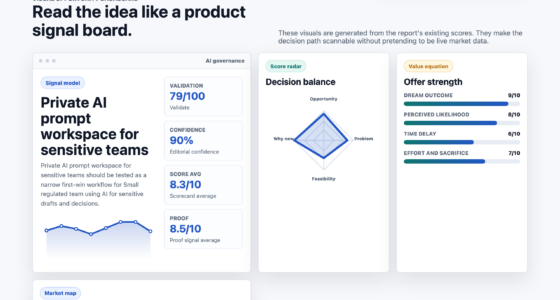
📊 Full opportunity report: Decoding AI Growth Through Cloud Computing Trends on ThorstenMeyerAI.com — validation score, market gap, and execution plan.

Get smart everyday buys delivered free with Prime
- Fast, free delivery on millions of items
- Prime Video, Amazon Music and more included
- Member-only deals all year
TL;DR
This article examines how patterns from cloud computing evolution shed light on AI industry growth and market dynamics. It highlights the potential for a few dominant players and the importance of building on top of foundational platforms.
Recent trends in cloud computing reveal a pattern that can help decode the growth and structure of the AI industry. Experts suggest that understanding these patterns is crucial for predicting future winners and market dynamics, as the AI sector continues to expand rapidly.
Market data shows the global cloud computing industry reached approximately $400 billion in 2025 and is projected to grow to nearly $778 billion by 2030. Contrary to earlier predictions of a monopoly or fragmented market, the cloud landscape has settled into a stable oligopoly dominated by three major players: Amazon Web Services (AWS) holding about 30–31%, Microsoft Azure around 24–25%, and Google Cloud near 12–13%. These firms together control roughly 67–68% of the market, with the remaining share fought over by smaller providers.
Importantly, the dominant cloud providers have fostered a vibrant ecosystem of companies building on top of their platforms. Notable examples include Snowflake, which runs on multiple clouds and competes directly with cloud providers’ own data solutions, and firms like Datadog, Cloudflare, Confluent, and MongoDB, which have grown significantly in layers above the hyperscalers. This pattern suggests that the most valuable companies in AI may not be the foundational labs but those that build neutral, multi-cloud solutions on top of them.
The cloud era was mispredicted in both directions by the sharpest investors alive. Both errors were the same mistake: dividing a fixed pie that was about to explode.
Implications of Cloud Market Structure for AI Dominance
The pattern of a small number of dominant cloud providers controlling the infrastructure, combined with a thriving ecosystem of independent companies, indicates that future AI leaders are likely to follow a similar model. This challenges the narrative of a single lab or company winning outright and emphasizes the importance of neutrality and ecosystem building. For investors and companies, understanding this structure is key to identifying where value will emerge in the AI era.
cloud computing platform for AI development
As an affiliate, we earn on qualifying purchases.
As an affiliate, we earn on qualifying purchases.
Lessons from Cloud Computing for AI Market Development
The evolution of cloud computing offers a blueprint for understanding AI industry growth. Initial predictions in 2007 and 2014 misjudged the market’s trajectory, but the eventual emergence of a stable oligopoly and a thriving ecosystem of companies building on top of cloud giants provided valuable lessons. These include the importance of market expansion rather than fixed-slice competition, the role of neutral platforms, and the value of specialized expertise in high-margin layers.
As the cloud market grew from $400 billion in 2025 to nearly $778 billion projected for 2030, the dominant players maintained stable shares, illustrating how a few large firms can coexist while fostering innovation and competition in adjacent layers. Applying these lessons to AI suggests that the most durable winners will likely be those who build on top of foundational models, offering neutrality and specialized capabilities.
"The cloud era teaches us that a small oligopoly of giants, complemented by a vibrant ecosystem of independent companies, is the natural market structure for platform-based industries."
— Thorsten Meyer
multi-cloud data integration tools
As an affiliate, we earn on qualifying purchases.
As an affiliate, we earn on qualifying purchases.
Unclear Aspects of AI Market Evolution
It remains uncertain whether the AI industry will follow the exact same pattern as cloud computing, especially as AI introduces new complexities such as proprietary data, model ownership, and ethical considerations. Additionally, the pace at which new dominant players emerge or existing giants consolidate remains unpredictable, and the role of regulation could significantly alter the landscape.
AI development software for enterprises
As an affiliate, we earn on qualifying purchases.
As an affiliate, we earn on qualifying purchases.
Next Steps in Monitoring AI and Cloud Trends
Stakeholders should watch for emerging companies that offer multi-cloud, neutral AI solutions, as well as regulatory developments that could reshape the market structure. Further analysis of how foundational models are adopted across sectors will clarify which business models are most sustainable. Continued market data collection and ecosystem mapping will be vital to understanding the evolving AI landscape.
As an affiliate, we earn on qualifying purchases.
Key Questions
Will a single AI lab dominate the industry?
Based on cloud market patterns, it is unlikely. The dominant model suggests a few large infrastructure providers with many specialized companies building on top of them.
Are "commodity" AI layers truly undifferentiated?
No. While they may appear similar from afar, specialized expertise in inference, fine-tuning, and orchestration creates significant barriers and value.
What role will regulation play in AI market structure?
Regulation could influence market dynamics, potentially favoring neutral, multi-platform companies or imposing constraints on dominant players, but the full impact remains uncertain.
How can new companies succeed in this landscape?
Building neutral, multi-cloud solutions and offering specialized, high-margin AI services aligned with existing infrastructure are promising strategies.
Source: ThorstenMeyerAI.com
Fall Picks
fall essentials
As an affiliate, we earn on qualifying purchases.