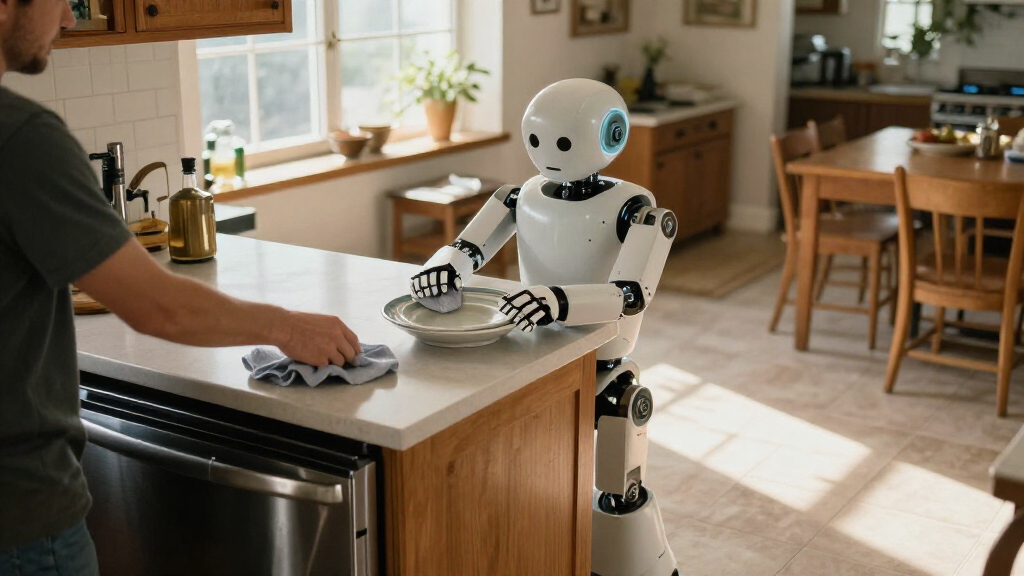

🔍 Read the full analysis: Could Humanoid Robots Take Household Chores Off Our Hands? on ThorstenMeyerAI.com

Get smart everyday buys delivered free with Prime
- Fast, free delivery on millions of items
- Prime Video, Amazon Music and more included
- Member-only deals all year
TL;DR
The Information reported on Oct. 31 that Meta and Chinese robotics company Fourier developed a humanoid prototype called Max in about three months. Meta has not announced the robot, and the reported company position is that the work is for internal research, with no plans to sell units. Reports do not establish that Max can reliably perform household chores.
Meta and Shanghai-based robotics company Fourier reportedly built a humanoid prototype called Max in about three months, according to a report by The Information published Oct. 31. The report describes a robot intended to support research into future home assistance, not a machine shown to be capable of doing household chores reliably; Meta has not announced Max and, according to the report, has no plans to sell the units.
Details attributed to The Information and repeated by Engadget, The Next Web and Investing.com describe Max as roughly five feet (1.5 metres) tall and weighing about 106 pounds (48 kilograms). It reportedly has a screen that can display facial expressions, speakers, five-fingered hands designed for handling small objects, and Nvidia’s Jetson Thor computer. Reuters said it could not immediately verify the report. Meta has published no announcement or technical information about the robot.
The Information reported that some Meta employees saw Max at an internal robotics summit in late August. Work on a follow-up, called Max 2, reportedly began in September. The next model is said to be in development with a redesigned torso, improved hands, a projector and additional sensors intended to help it handle stairs. These descriptions come from reporting about the project, not from a public demonstration or independently verified performance tests.
According to The Information, Meta characterized the work with Fourier as internal research and experimentation and said it had no plans to sell the units. The reported longer-term idea is to explore humanoid robots as a possible physical platform for Meta’s AI systems, including its Muse agent. No public launch date, consumer price or confirmed list of tasks has been given.
Infographic 01 · Meta’s humanoid, on paper
Max: a humanoid built in about three months
What multiple outlets reported from The Information’s story, and what is not confirmed.
What the report says Max is
From The Information (31 Oct 2026), as carried by Engadget, The Next Web and Investing.com
- Built by Meta with Fourier, a Shanghai robot maker
- Runs on Nvidia Jetson Thor, a computer for robots
- A screen that shows facial expressions, built-in speakers
- Five-fingered hands designed for small objects
- Shown to some Meta staff at an internal summit in late August
- Max 2: new torso, better hands, a projector, sensors for stairs
What you should not take from the headlines
- No Meta announcement. Reuters “could not immediately verify the report.”
- Not for sale. Meta told The Information the work is internal research, with no plans to sell units.
- No chores shown. “Can do household chores” is a goal, not a reported demonstration.
- Dropped: “lifts bottles and toys” and a Muse quote, found only on aggregator sites.
Jetson Thor, per Nvidia: up to 2,070 FP4 teraflops of AI compute, 128 GB memory, 130-watt power envelope; developer kit from $3,499 at launch in August 2025. Meta was named an early adopter.
Sources: The Information (paywalled), reported by Engadget, The Next Web, Investing.com and Reuters, all 31 Oct 2026 · Nvidia, 25 Aug 2025.
Powered by Thorsten Meyer AI
Household Help Is Not Yet Household Labor
The report highlights a distinction often blurred in headlines about home robots: a prototype intended for household assistance is not proof of a robot that can do chores. Homes contain clutter, stairs, fragile objects, pets and changing routines. A machine must handle those conditions safely and consistently—not simply move an object in a controlled test—before it can take meaningful work off a person’s hands.
The stakes extend beyond convenience. The International Labour Organization estimates that people perform 16.4 billion hours of unpaid care work each day, about three-quarters of it by women. Paid domestic work employs an estimated 80 million people worldwide, with 83% working informally, according to the figures cited in the source material. A robot that takes on some routine tasks could affect how households divide unpaid work and how paid care jobs are organized. The Max report does not show that such effects are near or establish what they would be.
For readers, the practical question is whether a home robot can perform useful tasks at an affordable cost, with acceptable safety and without constant remote human intervention. Max’s reported specifications do not answer those questions. The project is evidence of company research, not evidence that household humanoids are ready to replace domestic labor.
Products Worth Considering

Logitech MX Keys S Combo Wireless Keyboard and Mouse, Graphite

Dell UltraSharp 27 Thunderbolt Hub Monitor (U2726DER), QHD

Logitech MX Master 4 for Mac
As an affiliate, we earn on qualifying purchases.
A Fast Build With Existing Technology
The reported three-month development period does not mean Meta and Fourier created a humanoid from scratch in that time. Fourier already makes robots: in August 2025, it introduced the GR-3, a humanoid it described as a care robot for settings including nursing homes and rehabilitation centres. The reported partnership gives Meta access to a company with robotics manufacturing experience, while Meta brings an interest in AI and consumer-facing devices.
The computer named in the reports is Nvidia’s Jetson Thor, a platform designed for robotics. Nvidia made it generally available on Aug. 25, 2025, and said it could provide up to 2,070 FP4 teraflops of AI computing with 128 GB of memory. Those are Nvidia’s stated specifications, not a measure of Max’s ability to complete chores. On-device computing can let a robot process some information locally, but it does not by itself solve the challenges of grasping, navigation, reliability or safety in a home.
Other companies are also testing home robots, though their products and results have limits. The source material says 1X sells its NEO home robot for $20,000 and that it relies on remote human “experts” for tasks it does not know. Figure has reported that its robot completed whole chores in 56% of trials across 30 homes it had not previously encountered. That is Figure’s own reported result; it is not a benchmark for Max or a guarantee of performance in ordinary homes.
“The work with Fourier is for internal research and experimentation, and Meta has no plans to sell the units.”
— Meta, as reported by The Information
Max’s Chore Skills Remain Unproven
No public test results show what Max can do. Meta has not released a demonstration, task list or reliability data, and Reuters said it could not immediately verify the report. The reporting does not establish whether the prototype can cook, clean, do laundry or complete other household jobs independently. Nor does it specify how much human supervision or remote assistance it may require.
Several technical details remain unconfirmed by Meta, including the reported specifications, the Max 2 development plan and the intended role of Muse. The source material says some details appeared only on aggregator sites and were excluded because they lacked consistent sourcing. There is also no announced schedule for a consumer product, a price or information about safety testing, privacy protections and maintenance.
Comparisons with rival robots should be treated cautiously. Companies’ descriptions and trial figures may use different tasks, conditions and measures of success. They do not establish how a robot would perform across the variety of homes, or how much human labor would remain involved.
Watch for Tests and Company Confirmation
The next verifiable milestones would be a direct statement from Meta, a public demonstration of Max or Max 2, and independent testing that describes the tasks attempted, success rates and level of human assistance. Until then, the prototype’s reported capabilities should not be treated as a product specification.
If development continues, useful evidence will include whether the robot can safely manage ordinary household settings, how often it needs a person to intervene, and what it costs to buy and operate. The source material points to home robots helping with a limited set of tasks, potentially with a human in the loop, before 2030 as a plausible direction—not a confirmed timetable. A machine that can take over a household’s overall workload remains out of view.
Key Questions
Has Meta officially announced Max?
No. The account of Max comes from The Information’s Oct. 31 report and coverage by other outlets. Meta has not published an announcement or technical details, and Reuters said it could not immediately verify the report.
Can Max do household chores now?
The available reporting does not establish that. It describes a prototype intended to support future home assistance, but provides no public task demonstrations or performance data showing that Max can complete chores reliably.
Is Meta planning to sell the robot?
According to The Information, Meta said its work with Fourier is for internal research and experimentation and that it has no plans to sell the units. No consumer release date or price has been announced.
What is reportedly planned for Max 2?
The Information reported that development began in September and that the next version may have a redesigned torso, improved hands, a projector and more sensors for handling stairs. Meta has not confirmed those details publicly.
When might humanoid robots help in homes?
The source material describes limited assistance, often involving a human in the loop, before 2030 as a realistic possibility, not a confirmed forecast. It says a robot capable of replacing a household’s overall work is not yet in sight.
Source: ThorstenMeyerAI.com