📊 Full opportunity report: Empty Trust Tracker: A Starting Point For Estate Planning on IdeaNavigator AI — validation score, market gap, and execution plan.

Get smart everyday buys delivered free with Prime
- Fast, free delivery on millions of items
- Prime Video, Amazon Music and more included
- Member-only deals all year
TL;DR
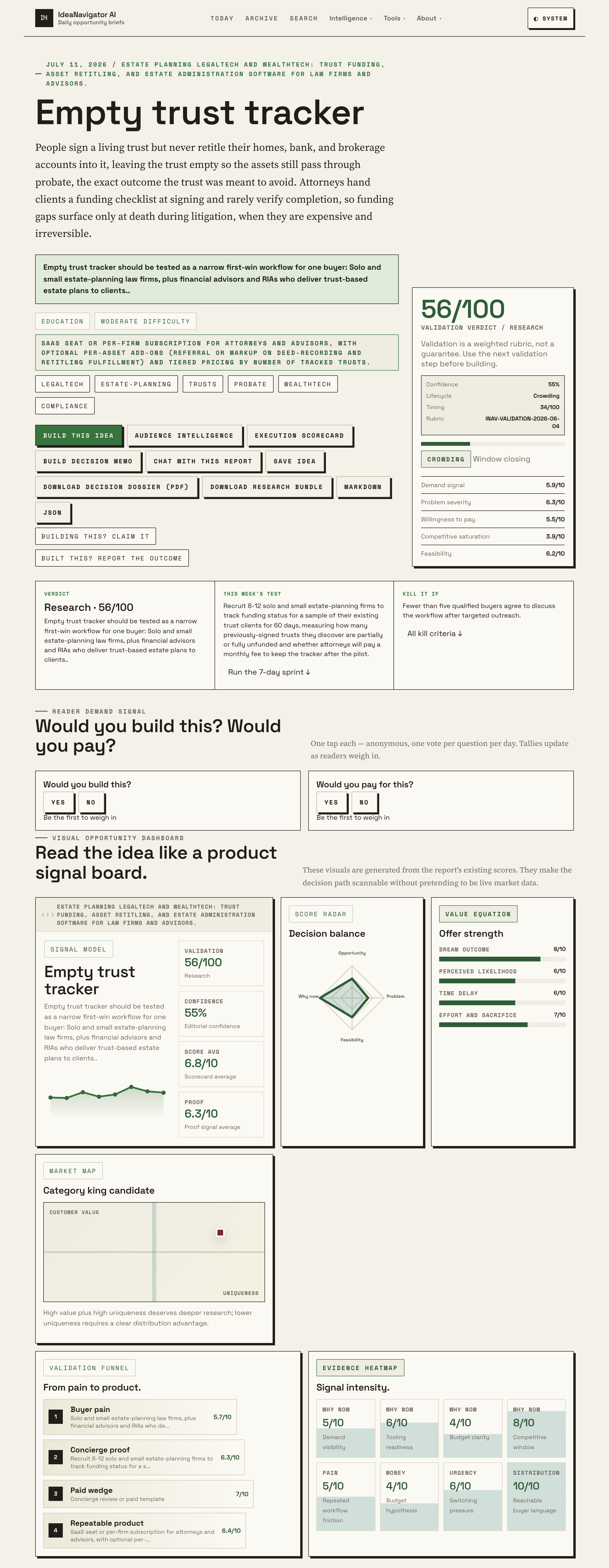
IdeaNavigator AI proposes testing an “empty trust tracker” with small estate-planning firms and financial advisers. The product would track whether clients move assets into signed trusts; its value and firms’ willingness to pay remain untested.
IdeaNavigator AI has proposed a 60-day pilot for software that helps small estate-planning firms and financial advisers track whether clients transfer assets into their living trusts. The concept addresses a gap between signing trust documents and completing the asset transfers that make the trusts useful, but there is no reported pilot result or evidence yet that firms will pay for the service.
The proposed tracker would let an attorney or adviser create a funding checklist for each trust, covering categories such as real estate, bank and brokerage accounts, business interests and beneficiary designations. Each item could be marked pending, in progress or confirmed funded. Clients could attach supporting records, such as a recorded deed or a statement showing an account was retitled, while automated reminders would prompt them to complete outstanding steps.
A firm dashboard would summarize the status of its clients’ trusts, including the percentage of assets recorded as funded. The idea is to give professionals a way to spot incomplete plans while clients can still address them, rather than relying on a checklist handed over at signing and discovering a gap much later. The proposal does not specify how the system would validate uploaded records or connect to financial institutions and county recording systems.
IdeaNavigator AI suggests a subscription model, with pricing by firm, seat or number of trusts tracked. It also describes optional fees or referrals for deed-recording and retitling services. To test the business case, it recommends recruiting eight to 12 solo and small firms to monitor a sample of existing clients’ trusts for 60 days. The pilot would measure how many were found partly or fully unfunded and whether participating firms would pay a monthly fee afterward.
The Gap After Trust Signing
A signed trust document does not by itself transfer ownership of a home or financial account into the trust. If an asset remains titled in an individual’s name, the intended estate plan may not handle it as expected. The proposed tracker targets this practical follow-through task, where missed transfers can leave families facing additional administration, including probate, depending on the asset and applicable circumstances.
For firms, a shared record of funding progress could make it easier to follow up with clients and identify unfinished work across a book of plans. That could matter as advisers and law firms consider offering more complete estate-planning services. However, the tracker’s actual effect on completion rates, client outcomes or firms’ workload has not been established. Those are questions for the proposed pilot, not demonstrated results.
Why Funding Is a Separate Step
Living trusts are used in estate planning, but signing the document and funding it are separate actions. Funding generally means transferring ownership of eligible assets or making other arrangements specified in a plan. The steps vary by asset; for example, real estate may require a deed, while an account may require a change to its title. Beneficiary designations can also affect how some assets pass, and should be handled according to the individual plan.
IdeaNavigator AI says roughly 11% of Americans hold a trust, but the proposal provides no survey, date range or definition behind that estimate. It also says existing document-drafting software does not close the funding gap, and points to deed-funding services priced from $250 as evidence of a paid market. These are claims in the proposal; no comparative market research or independent validation is included. The product concept is positioned as a tracking layer alongside such services, rather than as a substitute for legal advice or asset-transfer work.
Pilot Results Still Pending
No pilot findings are available in the proposal, and it does not report that firms have agreed to participate. The number of previously signed trusts that might prove partly or fully unfunded is unknown, as is whether a tracker would prompt clients to complete transfers. The suggested eight-to-12-firm sample is a validation plan, not evidence of market-wide demand.
Questions also remain about what counts as confirmed funding, who reviews submitted documents, and how the product would handle sensitive financial and property records. The proposal does not describe privacy safeguards, integrations, legal responsibilities, or how it would account for differences in state and asset-specific procedures. Its estimate of trust ownership and its characterization of market growth likewise need supporting data before they can be treated as independently verified trends.
A 60-Day Test Would Follow
The next proposed step is to recruit eight to 12 small firms and track a sample of their existing trust clients for 60 days. The test would record how many trusts show incomplete funding and ask participating professionals whether they would continue with a paid monthly subscription. No start date, participating firms or results have been announced in the available proposal.
If a pilot proceeds, its findings could show whether firms can use the tracker within their existing client workflows and whether clients act on reminders. Pricing, document review, data handling and the scope of any retitling or deed services would also need definition before the concept could be assessed as a complete offering.
Source: IdeaNavigator AI
Key Questions
What is an empty trust tracker?
It is a proposed tool for recording which assets a client has transferred into a living trust and which steps remain incomplete.
Does signing a living trust automatically fund it?
No. The proposal describes signing and funding as separate steps. Ownership of eligible assets may need to be transferred or otherwise handled according to the estate plan.
Has the tracker been tested?
No test results are provided. IdeaNavigator AI recommends a 60-day pilot with eight to 12 solo or small firms.
How would the proposed product make money?
The concept suggests subscriptions for firms or users, with possible tiered pricing by the number of trusts tracked and optional fees or referrals for transfer services.
Source: IdeaNavigator AI
Halloween Picks
halloween
As an affiliate, we earn on qualifying purchases.