
TL;DR
Anthropic’s $65 billion Series H round, pushing its valuation past $965 billion, isn’t just about money—it’s a bet on the future of compute capacity. The rapid revenue growth and strategic infrastructure investments mark a new phase in AI development, where scale and hardware are king.
When a company raises $65 billion in a single funding round, people typically think of hype or speculation. But in Anthropic’s case, it’s more about the hardware—about the chips, memory, and massive data centers needed to run the world’s most powerful AI models.
This isn’t just a valuation story. It’s a capacity story. The real question: how much of this huge sum is fueling faster, more efficient compute rather than just shiny new features? Let’s peel back the curtain on what makes this deal so different—and what it means for AI’s next giant leap. The compute-centric vision behind Anthropic’s Series H.
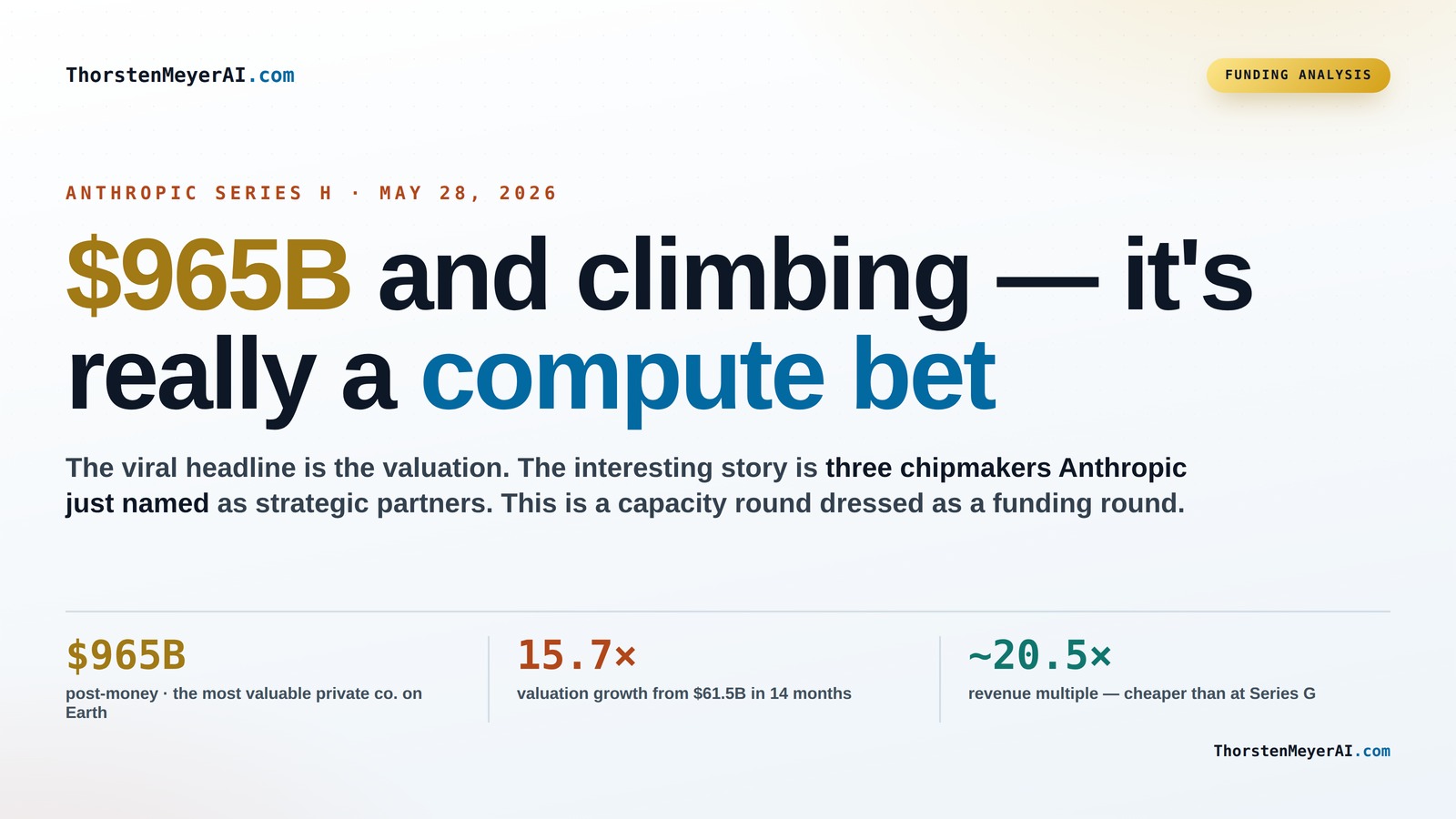
$965B and climbing — it’s really a compute bet
The viral headline is the valuation. The interesting story is in the press release’s middle paragraphs — and in three chipmakers Anthropic just named as strategic partners. This is a capacity round dressed as a funding round.
The numbers nobody can quite parse in sequence
Read together they describe a trajectory with no precedent in enterprise software. Read individually, each looks like a typo.

SQL Server 2025 Unveiled: The AI-Ready Enterprise Database with Microsoft Fabric Integration
As an affiliate, we earn on qualifying purchases.
As an affiliate, we earn on qualifying purchases.
From $61.5B to $965B in fourteen months
Salesforce took roughly two decades to reach revenue numbers Anthropic just blew past. The sequence below is the part most coverage skips — it’s not the size, it’s the shape.
Anthropic’s valuation ladder · Mar 2025 → May 2026
Five rounds, fourteen months. Bar height is the valuation; the climb itself is the story. Tap any milestone for context.

High Performance Datacenter Networks: Architectures, Algorithms, and Opportunities (Synthesis Lectures on Computer Architecture)
As an affiliate, we earn on qualifying purchases.
As an affiliate, we earn on qualifying purchases.
The multiple actually got cheaper
Bubbles look like multiples expanding while revenue lags. Anthropic’s pattern is the inverse — the valuation tripled, but revenue grew faster, and the multiple compressed.
Revenue-to-valuation multiple · Series G → Series H
Same company, three months apart. The denominator (revenue) is outrunning the numerator (valuation) — exactly the opposite of what a bubble narrative predicts.

AMD Radeon™ Pro W7800, Professional Graphics Card, Workstation, AI, 3D Rendering, 32GB GDDR6, DisplaPort™ 2.1, AV1, 45 TFLOPS, 70 CUS, 260W TDP, 8K
70 CU Compute Units, 2 AI Accelator per CU and 45 TFLOPS FP32 – to accelerate demanding workloads.
As an affiliate, we earn on qualifying purchases.
As an affiliate, we earn on qualifying purchases.
10+ gigawatts and three chipmakers
When you name Micron, Samsung & SK hynix alongside your equity backers, you’re saying the binding constraint isn’t demand or model quality — it’s the physical supply of memory chips. The Series H is a capacity round.
Compute commitments backing Anthropic’s capacity bet
$200B+ in announced compute spend across multi-year contracts. The $65B Series H raise has to be read against that bill, not against operating losses.

AI Engineering: Building Applications with Foundation Models
As an affiliate, we earn on qualifying purchases.
As an affiliate, we earn on qualifying purchases.
A genuinely durable bet — or a structural exposure?
Both readings can be true at once. The answer arrives over the next 18–24 months as the gigawatts come online and either fill with paying demand or don’t.
Revenue growth has no precedent in B2B software ($1B → $47B in 17 months). The multiple is compressing, not expanding. Claude is the only frontier model on all 3 major clouds. Enterprise AI spend share went from ~10% to >65% in a year. Compute commitments are tied to specific contracts with capacity dates.
20× revenue is not cheap by any historical software-investing standard. Revenue is reported gross of cloud-reseller pass-throughs, which inflates the top line. Profitability is 2 years out. Amodei’s own warning: a 12-month delay in AI progress “would make him bankrupt” — the compute commitments are a structural exposure to demand persistence.
The valuation race — and the IPO context
Anthropic shipped Opus 4.8 the same morning as Series H — not a coincidence. One week after OpenAI filed confidentially for IPO. The late-2026 frame is set: two frontier AI companies racing to public markets, each pitching durability.
Key Takeaways
- Anthropic’s $65 billion Series H isn’t just about valuation—it’s a massive infrastructure investment aimed at scaling compute capacity.
- Rapid revenue growth, now surpassing $47 billion annually, is backing the company’s valuation and showing real market demand.
- The multiple compression from 27x to 20.5x revenue signals that revenue acceleration is making valuations more sustainable.
- Major chipmakers and hyperscalers are central to Anthropic’s growth, highlighting the hardware-centric future of AI.
- This deal sets a precedent: the real race in AI is now about who controls the infrastructure, not just algorithms.
Why this $965B valuation is driven by more than just AI hype
Anthropic’s latest valuation of $965 billion is a record, but it’s not just a number. It reflects how much the company believes—no, bets—that the bottleneck in AI isn’t just talent or algorithms. It’s the hardware behind the scenes.
Think of it like building a skyscraper: no matter how innovative your design, if you don’t have enough steel, concrete, and cranes, the project stalls. This round is about securing those cranes—massive compute resources—to support future growth.
What makes this interesting? The press release highlights not just the money but the strategic partnerships with chipmakers like Micron, Samsung, and SK hynix. Over 10 gigawatts of compute capacity are committed—enough to run millions of high-end GPUs at once. This isn’t just a purchase; it’s a long-term infrastructure bet that will determine how quickly and efficiently AI models can be scaled in the years ahead. By investing heavily in hardware, Anthropic is signaling that the real value isn’t just in the models they develop but in the physical capacity to train, run, and iterate on those models at unprecedented scale. This shift could redefine how AI companies measure success—not solely by algorithms or data but by raw compute power, which ultimately determines what’s feasible in the AI landscape.

How fast is Anthropic’s revenue really growing? Spoiler: Rapid acceleration
Anthropic’s revenue growth is astonishing. From just over $1 billion in December 2024, it skyrocketed to over $47 billion by early May 2026. That’s a 5.4x jump in just 14 weeks—faster than most startups could dream. Learn more about AI infrastructure growth.
Sources say the company expects to hit around $11 billion in Q2 alone, with annualized revenue surpassing $50 billion by June. This rapid scaling isn’t just marketing hype; it’s backed by real customer demand for Claude, their flagship AI model.
Imagine a streaming service suddenly making more money than Netflix—yet still being private and valued at nearly a trillion dollars. That’s the scale Anthropic is racing toward. This explosive growth underscores a fundamental shift: AI is no longer just a research project or niche tool; it’s becoming a core part of enterprise infrastructure. The speed of revenue acceleration highlights the urgency for companies like Anthropic to build out their compute capacity quickly—because without enough hardware, this growth would hit a ceiling. This rapid revenue expansion also indicates that the market is willing to pay a premium for scalable, high-performance AI services, which in turn justifies the massive investments in infrastructure. The key takeaway? To sustain this trajectory, Anthropic needs not only innovative models but also the physical hardware to support them—making hardware investments as crucial as the AI models themselves.

The surprising math: revenue growth outpaces valuation increases
Here’s the mind-bender: even as Anthropic’s valuation tripled from $380 billion to $965 billion, its revenue grew faster. The valuation-to-revenue multiple actually shrank from about 27x to roughly 20.5x. Unpacking Anthropic’s Series H.
This isn’t just a statistical quirk; it signals a fundamental shift in how investors view AI companies. Traditionally, high valuations often came with slow revenue growth, driven by hype or speculative expectations. But in Anthropic’s case, rapid revenue acceleration is making the valuation multiples more reasonable, suggesting that the company’s value is increasingly rooted in real, scalable business operations rather than just potential or hype. This decreasing multiple indicates that investors are beginning to see the company’s growth as sustainable and driven by tangible infrastructure investments that will support even larger revenues in the future. Comparing this to OpenAI, which trades at a 65x multiple based on last year’s revenue—despite being smaller and less profitable—shows how the market is shifting toward valuing actual capacity and revenue streams over hype. This trend could encourage other AI firms to prioritize building scalable infrastructure, knowing that tangible hardware investments can lead to more reasonable valuations and investor confidence.

The real money: infrastructure, chips, and cloud giants
Anthropic’s funding isn’t just about hiring more researchers. The bulk of the cash is tied to hardware—chips, memory, storage, and cloud capacity. The round includes $15 billion from hyperscalers like Amazon, plus commitments from Micron, Samsung, and SK hynix.
Picture this: enough GPU power to run millions of AI models simultaneously, stored in warehouses the size of football fields. This hardware is the backbone of Anthropic’s future, allowing them to train larger models faster and more cheaply. But beyond just the physical infrastructure, these investments also carry strategic implications. They secure supply chains, foster exclusive partnerships, and set the stage for a hardware ecosystem that could dominate AI training and deployment. This hardware-centric approach signifies a shift: instead of relying solely on software innovation, future AI progress will depend heavily on physical infrastructure. This move could create barriers to entry for smaller competitors and further concentrate power among giants with the capacity to invest heavily in hardware. Ultimately, this hardware focus isn’t just a cost; it’s a strategic moat—one that will influence who leads in AI capabilities in the coming years.
Why is this a ‘capacity round’? What does that mean?
A ‘capacity round’ means the money is primarily for scaling up compute infrastructure, not just for hiring or marketing. Anthropic is betting big on the chips, data centers, and cloud services needed to power the next wave of AI models.
Imagine buying a fleet of supercomputers instead of just new features. That’s the core of this round. It’s about building the physical muscles to handle massive models, faster and cheaper. This approach reflects a strategic understanding: without enough compute capacity, even the most innovative models can’t be trained or deployed at scale. The investments from Amazon and chipmakers aren’t just about hardware; they’re about creating a resilient, scalable foundation for AI’s future. This hardware focus also involves significant tradeoffs—longer lead times, higher upfront costs, and the need for robust supply chains. But the payoff is a sustainable advantage in AI development, where capacity becomes the bottleneck that determines who can innovate at the largest scale. This shift underscores a broader trend: future AI dominance will depend less on algorithms and more on physical infrastructure, making capacity rounds a pivotal strategic move.

What does this mean for AI’s future? Bigger models, faster growth
With this kind of backing, Anthropic can train bigger models, faster. Think of it like upgrading from a bicycle to a rocket—more compute means more complex, capable AI systems.
This scale unlocks new possibilities: better safety, more nuanced understanding, and broader deployment. It’s not just about chasing numbers; it’s about creating AI that can handle real-world complexity. The implications are profound: as infrastructure enables larger and more sophisticated models, AI can move from experimental or niche applications to mainstream enterprise solutions. This could lead to breakthroughs in natural language understanding, robotics, and even general intelligence. But it also raises questions about the tradeoffs—such as energy consumption, hardware costs, and environmental impact. The challenge will be balancing rapid growth with sustainability. Nonetheless, the trend is clear: hardware capacity will be the primary enabler of AI’s next frontier, making investments in infrastructure not just strategic but essential for future innovation.

Strategic implications: AI arms race, infrastructure dependence, and market leadership
Anthropic’s move signals a new era—one where infrastructure and hardware are just as critical as algorithms. The company’s push past OpenAI in valuation is a clear message: whoever controls the compute wins.
Major players like Amazon, Microsoft, and chipmakers are now key stakeholders, shaping AI’s future through hardware investments. This arms race is less about just building better models—it’s about building better data centers, chips, and supply chains. Controlling these physical assets creates a strategic advantage, making it harder for smaller competitors to catch up. The infrastructure-centric approach also shifts the competitive landscape: success depends less on algorithmic breakthroughs and more on physical and logistical mastery. This could lead to a consolidation of power among a few giants who can afford massive hardware investments, potentially stifling innovation from smaller players and raising concerns about monopolistic tendencies. The market implications are significant: future AI leadership will be determined by who can scale their infrastructure fastest and most efficiently, turning hardware into the new battleground for AI dominance.

What should you take away? The key lessons from Anthropic’s mega round
- Infrastructure is king: Massive compute capacity drives valuation and growth, not just AI algorithms.
- Revenue growth matters: Rapid monetization can make valuations more reasonable, even at trillion-dollar scales.
- Hardware partnerships are strategic: Chipmakers and cloud giants are now core players in AI’s future.
- Expect more capacity-driven moves: Future funding rounds will likely focus on hardware rather than just AI research.
Frequently Asked Questions
Is the $965 billion valuation real or just hype?
The valuation is based on projected revenue growth and infrastructure investments, reflecting strong investor confidence in Anthropic’s hardware-driven scaling. While high, it’s grounded in rapid revenue acceleration and strategic hardware commitments.How does Series H differ from earlier funding rounds?
Series H is primarily a capacity round, focusing on hardware and infrastructure commitments, rather than just equity or product expansion. It signals a shift toward investing in physical resources needed for massive AI models.Why does this round look like a compute purchase?
Because most of the money is allocated to chipmakers, memory, storage, and cloud capacity. It’s about building the physical muscle to support larger, faster AI models—more of a hardware upgrade than a typical software funding round.What does this mean for the AI arms race?
It accelerates the hardware war—more chips, bigger data centers, faster networks. Control over infrastructure becomes the new battleground for AI dominance.Will this lead to an IPO or stay private?
While the valuation milestone heightens public attention, the focus appears to be on capacity building and market leadership. An IPO could be next, but for now, the emphasis remains on scaling infrastructure privately.Conclusion
This isn’t just another billion-dollar funding round. It’s a loud, clear statement: AI’s biggest bottleneck isn’t code or talent—it’s the hardware that powers it. As Anthropic pours billions into chips, memory, and data centers, the entire industry shifts from software prowess to infrastructure dominance.
If you’re watching AI’s next chapter, focus on the hardware. Because in this race, the real winners will be those who build the capacity to run the universe’s most powerful models.