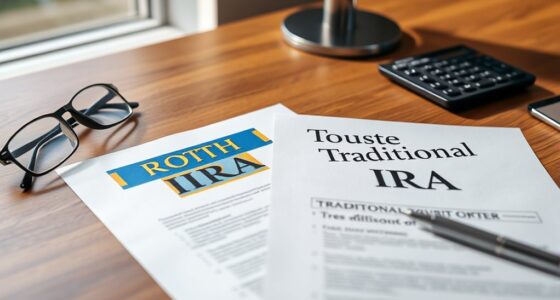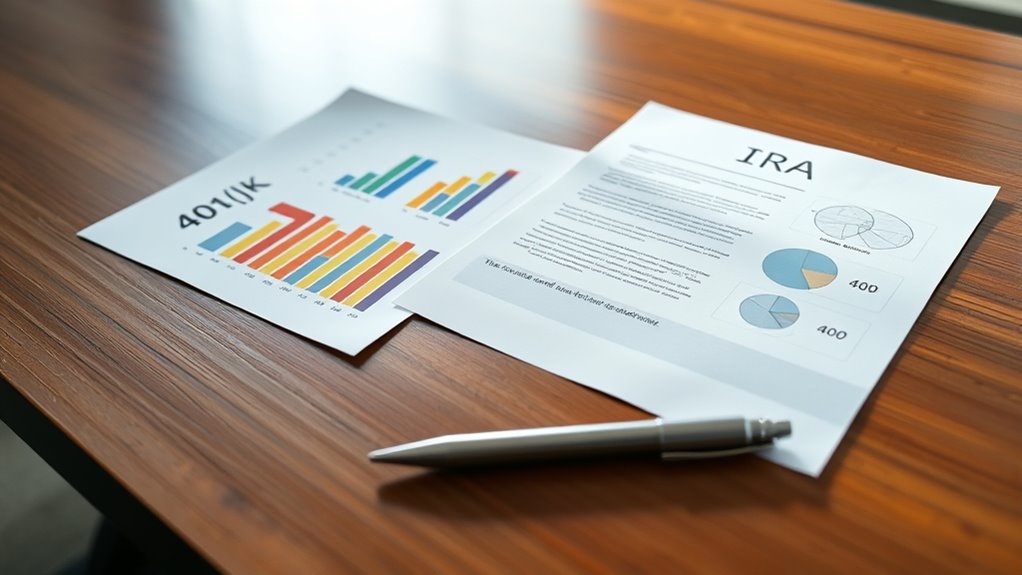

Choosing between a 401(k) and an IRA depends on your employment situation, savings goals, and investment preferences. A 401(k) offered through your employer often includes automatic payroll deductions and employer match, but has limited investment options. An IRA provides broader choices and more control but requires you to set it up yourself. Understanding these differences helps you make the best decision for your retirement plan—continuing offers more details to clarify your options.
Key Takeaways
- 401(k)s often have employer matching and limited investment options, while IRAs offer broader investment flexibility.
- IRAs are accessible to all with earned income, whereas 401(k)s depend on employer offerings and eligibility.
- 401(k)s typically have higher contribution limits and catch-up options for older savers than IRAs.
- Traditional accounts reduce taxable income now, with taxes paid upon withdrawal; Roth accounts offer tax-free withdrawals.
- IRAs allow more flexible withdrawal options and are not tied to employment, unlike 401(k)s.

When planning for retirement, understanding the key differences between 401(k) plans and IRAs is vital. These accounts serve as primary tools to grow your savings, but they vary markedly in how you access, contribute to, and manage your funds. Your eligibility for a 401(k) depends on whether your employer offers the plan and if you’re eligible to participate. If your employer provides a 401(k), you can contribute through payroll deductions, often with automatic payments that make saving easier. Many plans offer employer matching contributions, which is essentially free money that boosts your savings. However, if you leave your job, you’ll typically need to roll over your 401(k) to an IRA or another plan to keep your money growing tax-deferred. IRAs, on the other hand, are open to any individual with earned income, including nonworking spouses when filing jointly. You can open IRAs through banks, online brokers, or financial institutions, giving you more control and flexibility over your account. IRAs generally have fewer restrictions on access, allowing for more flexible withdrawal options in certain circumstances. Contribution limits differ widely between the two. In 2025, you can contribute up to $23,500 to a 401(k) if you’re under 50, with catch-up contributions of up to $7,500 if you’re between 50 and 59 or 64+. For those 60 and older, some plans allow even higher catch-up contributions, up to $11,250. IRAs have lower limits—$7,000 for those under 50 and $8,000 for those 50 and above, which includes a $1,000 catch-up. Keep in mind, these limits apply across all your IRAs combined, whether traditional or Roth. Investment options are another key difference. Your 401(k) choices are set by your employer and typically limited to a handful of funds or options. IRAs offer broader flexibility, allowing you to choose from mutual funds, ETFs, stocks, and bonds, depending on the provider. This means you can tailor your investment strategy more precisely in an IRA. The tax treatment also varies; traditional 401(k)s and IRAs usually involve pre-tax contributions, lowering your taxable income now, but you’ll pay taxes upon withdrawal. Roth versions, however, involve post-tax contributions, making qualified withdrawals tax-free. Keep in mind that high-income earners might face restrictions on Roth IRA contributions, though Roth 401(k)s have no income limits. While employer matching is common in 401(k)s, IRAs lack this benefit because they are individually established. Contributions to IRAs are self-initiated, typically through direct deposits, and there are income limits that could restrict Roth IRA eligibility. Overall, choosing between a 401(k) and an IRA depends on your employment situation, income level, investment preferences, and saving goals. Both accounts can help you build a substantial nest egg, but understanding these differences ensures you select the right option for your retirement planning.

A Random Walk Down Wall Street: The Best Investment Guide That Money Can Buy
As an affiliate, we earn on qualifying purchases.
As an affiliate, we earn on qualifying purchases.
Frequently Asked Questions
Can I Have Both a 401(K) and an IRA Simultaneously?
Yes, you can have both a 401(k) and an IRA simultaneously. Contributing to both allows you to maximize your retirement savings and diversify your investments. While your 401(k) might have higher contribution limits, an IRA offers more investment options and potential for tax advantages. Just keep in mind that there are income limits for tax deductions on IRA contributions, especially if you or your spouse are covered by a workplace retirement plan.
Are There Income Limits for Contributing to a Roth IRA?
Yes, there are income limits for contributing to a Roth IRA. If your modified adjusted gross income (MAGI) exceeds certain thresholds, your contribution limit phases out or you become ineligible to contribute directly. For 2023, singles with MAGI over $138,000 and heads of household over $218,000 face limits. Married couples filing jointly with MAGI over $218,000 also see phased-out contributions. You might consider a backdoor Roth if you surpass these limits.
How Do Early Withdrawal Penalties Differ Between 401(K) and IRA?
Think of early withdrawals as ripping a bandage off—both plans have penalties, but they differ. With a 401(k), you face a 10% penalty plus income tax unless you qualify for an exception, like hardship or separation. For an IRA, the same 10% penalty applies, but certain exceptions, such as first-time home purchase or qualified education expenses, can help you avoid it. Always check specific rules before pulling funds early.
What Are the Tax Implications of Rolling Over Accounts?
When you roll over a retirement account, you generally avoid immediate taxes if you do a direct rollover. If you choose an indirect rollover and don’t complete it within 60 days, you might face income taxes and penalties. Additionally, if your employer withholds taxes during a rollover, you’ll need to replace that amount to prevent taxes on it. Always guarantee you follow IRS rules to prevent unexpected tax consequences.
Which Account Type Offers More Investment Options and Flexibility?
Think of your retirement account as a vast garden of opportunities. An IRA generally offers more investment options and flexibility, like choosing from a wide palette of plants. You can pick individual stocks, bonds, or mutual funds without the constraints of employer plans. A 401(k), while more structured, often limits choices to a set menu. So, if variety fuels your investment passion, an IRA is your fertile ground.
401(k) employer matching funds
As an affiliate, we earn on qualifying purchases.
As an affiliate, we earn on qualifying purchases.
Conclusion
Choosing between a 401(k) and an IRA depends on your goals and situation. Did you know that over 60% of Americans with retirement accounts contribute to a 401(k), often benefiting from employer matches? This highlights how workplace plans can boost your savings. Whichever option you pick, start saving early and contribute consistently. Your future self will thank you for the smart choices you make today, setting you up for a more secure retirement.

The Power of Zero, Revised and Updated: How to Get to the 0% Tax Bracket and Transform Your Retirement
As an affiliate, we earn on qualifying purchases.
As an affiliate, we earn on qualifying purchases.

Tax Planning To and Through Early Retirement
As an affiliate, we earn on qualifying purchases.
As an affiliate, we earn on qualifying purchases.