
When working remotely abroad, it is crucial to understand the visa options available, including proof of income, health insurance, and supporting documents to secure legal residence. You’ll need to verify your income through bank statements or contracts and stay compliant with local tax laws to avoid penalties. Ensuring your pay, taxes, and visa paperwork are managed properly will streamline your experience. Keep going to discover how to handle these aspects smoothly and stay compliant long-term.
Key Takeaways
- Obtain a suitable remote work visa by providing proof of employment, income, health insurance, and accommodation arrangements.
- Demonstrate consistent income through bank statements or employment contracts to meet visa requirements.
- Comply with local tax laws by understanding residency rules, registering for tax IDs, and filing income returns as needed.
- Ensure health insurance covers medical expenses and COVID-19 treatment, meeting the host country’s mandatory requirements.
- Be aware of tax treaties and consult professionals to avoid double taxation and ensure legal compliance while working abroad.
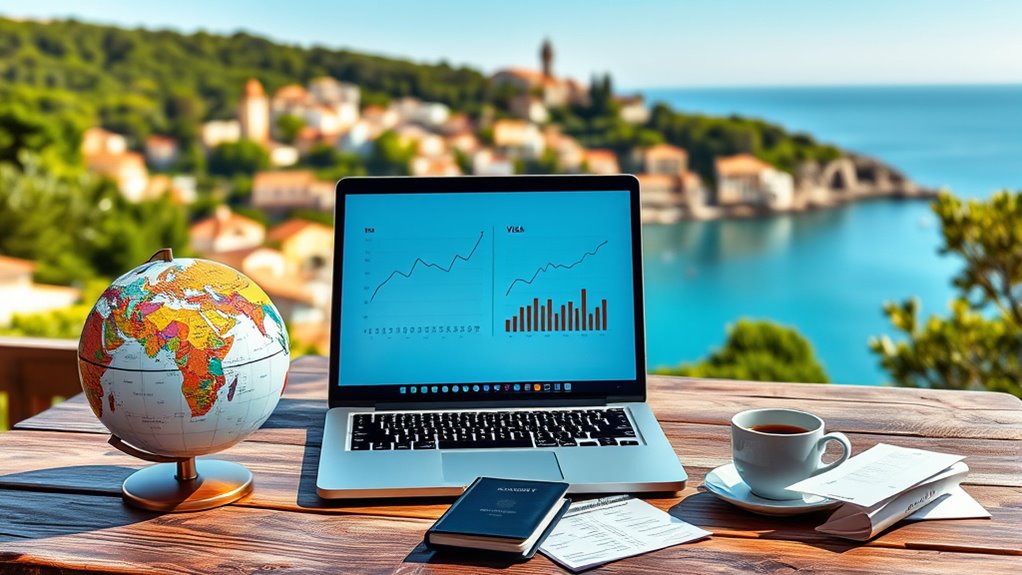
Working remotely abroad has become an increasingly popular way to combine work and travel, offering the flexibility to live in a new country while maintaining your career. To do this successfully, you need to understand the visa options available, how to handle your pay, and what tax implications to expect. Over 40 countries now offer digital nomad or remote worker visas, with Europe leading at 31%, followed by the Americas at 41%, and smaller shares in Africa, the Middle East, and Asia-Pacific. These visas typically require proof of employment outside the host country, a minimum income threshold, valid health insurance, a clean criminal record, and proof of accommodation. Some countries, like Mauritius, even provide long-term visas at no cost, while others, such as Cabo Verde, charge application and processing fees. Eligibility often depends on your nationality, and certain countries restrict these visas to specific professions or highly skilled workers. Visa durations vary, with most countries allowing stays up to a year, giving you ample time to settle into your new environment.
Over 40 countries now offer digital nomad visas, requiring proof of employment, income, health insurance, and clean criminal records.
Applying for a remote work visa generally involves submitting your application online or through a local embassy or consulate. You’ll need to provide forms, copies of your passport, photographs, and supporting documents like employment contracts or proof of income. Some countries require in-person visits for biometrics or document submissions, and processing times can differ widely. For faster approval, some nations offer expedited services at an extra cost. If you have dependents, you can often include them in your application by providing additional documents like marriage or birth certificates.
Proving your income is a critical part of the process. Many countries have minimum income requirements, such as Cabo Verde, which mandates roughly $1,585 USD per month for an individual or about $2,850 for a family, often demonstrated through bank statements or employment contracts. You need to show proof of remote employment or self-employment with a foreign company, and income often must meet a certain after-tax threshold. You also need to demonstrate financial stability, which can be supported by consistent income documentation and tax compliance, ensuring you meet local tax regulations. For freelancers or consultants, presenting client contracts or ongoing work arrangements is essential. Maintaining financial stability is key to securing your visa and staying compliant.
Tax considerations are equally important. Your tax liability depends on local laws and how long you stay. Some nations, like Mauritius, offer tax holidays or exemptions for remote workers, while others require you to comply with local tax regulations after a certain residence period. Many countries have double taxation agreements, so consulting a tax professional before relocating helps prevent unexpected liabilities. Failure to adhere to tax laws can lead to fines, deportation, or loss of your visa. Additionally, some jurisdictions demand that you obtain local tax identification numbers and file returns if you earn income while abroad.
Health insurance is a mandatory requirement in most countries. You’ll need coverage that includes medical treatment, evacuation, and sometimes COVID-19-related expenses, valid throughout your stay. Some countries also ask for proof of travel insurance and a criminal background check or police clearance. Navigating these requirements can be complex, but understanding them upfront ensures a smoother transition to working remotely in a new country.

Travel Adapter USB C, Universal All in One Worldwide Travel Adapter Fast Charge GaN PD3.0 Type C USB-A Quick Charging Ports Power Converters Wall Charger AC Power Plug Adapter for USA EU UK AUS Black
【Universal Worldwide Charging】This travel adapter accepts plugs from More than 150 Countries with US/EU/UK/AU European Plugs like Thailand,…
As an affiliate, we earn on qualifying purchases.
As an affiliate, we earn on qualifying purchases.
Frequently Asked Questions
How Do I Open a Local Bank Account While Working Remotely Abroad?
To open a local bank account abroad, you typically need your passport, proof of address, and sometimes a visa or residency permit. Visit a branch in person, or check if online account opening is available. Be prepared to provide documentation confirming your identity and address. Some banks may require an initial deposit. Research specific bank requirements beforehand to guarantee a smooth process and avoid surprises.
What Are the Best Tools for International Remote Collaboration?
Think of your team as a well-orchestrated band. To keep everyone in harmony, you need the right instruments. Tools like Slack or Microsoft Teams act as your communication hubs, fostering instant chats and video calls. Trello or Asana serve as your sheet music, organizing tasks clearly. Google Drive or Dropbox act as your shared rehearsal space, ensuring everyone accesses files seamlessly. These tools help your remote band perform perfectly together.
How Can I Ensure Data Privacy and Security Internationally?
To guarantee data privacy and security internationally, you should use strong encryption for all communications and data storage. Regularly update your software, implement multi-factor authentication, and use VPNs to protect your connection. Be aware of local data protection laws and choose providers that comply with international standards like GDPR. Educate yourself on best practices, and always review your security policies to adapt to evolving threats.
Are There Health Insurance Options for Remote Workers Overseas?
Yes, you can find health insurance options for remote work overseas. Many international health insurance providers offer plans tailored for expatriates and remote workers, giving you coverage in multiple countries. You should compare plans based on coverage, costs, and network access. Some employers also provide international health insurance, so check if that’s an option. Researching specific plans guarantees you get the right coverage for your needs abroad.
How Do I Handle Currency Exchange and Transfer Fees?
Currency exchange and transfer fees can feel like draining a river with a teaspoon. To handle this, you should compare banks and transfer services for the lowest rates, consider using specialized international accounts, and schedule transfers during favorable exchange rate periods. Using services like Wise or Revolut can dramatically cut costs. Always stay informed about hidden fees, so your hard-earned money doesn’t vanish into thin air during transfers.
compact travel health insurance
As an affiliate, we earn on qualifying purchases.
As an affiliate, we earn on qualifying purchases.
Conclusion
Working remotely abroad can be a fantastic adventure, but don’t forget to stay on top of pay, visas, and taxes—think of it like your own modern-day Excalibur. Keep yourself informed and plan ahead, so you avoid any pitfalls that could turn your journey into a quest for lost treasure. With the right preparation, you’ll be living the dream in no time—just don’t forget, even Sir Lancelot needed a good map!
RFID blocking travel wallet
As an affiliate, we earn on qualifying purchases.
As an affiliate, we earn on qualifying purchases.

The Practical Guide to Portugal's Digital Nomad Visa: The D8 Visa: From Application to Arrival — Real Numbers, Real Timelines, Real Answers
As an affiliate, we earn on qualifying purchases.
As an affiliate, we earn on qualifying purchases.