
Hyperinflation happens when prices increase over 50% a month, rapidly eroding your money’s value. History shows it usually results from governments printing too much money to cover debts or fund spending, especially during crises. This spirals out of control, causing wages, savings, and currency value to plummet, leading to economic chaos. Understanding these lessons helps you grasp how unchecked money printing fuels hyperinflation and what can be done to prevent it.

Get smart everyday buys delivered free with Prime
- Fast, free delivery on millions of items
- Prime Video, Amazon Music and more included
- Member-only deals all year
Key Takeaways
- Hyperinflation occurs when prices rise over 50% monthly, eroding currency value rapidly and undermining economic stability.
- Historical cases like Weimar Germany and Zimbabwe demonstrate how excessive money printing fuels hyperinflation.
- Causes include government over-issuance of money, demand-pull factors, and collapsing exchange rates.
- The social impacts are severe, including currency collapse, declining wages, poverty, and political upheaval.
- Effective lessons emphasize credible reforms, external assistance, and maintaining financial stability to prevent hyperinflation.
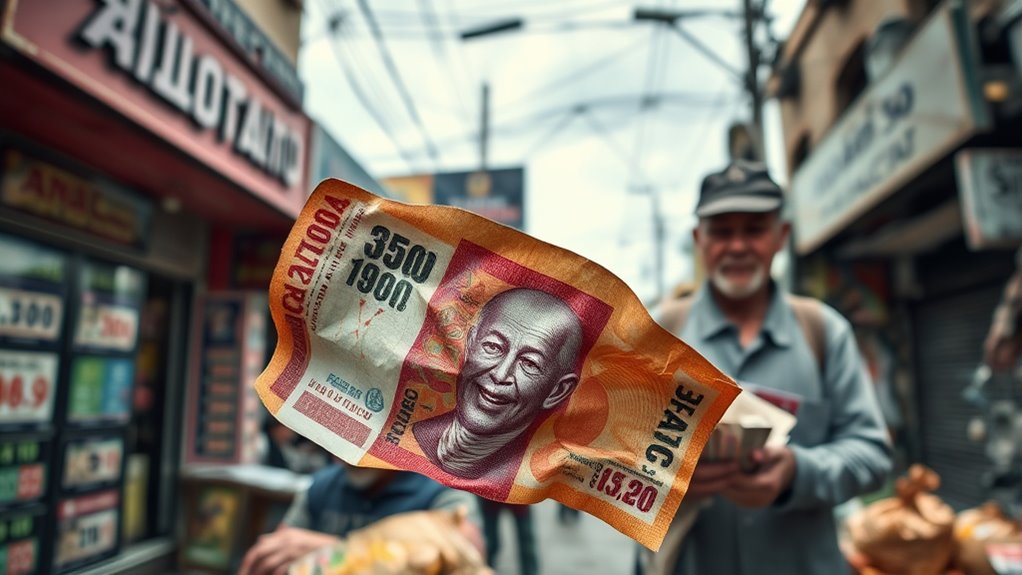
Have you ever wondered what causes prices to skyrocket uncontrollably in a country? Hyperinflation is the answer. It’s an extreme form of inflation where prices increase faster than 50% per month, making everyday transactions nearly impossible. Unlike regular inflation or even galloping inflation—which can reach 10% annually—hyperinflation is characterized by a rapid acceleration that erodes the value of the currency so quickly that people lose confidence in it. When this happens, the nominal price levels soar, often outpacing the growth of the money supply, as residents rush to spend their cash before it becomes worthless. This leads to a collapse in the real value of the local currency, prompting many to minimize their holdings and switch to foreign currencies, gold, or barter systems. The entire economy destabilizes as purchasing power diminishes, wages lag behind soaring prices, and savings vanish overnight.
The root cause of hyperinflation is typically excessive growth in the money supply. Governments often print money to cover budget deficits or pay debts, especially during crises like war, political upheaval, or economic collapse. When demand outpaces supply due to demand-pull inflation, prices can accelerate further. If a government’s financial situation worsens—say, due to a drop in tax revenue or a surge in foreign debt denominated in hard currencies—the situation worsens. As the exchange rate collapses, debt repayment becomes impossible, forcing governments to print even more money. This vicious cycle of printing money to meet obligations fuels hyperinflation, which then feeds on itself, making a recovery difficult. Hyperinflation can also occur when economic shocks hit a country unexpectedly, destabilizing its financial system. Additionally, a loss of confidence in the government or central bank often exacerbates the situation, accelerating the inflationary spiral.
History offers stark lessons. In Weimar Germany during the 1920s, reparations after World War I and reckless money printing caused prices to double every few days. Zimbabwe in the late 2000s experienced hyperinflation peaking at nearly 80 billion percent month-on-month, driven by land reforms, economic mismanagement, and collapsing productivity. Venezuela’s ongoing crisis stems from economic mismanagement and falling oil prices, with inflation soaring and wages failing to keep pace. Even Hungary in 1946 faced the highest recorded monthly inflation rate—over 4 quintillion percent—while Yugoslavia in the 1990s saw a currency become completely worthless amid political upheaval and sanctions.
The effects are devastating. Currency values plunge, imports become prohibitively expensive, and domestic inflation spirals upward. Savings and wages lose their worth, prompting capital flight, business failures, and a breakdown in investment. Governments struggle to collect taxes and often resort to printing money, worsening the crisis. People turn to foreign currencies, gold, or barter, creating black markets and hoarding. Social consequences are severe—poverty, starvation, declining public health, and rising mortality rates. Public trust in institutions erodes, protests increase, and political stability collapses, often leading to international intervention like IMF bailouts.
To combat hyperinflation, governments sometimes impose capital controls or switch to foreign currencies—dollarization—to stabilize their economies. However, if poorly executed, these policies can deepen the crisis. Some try gradual reforms, but these are risky and may prolong instability. Ultimately, history shows that hyperinflation is a symptom of deeper structural issues, and recovery demands disciplined policy measures, credible reforms, and often external assistance. Recognizing the importance of financial stability is crucial for preventing hyperinflation from occurring again in vulnerable economies.
Frequently Asked Questions
How Does Hyperinflation Differ From Regular Inflation?
Hyperinflation happens when prices skyrocket rapidly, often exceeding 50% per month, causing your money to lose value quickly. Regular inflation is slower and more controlled, gradually raising prices over time. During hyperinflation, you might see your savings vanish in days, and daily transactions become chaotic. It’s a severe economic crisis that destabilizes currency, unlike normal inflation, which is a manageable rise in prices over time.
Can Hyperinflation Happen in Stable Economies?
Ever wondered if hyperinflation could strike a stable economy? It’s rare but possible if a nation faces extreme political turmoil or loses confidence in its financial system. When governments print money irresponsibly or face sudden shocks, inflation can spiral out of control. Even stable economies aren’t immune if they encounter severe crises. The key is maintaining prudent fiscal policies and confidence to prevent hyperinflation from taking hold.
What Are the Long-Term Effects of Hyperinflation?
The long-term effects of hyperinflation can be severe. You might find your savings wiped out, making it hard to plan for the future. It can cause economic instability, leading to unemployment and a loss of confidence in your country’s currency. Businesses may close, and your purchasing power declines drastically. Over time, hyperinflation erodes the foundation of your economy, making recovery difficult and increasing hardship for you and others.
How Can Individuals Protect Their Savings During Hyperinflation?
Think of your savings as a delicate glass sculpture in a storm. During hyperinflation, you can protect it by diversifying your assets into tangible items like precious metals or foreign currencies, which hold value when local currency plummets. Avoid keeping all your savings in cash, and consider investing in stable assets or assets that appreciate. Stay informed about economic shifts to make timely decisions and safeguard your financial future.
Are There Modern Examples of Hyperinflation Besides Historical Cases?
Yes, you can find modern examples of hyperinflation, like Zimbabwe in the late 2000s and Venezuela since 2016. In these cases, inflation soared rapidly, eroding savings and destabilizing economies. You should stay informed about economic conditions in countries experiencing instability. Diversifying your assets, avoiding holding large amounts of local currency, and considering alternative investments like cryptocurrencies or precious metals can help protect your wealth during such volatile periods.
Conclusion
Now that you’ve seen how hyperinflation spirals out of control, think of it as a runaway train barreling down the tracks. Without proper brakes—sound policies and strong institutions—it crashes and leaves chaos behind. By studying history’s lessons, you can help steer clear of such disasters. Remember, understanding hyperinflation isn’t just about numbers; it’s about recognizing the warning signs before the train goes off the rails. Stay vigilant and informed.
Halloween Picks
halloween
As an affiliate, we earn on qualifying purchases.