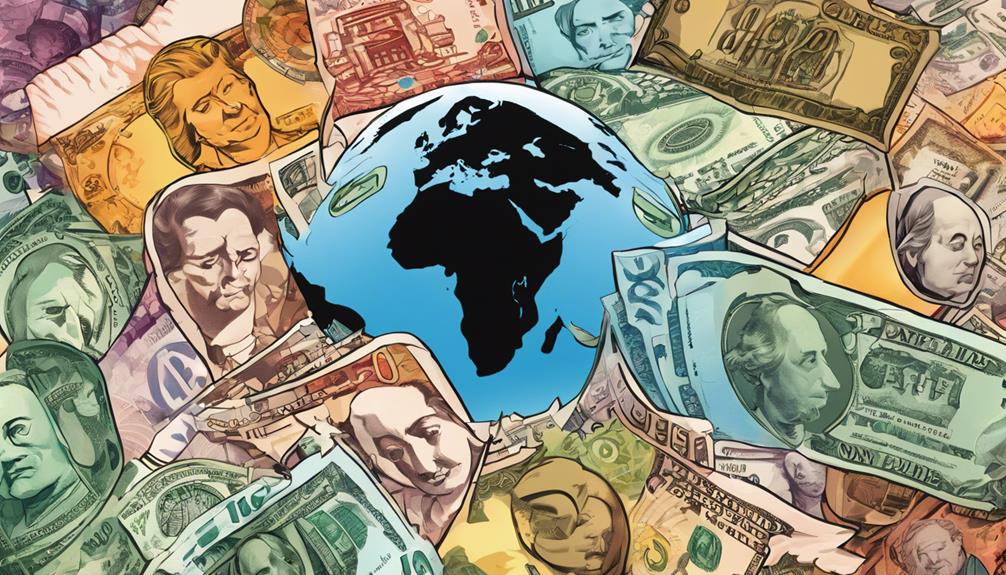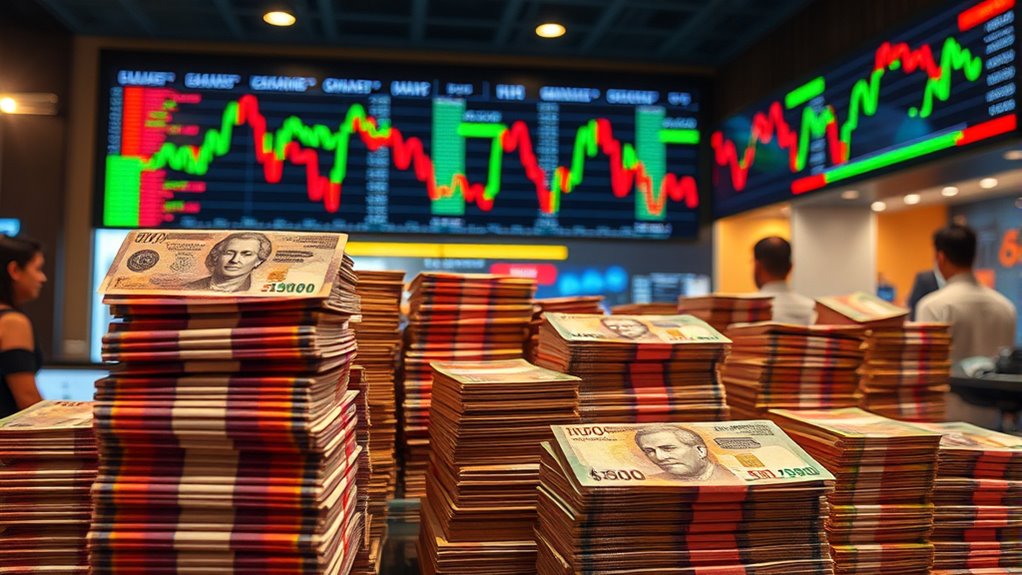

Currency exchange rates show how much of one currency you need to buy another. These rates shift constantly because of supply and demand influenced by economic factors, interest rates, political stability, and market expectations. When demand for a currency rises, its value increases; when it drops, the currency depreciates. Government policies and external events also affect rates briefly or long-term. To understand the complex forces behind these fluctuations, there’s more to uncover just ahead.
Key Takeaways
- Exchange rates show the cost of one currency in terms of another, fluctuating due to supply and demand in forex markets.
- Market forces, economic indicators, political stability, and interest rates influence currency demand and value.
- Central banks can affect rates through policies, interventions, or pegging currencies to stabilize or influence their value.
- External factors like global events, news, and technological advancements cause rapid short-term exchange rate fluctuations.
- Over time, rates tend to converge toward purchasing power parity, balancing the relative prices of goods internationally.

Understanding currency exchange rates is essential because they determine how much of one currency you need to buy a unit of another. When you travel abroad or conduct international transactions, you rely on these rates to know the value of your money in different countries. An exchange rate expresses this relative price — for example, if USD/EUR is 0.95, it means one euro costs 0.95 dollars. These rates are constantly changing because the forex markets operate 24/7, five days a week, with rates updating in real-time based on supply and demand. The rates you see are influenced by several factors, including market forces, economic indicators, government policies, and trader speculation. Additionally, technological advancements have increased the speed at which these fluctuations occur, making the forex market highly responsive to global events.
The primary driver of exchange rate fluctuations is the market’s supply and demand. When more investors want a currency, perhaps because of its country’s economic prospects or interest rates, its value tends to rise. Conversely, if demand drops or there’s economic uncertainty, the currency depreciates. Economic factors like inflation rates, interest rates, trade balances, and overall economic growth shape these demand patterns. For instance, countries with higher interest rates often attract foreign capital, increasing demand for their currency. On the other hand, high inflation erodes a currency’s value relative to others, leading to depreciation. Political stability also plays a critical role; instability or conflict can trigger capital flight, weakening the currency.
Governments and central banks can influence exchange rates through policies and interventions. Countries with pegged or fixed exchange rate regimes tie their currency’s value to another currency or commodity, like gold, to maintain stability. Managing a floating rate involves less direct control, but central banks may intervene occasionally to stabilize or influence the rate, especially during excessive volatility. Traders’ expectations and news events also cause short-term fluctuations, as markets react quickly to political developments, economic reports, or global crises. The exchange rate system adopted by a country determines how much influence government policies have over these rates.
The difference between nominal and real exchange rates further clarifies currency values. The nominal rate is the straightforward price of one currency in terms of another, while the real rate adjusts for differences in price levels between countries, reflecting actual purchasing power. Over time, economic theories like Purchasing Power Parity suggest these rates should converge, meaning identical goods should cost the same in different countries once exchange rates are considered.

Currency Converter. Exchange rates online and calculator offline
Possibility to change the rate manual.
As an affiliate, we earn on qualifying purchases.
As an affiliate, we earn on qualifying purchases.
Frequently Asked Questions
How Do Currency Exchange Rates Impact International Trade?
Currency exchange rates directly impact your ability to buy and sell goods internationally. When rates are favorable, you get more value for your money, making imports cheaper and exports more competitive. Conversely, unfavorable rates can increase costs and reduce profits. They influence pricing, demand, and competitiveness, so you need to closely monitor fluctuations. Staying aware helps you make smarter decisions in international trade, minimizing risks and maximizing opportunities.
What Role Do Central Banks Play in Currency Fluctuations?
Central banks influence currency fluctuations by adjusting interest rates, buying or selling their currency, and implementing monetary policies. When they raise interest rates, your currency often strengthens because investors seek higher returns. Conversely, when they sell large amounts of currency, it can weaken the exchange rate. Their interventions aim to stabilize or steer the economy, but these actions can cause short-term or long-term fluctuations in your currency’s value.
Can Currency Exchange Rates Predict Future Economic Stability?
Currency exchange rates can give you clues about future economic stability, but they’re not foolproof predictors. When rates are volatile or trending sharply, it might signal underlying economic issues or upcoming changes. However, many factors influence stability beyond currency values, like political events or global markets. So, while exchange rates can offer insights, you shouldn’t rely solely on them to forecast future economic health.
How Do Political Events Influence Currency Value Changes?
Political events can considerably influence your currency’s value. When governments announce policies or face instability, investors often react quickly, buying or selling currency based on perceived risks. For example, elections, protests, or changes in leadership can cause sharp fluctuations. These events create uncertainty, leading to decreased confidence or increased speculation, which directly impacts your currency’s strength. Staying informed about political developments helps you anticipate potential changes in exchange rates.
What Are the Risks of Currency Speculation for Investors?
You may think currency speculation is risky, but with careful analysis, you can manage those risks. The main dangers include sudden market shifts, political instability, and economic crises that can cause big losses. If you don’t stay informed and diversify your investments, you might face significant setbacks. However, by monitoring trends and setting stop-loss orders, you can protect yourself and potentially profit from currency movements.

Anker Nano Travel Adapter, 5-Port Power Adapter with 1× 2-Pin AC, 2 USB A, 2 USB C for 20W, Smart Temperature Control, Works in 200+ Countries, Not a Voltage Converter, Travel Essentials (1-Pack)
Universal Plug Compatibility: Type A (US / Canada / Japan / China), Type C (EU), Type G (UK…
As an affiliate, we earn on qualifying purchases.
As an affiliate, we earn on qualifying purchases.
Conclusion
Now that you understand how currency exchange rates fluctuate based on various factors, you’re better equipped to navigate the world of international finance. Remember, these rates are constantly changing, influenced by economic and political events. So, next time you exchange money or travel abroad, ask yourself: are you making the most of these fluctuations? Staying informed helps you make smarter decisions and seize opportunities in the ever-changing currency market.

GPS Tracker for Vehicles, Pets & Valuables – No Subscription, Real-Time Tracking via App – Lightweight, Waterproof, Long Battery Life – Compatible with iOS & Android
No Monthly Fees GPS Tracker – Lifetime Use This GPS tracker for vehicles needs no SIM, no subscription….
As an affiliate, we earn on qualifying purchases.
As an affiliate, we earn on qualifying purchases.

Money in International Exchange: The Convertible Currency System
As an affiliate, we earn on qualifying purchases.
As an affiliate, we earn on qualifying purchases.